On this page
A local power cut on your street usually leaves trains running, because the railway takes its supply separately. A failure on the wider grid can stop them, as it did on 9 August 2019. Traffic lights are different. They run on the local network and go dark in the affected area, so drivers must treat those junctions with great care.
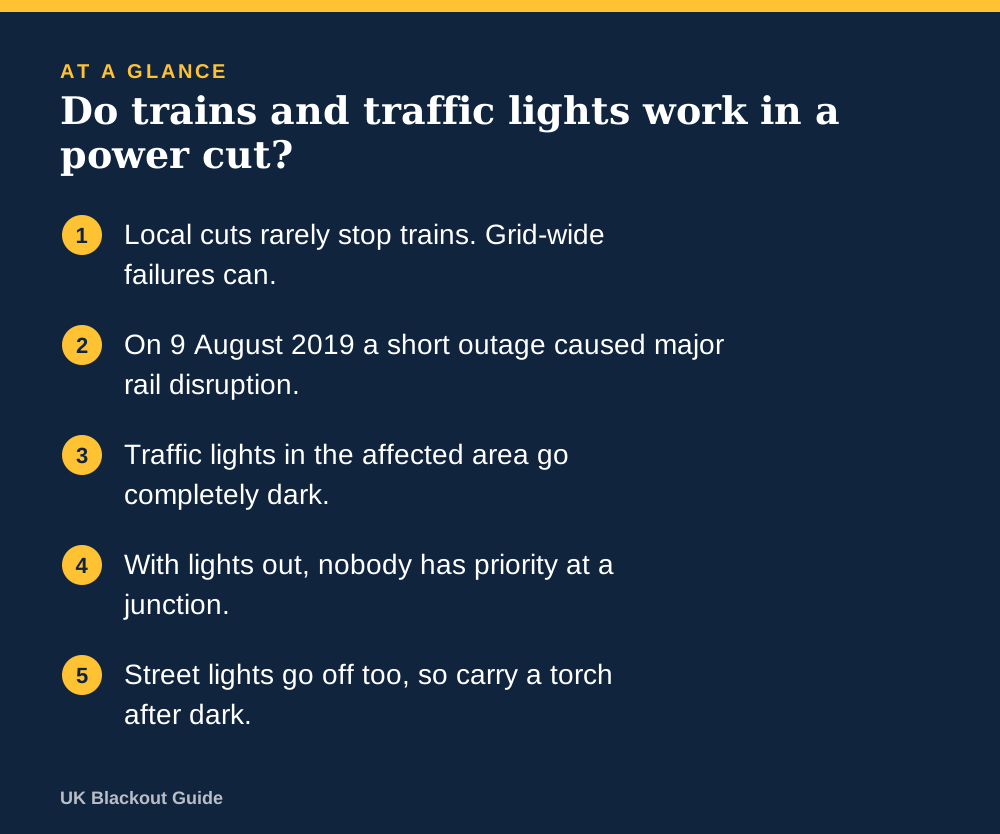
- Local cuts rarely stop trains. Grid-wide failures can.
- On 9 August 2019 a short outage caused major rail disruption.
- Traffic lights in the affected area go completely dark.
- With lights out, nobody has priority at a junction.
- Street lights go off too, so carry a torch after dark.
Why your street going dark rarely stops the trains
The railway does not draw its power from the same low-voltage cables as the houses beside it. Electrified lines are fed from higher up the network, and signalling has its own supplies. A fault that takes out a few streets normally passes unnoticed on the line.
Stations are more exposed. Ticket machines, gates, lifts, departure boards and lighting can all be on the local supply, so a station may be open but awkward to use. Carry your ticket on paper or saved offline on your phone, not only in an app that needs a signal.
What happened on the railway in 2019
On 9 August 2019 a lightning strike was followed by the loss of two generators. About 1 million customers were disconnected, most for under an hour. The effect on the railway lasted far longer than the cut itself and caused major disruption.
On that day the trains did not restart the moment the lights did. Trains and crews ended up in the wrong places, and it took hours to untangle. The full account is in what happened on 9 August 2019.
The National Risk Register rates a national outage as low likelihood but very high impact, and describes knock-on effects on transport. In any wide cut, check with a radio bulletin or the operator before you set out.
Traffic lights, crossings and street lights
Traffic lights have no backup in most places. When the local supply fails they simply go blank. The Highway Code says to treat the junction as an unmarked one and proceed with great care. Nobody has priority, so slow right down, make eye contact where you can, and be ready to give way.
Pedestrian crossings stop working at the same time, and street lights go off. On foot after dark, wear something pale or reflective and carry a light. A head torch from our recommended list keeps both hands free and makes you visible to drivers.
Our guide to driving in a power cut covers dark junctions, fuel and when it is better not to travel at all.
If you are caught away from home
Stay where you are until you have real information. A battery or car radio will tell you more than a crowd on a platform. If you are on a stopped train, stay on board unless staff tell you to leave. The track is dangerous even when the overhead lines or rails seem dead.
Save your phone battery for the calls that matter, since mobile coverage may only hold temporarily. Regular commuters and drivers can take most of the worry out of this with a small bag in the car or at work. A power bank, a torch, water, a snack and some cash are enough. Our car emergency kit guide has the full list.
Common questions
Does the London Underground run in a power cut?
A local street-level cut does not usually affect it, but a wider grid failure can. Follow staff instructions and check before you travel.
Do level crossings work in a power cut?
Do not assume a crossing is safe because lights or barriers are not operating. Stop, look and listen, and use the crossing telephone if there is one.
Are electric car chargers affected like traffic lights?
Yes. Public chargers in the affected area stop working until the supply returns.
Reviewed against these sources on 18 November 2026. If official advice has changed since, follow the official advice.
General information only. This page is not professional, safety, medical, legal or financial advice, and it is not official guidance. No national blackout has been forecast or announced, and nothing here suggests one is expected. We are independent and have no connection to the government or any energy company. Always check the official sources linked on this page. Full disclaimer
Keep reading
 Explainer
The 9 August 2019 power cut: what happened
On 9 August 2019 a lightning strike and the loss of two generators cut power to about 1 million customers, most for under an hour. What happened and why.
Read: The 9 August 2019 power cut: what happened News
Amazon Web Services outage, May 2026: what happened and why
The Amazon Web Services outage of 7 May 2026 began when a US data centre overheated. What AWS said, who was affected, and what it means for UK households.
Read: Amazon Web Services outage, May 2026: what News
Amazon Web Services outage, October 2025: what happened and why
The Amazon Web Services outage of 20 October 2025 disrupted Lloyds, HMRC, Snapchat and many more. AWS blamed a DNS fault in its DynamoDB database service.
Read: Amazon Web Services outage, October 2025: Explainer
How the BBC plans to keep broadcasting in a blackout
A BBC report on 7 November 2026 set out how it would keep broadcasting on FM radio through a long blackout. What it said and what radio you need to hear it.
Read: How the BBC plans to keep broadcasting in a