On this page
On 9 August 2019 a lightning strike on the network was followed by the loss of two generators. About 1 million customers were disconnected, most of them for under an hour. The grid did not shut down, and supply was restored quickly, but the knock-on disruption to the railway lasted much longer than the power cut itself.
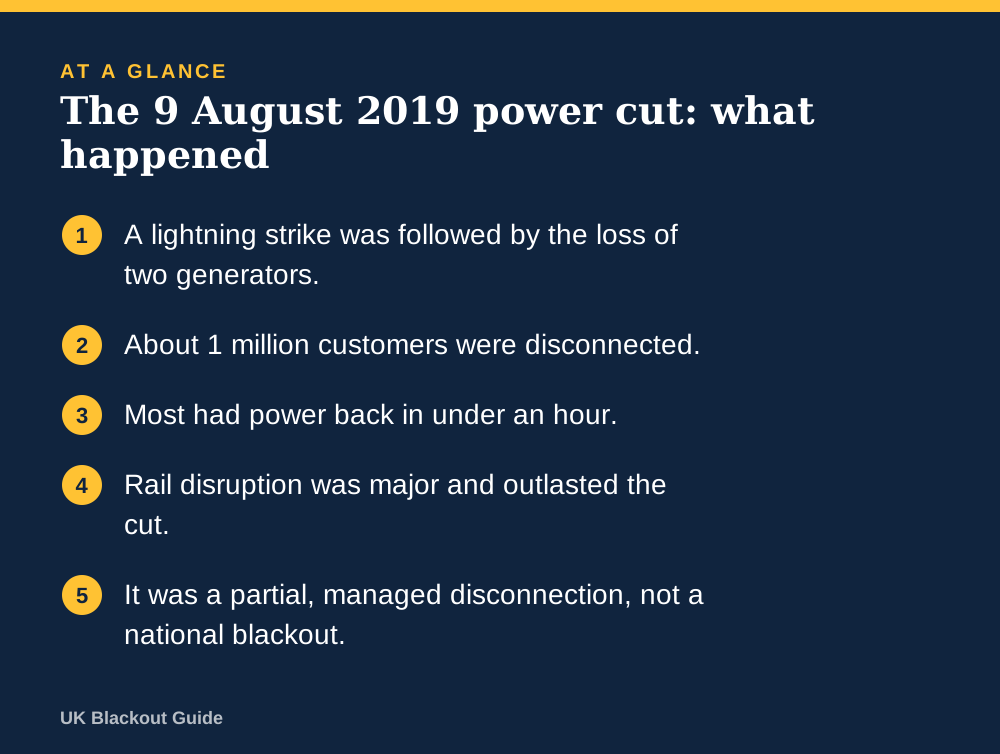
- A lightning strike was followed by the loss of two generators.
- About 1 million customers were disconnected.
- Most had power back in under an hour.
- Rail disruption was major and outlasted the cut.
- It was a partial, managed disconnection, not a national blackout.
The sequence of events on 9 August 2019
The incident happened on 9 August 2019. It began with a lightning strike on the network. Lightning strikes on power lines are routine, and the system is built to ride through them. On this occasion the strike was followed by the loss of two generators.
Losing two sources of power almost at once left the system short. About 1 million customers were disconnected. Most of them had their electricity back in under an hour.
In terms of homes affected and time without power, it was a modest event. Winter storms regularly leave people off supply for far longer, as Storm Arwen did in 2021. It is remembered because it happened on the national system, with no notice.
Why losing two generators switched off homes
Like any electricity grid, the UK grid has to balance supply and demand second by second. The measure of that balance is frequency, which in Great Britain is held close to 50 Hz. If a large amount of generation disappears suddenly, demand outstrips supply and the frequency starts to fall.
A falling frequency is dangerous for the whole system, because power stations protect themselves by disconnecting if it drops too far. That could turn a shortfall into a full shutdown. To prevent it, the network has automatic protection that sheds a share of demand when frequency falls below a set level.
That is what the 1 million disconnections were. Part of the load was switched off automatically so the rest of the system could stay up. It worked: the grid stabilised, and the disconnected customers were reconnected within the hour.
Why the railway took the hardest hit
The most visible damage was on the railway, where there was major disruption. The power cut was over in less than an hour for most people. The disruption to rail passengers went on for much longer.
A railway does not recover the moment its supply returns. Once services stop, trains and crews are out of position, and the timetable takes hours to rebuild. A short electrical event became a long evening for many travellers, and it shows why whether trains run in a power cut depends on more than the supply coming back.
Was it a blackout
In everyday speech, yes: the lights went out for a lot of people at once. In the technical sense, no, and the difference between a power cut and a blackout is the reason. A blackout in the strict sense means the system itself has shut down and has to be restarted from nothing. On 9 August 2019 the system stayed live throughout, and most of the country was unaffected.
The distinction is useful when you read headlines, including those asking whether the UK has ever had a national blackout.
It was also not a typical power cut. Most cuts have local causes such as cable faults, storm damage or flooding, the everyday answers to what causes power cuts in the UK.
Two ways to read the day
One reading is reassuring. A rare combination of faults hit the national system, the automatic defences did their job, and nearly everyone was back on within an hour.
The other is more sober. An interruption of under an hour was enough to cause major rail disruption that lasted much longer than the cut.
Both describe what happened on one day. Neither tells you how likely a wider outage is. On that, the National Risk Register describes a national power outage as low likelihood but very high impact, and no national blackout has been forecast or announced.
What a one-hour cut asks of a household
Very little, if you have the basics. For a cut of under an hour you need a torch you can find in the dark, a phone with some charge, and the habit of not opening the fridge or freezer.
Report it by calling 105, which is free in England, Scotland and Wales. Unplug the TV and PC in case of a surge when the supply returns, and switch off anything hot such as an iron or oven so it does not come back on unattended.
If you were travelling that day, the lesson was different: keep a power bank and some cash in your bag, both on our list of power cut essentials, and expect a long wait.
Common questions
How many people lost power on 9 August 2019?
About 1 million customers were disconnected, and most were reconnected in under an hour.
What caused the August 2019 power cut?
A lightning strike on the network was followed by the loss of two generators, which left the system short of power.
Did the whole country lose power in 2019?
No. The grid stayed live and most of the country was unaffected. A share of demand was disconnected automatically to keep the system stable.
Reviewed against these sources on 18 November 2026. If official advice has changed since, follow the official advice.
General information only. This page is not professional, safety, medical, legal or financial advice, and it is not official guidance. No national blackout has been forecast or announced, and nothing here suggests one is expected. We are independent and have no connection to the government or any energy company. Always check the official sources linked on this page. Full disclaimer
Keep reading
 News
Amazon Web Services outage, May 2026: what happened and why
The Amazon Web Services outage of 7 May 2026 began when a US data centre overheated. What AWS said, who was affected, and what it means for UK households.
Read: Amazon Web Services outage, May 2026: what News
Amazon Web Services outage, October 2025: what happened and why
The Amazon Web Services outage of 20 October 2025 disrupted Lloyds, HMRC, Snapchat and many more. AWS blamed a DNS fault in its DynamoDB database service.
Read: Amazon Web Services outage, October 2025: News
British Library cyber attack, 2023: what happened and why recovery has taken years
The British Library was hit by ransomware in October 2023 and is still rebuilding. What was lost, what came back and when, and what its own review found.
Read: British Library cyber attack, 2023: what Question
Can you get compensation for a power cut?
You may be owed a payment after a long unplanned power cut under Ofgem's Guaranteed Standards. Who pays, what counts, and how to make a claim that succeeds.
Read: Can you get compensation for a power cut?