On this page
Most UK power cuts are caused by faults on the local distribution network: storm damage to overhead lines, underground cables dug up or worn out, and equipment failing at substations. Some are planned for maintenance. A smaller number start inside the home, at the fuse box. Problems on the national system are a separate matter, and the National Risk Register rates a national outage as low likelihood.
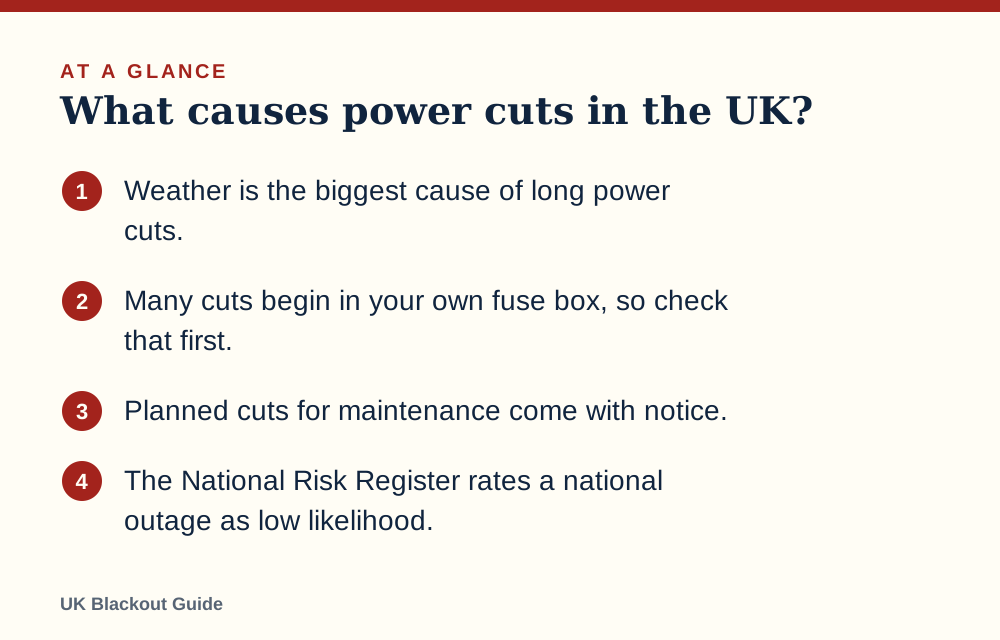
- Weather is the biggest cause of long power cuts.
- Many cuts begin in your own fuse box, so check that first.
- Planned cuts for maintenance come with notice.
- The National Risk Register rates a national outage as low likelihood.
Start with your own fuse box
A surprising share of power cuts are not power cuts at all. A faulty appliance, a blown bulb or damp in an outside socket can trip a switch in your consumer unit (the modern fuse box) and take out some or all of your circuits.
Look at the unit to work out why your power has gone off. If one switch is down and the rest are up, push it back up. If it trips again, unplug everything on that circuit and try once more, then plug items back in one at a time to find the culprit. If the main switch is on, nothing has tripped and the neighbours are dark too, the fault is on the network.
Prepayment meters are another household cause. If the credit has run out, the supply stops, and that is a matter for your supplier, not the network.
Weather damage to overhead lines
Wind is the main cause of long power cuts in the UK. It rarely snaps the wires directly. More often it brings trees and branches down across them, or blows debris into equipment. Lightning, ice building up on lines, and flooding at substations do the rest.
Among the storms that have caused power cuts in recent years, Storm Arwen in November 2021 cut power to about 1 million customers, and some rural homes in northern England and Scotland waited more than a week. In December 2015, Storm Desmond flooded a substation in Lancaster and cut power to about 61,000 properties in one go.
Space weather is a separate subject. The government has not said it is expected to cause a UK blackout, and solar storms and the grid explains it in general terms.
Rural homes are more exposed because they are usually fed by long overhead lines with few alternative routes. If a storm brings a line down near you, keep well away from it, because what to do about fallen power lines starts with distance.
Treat every fallen or sagging power line as live. Stay well back, keep children and pets away, and call 105. If there is immediate danger to life, call 999.
Underground cable faults
In towns and cities most cables are buried, which protects them from wind but not from spades. Contractors digging up a road are a regular cause of sudden urban power cuts.
Cables also age. Insulation breaks down over decades, joints let in water, and a fault can develop with no outside cause. Underground faults are slower to find than a tree on a line, because engineers have to locate the exact spot before they dig. In the meantime they can often reroute supply around the damaged section, which is why your power may come back, go off and return again.
Equipment failure at substations
Between the power station and your socket, electricity passes through several substations where transformers step the voltage down. Transformers, switches and fuses all wear out or fail occasionally. A fault at a small local substation might affect a few hundred homes. A fault at a larger one can take out a town.
Animals and birds cause some of these failures by bridging live parts. So does vandalism and metal theft, which is dangerous for the thief and expensive for everyone else.
Planned maintenance cuts
Planned power cuts happen when network operators switch off supply to work safely on lines and equipment. You should be told in advance, usually by letter or card, with a date and a time window. These cuts tend to be in working hours and last a few hours.
If you rely on electricity for medical equipment, a planned cut is a good prompt to join the Priority Services Register so the operator knows about you.
Problems on the national system
The last cause sits at the top of the system. If generation suddenly falls short of demand, automatic protection disconnects some customers to keep the rest of the grid stable. That is what happened on 9 August 2019, when a lightning strike was followed by the loss of two generators and about 1 million customers were cut off, most for under an hour. Readers also ask whether new demand from data centres changes that picture, and we look at the question in whether AI data centres will cause blackouts.
In a national energy shortage, there could be planned rota power cuts of about three hours, shared out by load block letter. None has been announced.
The National Risk Register rates a national power outage as low likelihood but very high impact, as explained in how likely a national blackout is.
Being ready for the common causes
Because most cuts are sudden local faults, the most useful preparation is a light that comes on by itself. Plug-in automatic power cut lights sit in a socket, charge from the mains and switch on automatically when the supply fails. One in the hallway and one on the landing means nobody is feeling for a torch at the top of the stairs.
The second step is to know who to ring. Save 105 in your phone now (03457 643643 in Northern Ireland), and note your operator from powercut105.com. For homes that want to cover longer storm cuts, our power cut essentials list sets out what to add next.
Common questions
Why does my power flicker off and on in a storm?
Automatic switches on overhead lines briefly cut and restore supply to clear temporary faults such as a branch touching a wire. Several flickers suggest a fault that may become a full cut.
Can high demand on a cold evening cause a power cut?
Heavy demand can overload local equipment and blow a fuse at a substation, though this is uncommon. Nationally, the system operator holds reserves to cover demand peaks.
Is my supplier responsible for power cuts?
No. Your network operator owns and repairs the cables. Your supplier sells you the energy and handles billing and meters.
Why do my neighbours have power when I do not?
Homes on the same street can be on different phases or circuits. It can also mean the fault is in your own fuse box or meter, so check there first.
Reviewed against these sources on 18 November 2026. If official advice has changed since, follow the official advice.
General information only. This page is not professional, safety, medical, legal or financial advice, and it is not official guidance. No national blackout has been forecast or announced, and nothing here suggests one is expected. We are independent and have no connection to the government or any energy company. Always check the official sources linked on this page. Full disclaimer
Keep reading
 Explainer
The 9 August 2019 power cut: what happened
On 9 August 2019 a lightning strike and the loss of two generators cut power to about 1 million customers, most for under an hour. What happened and why.
Read: The 9 August 2019 power cut: what happened News
Amazon Web Services outage, May 2026: what happened and why
The Amazon Web Services outage of 7 May 2026 began when a US data centre overheated. What AWS said, who was affected, and what it means for UK households.
Read: Amazon Web Services outage, May 2026: what News
Amazon Web Services outage, October 2025: what happened and why
The Amazon Web Services outage of 20 October 2025 disrupted Lloyds, HMRC, Snapchat and many more. AWS blamed a DNS fault in its DynamoDB database service.
Read: Amazon Web Services outage, October 2025: Explainer
How the BBC plans to keep broadcasting in a blackout
A BBC report on 7 November 2026 set out how it would keep broadcasting on FM radio through a long blackout. What it said and what radio you need to hear it.
Read: How the BBC plans to keep broadcasting in a