On this page
The government has not said that AI data centres are expected to cause blackouts in the UK, and no national blackout has been forecast or announced. This page explains in general terms how large electricity users are connected. A data centre cannot simply plug in. It needs a grid connection agreed in advance, and the system operator plans around known demand.
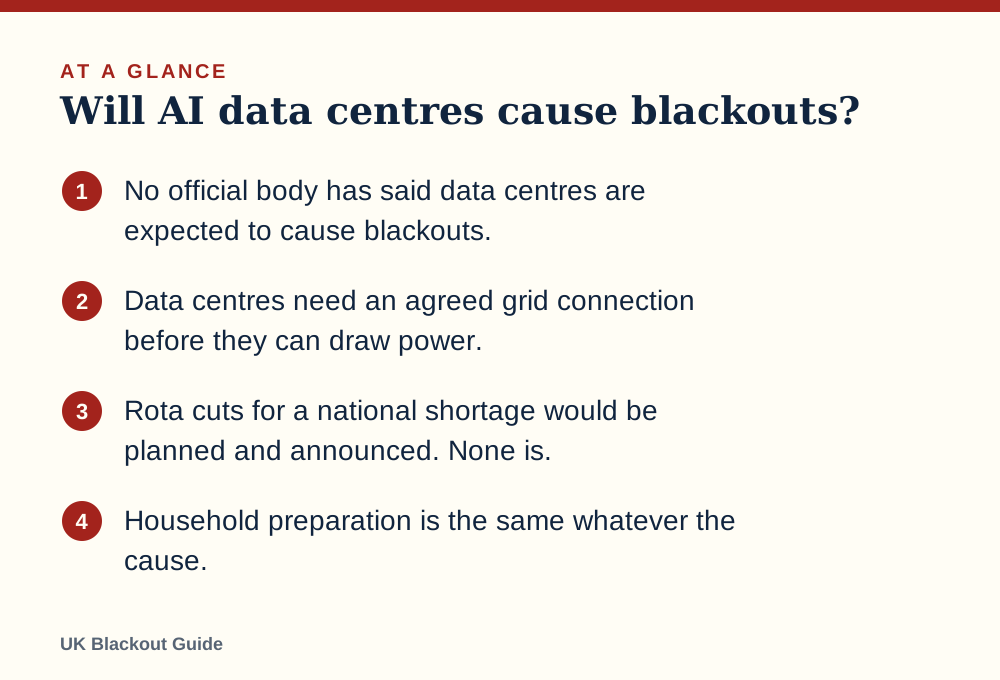
- No official body has said data centres are expected to cause blackouts.
- Data centres need an agreed grid connection before they can draw power.
- Rota cuts for a national shortage would be planned and announced. None is.
- Household preparation is the same whatever the cause.
Where the worry comes from
Training and running artificial intelligence takes warehouses full of power-hungry computer chips, and those chips need cooling around the clock. A single large data centre can use as much electricity as a town. Technology companies are building them quickly, and headlines from several countries have asked whether grids can keep up.
It is a fair question. Electricity demand in Great Britain is expected to grow for other reasons too, as more homes switch to electric cars and heat pumps. Adding a new, fast-growing industrial user on top naturally makes people wonder about the lights.
The government has not said that data centres are expected to cause a blackout, and none of the official statements we rely on makes that link, including those behind our answer on whether the UK is going to have a blackout. What follows is a general description of how the system handles large users.
A data centre cannot just plug in
Your kettle can be switched on without asking anyone. A data centre cannot. Any large user has to apply for a connection to the transmission or distribution network, and the network company has to confirm that the cables, transformers and substations can carry the load. If they cannot, the user waits while the network is reinforced, or is offered a smaller connection.
This means the demand does not arrive by surprise. It is known in advance, it appears in the forecasts, and it is physically limited by the size of the connection. A site with an agreed capacity cannot draw more than that.
The practical effect reported in Britain has been a queue for connections. That is frustrating for developers, but it is the system saying no before a problem arises instead of after.
How new demand is balanced
NESO, the National Energy System Operator, matches supply to demand second by second, the core of how the electricity grid works, and plans years ahead for how much generation the country needs. A data centre is, from the grid's point of view, an unusually easy customer to forecast. It runs at a fairly steady level day and night, unlike homes, which surge on cold winter evenings.
Data centres also carry their own protection against power cuts. Because a loss of supply is so costly to them, they are built with large battery systems and standby generators. Some can reduce their draw from the grid, or run on their own backup, when the system is tight. A large user that can step aside at peak times helps the operator instead of hurting it.
What would happen in a national energy shortage
No national energy shortage has been announced. If there were one, whatever the reason, the planned response is a series of controlled steps.
- Bring on reserve generation and import more through interconnectors.
- Pay large users, including data centres, to cut back.
- Ask households to shift use away from the peak.
- As a last resort, share the shortage through planned rota power cuts of about three hours at a time.
Rota cuts are announced and scheduled by load block letter. None has been announced.
A full national blackout is a different sort of event. The National Risk Register rates it as low likelihood but very high impact, as set out in how likely a national blackout is.
The local picture
The place where data centres can matter is the local network. Where several large sites cluster in one area, they can use up spare capacity at nearby substations. That can delay new connections for other users, such as housing developments or businesses.
This is a competition for new capacity, and it does not affect homes already on the network. Your supply is already connected and does not get switched off to make room for a newcomer. Local power cuts continue to come from the usual sources, set out in what causes power cuts in the UK.
The other version of the question
A second version of the question is about AI as a tool, not a load: whether software could be used to interfere with the grid, a subject we cover under cyber attacks and the power grid. The government has not said this is expected. In general terms, grid control rooms are run by trained engineers with manual fallbacks, and the control systems are kept separate from the public internet.
What this means for your household
Nothing about AI changes what a household should do. Ordinary power cuts come from local faults and storm damage, whatever is in the news. The government's Be Ready campaign asks everyone to be able to manage for three days, which is the basis of what should be in an emergency kit, and that advice is general preparedness, not a forecast.
If you are deciding where to start, our list of power cut essentials ranks the basics.
The item most people use first is a power bank for the phone.
Common questions
Do data centres get priority over homes in a shortage?
No. In a shortage, large users are among the first asked or paid to reduce demand. Rota cuts, if ever needed, would be shared by load block.
Will data centres push up my electricity bill?
Network upgrades and new generation have costs, and how they are shared is a matter for government and Ofgem. It is a separate question from whether the lights stay on.
Is electricity demand in Britain rising?
It is expected to grow as transport and heating switch to electricity and new industries connect. The system operator plans for this in its long-term forecasts.
Reviewed against these sources on 18 November 2026. If official advice has changed since, follow the official advice.
General information only. This page is not professional, safety, medical, legal or financial advice, and it is not official guidance. No national blackout has been forecast or announced, and nothing here suggests one is expected. We are independent and have no connection to the government or any energy company. Always check the official sources linked on this page. Full disclaimer
Keep reading
 Explainer
The 9 August 2019 power cut: what happened
On 9 August 2019 a lightning strike and the loss of two generators cut power to about 1 million customers, most for under an hour. What happened and why.
Read: The 9 August 2019 power cut: what happened News
Amazon Web Services outage, May 2026: what happened and why
The Amazon Web Services outage of 7 May 2026 began when a US data centre overheated. What AWS said, who was affected, and what it means for UK households.
Read: Amazon Web Services outage, May 2026: what News
Amazon Web Services outage, October 2025: what happened and why
The Amazon Web Services outage of 20 October 2025 disrupted Lloyds, HMRC, Snapchat and many more. AWS blamed a DNS fault in its DynamoDB database service.
Read: Amazon Web Services outage, October 2025: Explainer
How the BBC plans to keep broadcasting in a blackout
A BBC report on 7 November 2026 set out how it would keep broadcasting on FM radio through a long blackout. What it said and what radio you need to hear it.
Read: How the BBC plans to keep broadcasting in a