On this page
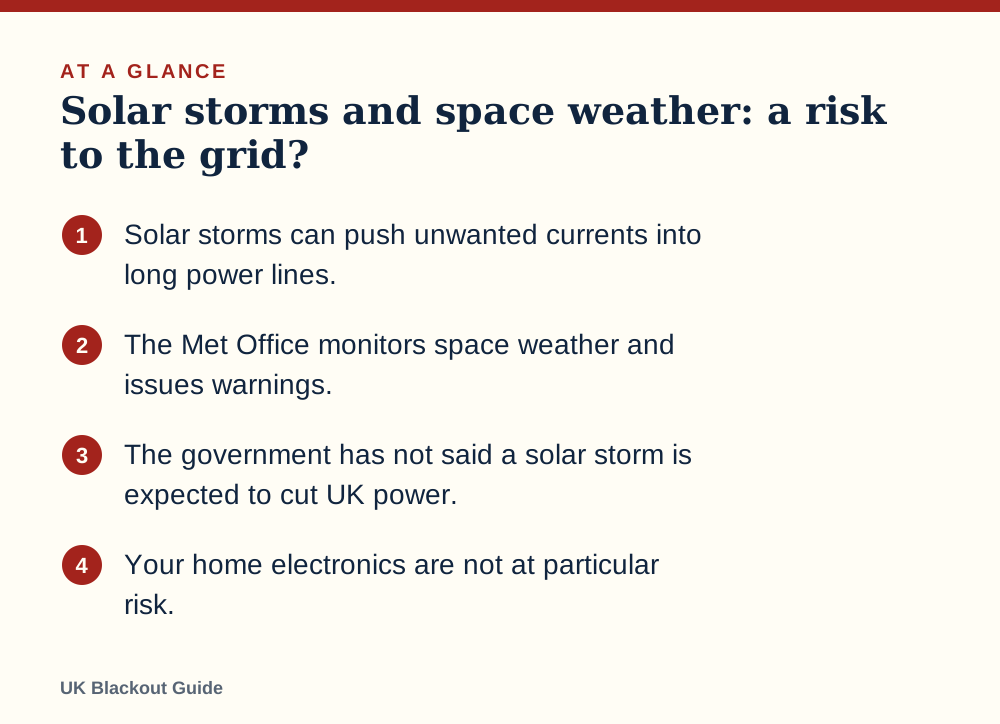
The government has not said that a solar storm is expected to cause a UK blackout. In general terms, eruptions on the Sun can induce stray currents in long power lines and put stress on large transformers. The Met Office monitors space weather. Home electronics are not at particular risk, and household preparation is the same as for any power cut.
- Solar storms can push unwanted currents into long power lines.
- The Met Office monitors space weather and issues warnings.
- The government has not said a solar storm is expected to cut UK power.
- Your home electronics are not at particular risk.
What a solar storm is
The Sun regularly throws out bursts of radiation and clouds of charged particles. Three kinds matter on Earth, and they arrive at different speeds.
| Event | Arrives in | Main effect |
|---|---|---|
| Solar flare (a burst of radiation) | Minutes | Disrupts some radio signals on the sunlit side of the Earth |
| Radiation storm (fast particles) | Minutes to hours | Affects satellites and high-altitude flights |
| Coronal mass ejection (a cloud of charged gas) | Roughly one to three days | Disturbs the Earth's magnetic field, which is the part that affects power grids |
When a coronal mass ejection hits the Earth's magnetic field it causes a geomagnetic storm. The visible sign is the aurora, the northern lights, appearing much further south than usual. Most geomagnetic storms are harmless light shows. Only the most severe trouble electricity networks.
How it reaches the electricity grid
A geomagnetic storm makes the Earth's magnetic field shift rapidly. A changing magnetic field drives electric currents through any long conductor, and the longest conductors around are the high-voltage transmission lines at the heart of how the electricity grid works. The stray currents flow along the lines and into the ground through the large transformers at each end.
Transformers are built for alternating current. A steady stray current makes them run inefficiently and heat up, and it can upset the voltage on the network. Protective equipment may then trip lines out of service. If enough lines trip in quick succession, the result is a power cut over a wide area.
The best-known example is Quebec in 1989, when a geomagnetic storm tripped the province's grid and the power went off for hours. The largest storm on record, the Carrington Event of 1859, came before electricity grids existed. It disrupted the telegraph network, the only long wires of its day. Both are accounts of what happened, not signs of what will happen here.
What the government has and has not said
The government has not said that a solar storm is expected to cause a blackout in the UK. The official statements we rely on are general ones. The Be Ready campaign is preparedness and not a forecast, and the National Risk Register rates a national power outage as low likelihood but very high impact, the official position on how likely a UK blackout is.
The rest of this page is general science about how space weather and power lines interact. The effect of a geomagnetic storm is strongest at high latitudes. Great Britain's grid is compact compared with those of North America, so its lines are shorter, and it is heavily interconnected, so power can be rerouted around equipment that has tripped.
Space weather is forecast
Unlike a lightning strike or a cable fault, a solar storm can be seen coming. Satellites watch the Sun continuously, and the Met Office runs a space weather forecasting service around the clock. When a large coronal mass ejection leaves the Sun, forecasters usually have a day or more before it arrives, though they cannot judge its full strength until it is close to the Earth.
In general terms, notice gives grid operators time to take precautions, such as postponing maintenance so that every line is available.
For the public, a severe space weather warning would be covered on the news in the same way as a red weather warning. It would be a sensible prompt to charge your devices and check your torch, and no more than that.
Effects beyond the grid
Power is only part of the story. A severe storm can affect several other systems for hours or days:
- Satellite positioning (GPS). Positions can become inaccurate or drop out. If you are driving somewhere unfamiliar, a paper map is a reasonable backup.
- Satellite communications and some broadcasting links.
- High-frequency radio used by aviation and shipping.
- Flights, particularly polar routes, which may be rerouted.
Mobile networks and broadband mostly run through cables and local masts, so they are less directly exposed, though they depend on electricity like everything else. FM and DAB radio broadcasts from masts on the ground would generally be unaffected by the space weather itself, which keeps radio at the centre of getting news in a blackout.
Your phone and appliances are not at special risk
A common fear is that a solar storm would fry every electronic device. It would not. The induced currents need conductors many miles long to build up. The wiring in a house, a phone or a car is far too short to be affected.
The risk to home equipment is the ordinary one behind whether a power cut can damage appliances, the kind that comes with any disturbed supply: voltage dips, cuts and a possible surge when power returns. If a severe storm is forecast, the usual advice applies. Unplug sensitive electronics if the power goes off, and consider a surge-protected lead for expensive equipment.
Solar panels on your roof are not harmed by solar storms either. The name is a coincidence. Like all grid-tied systems, they will shut off if the mains fails unless you have a battery able to run independently.
What to do if a severe storm is forecast
Treat it like a bad weather warning. Charge phones and power banks, check your torches, fill a flask, and make sure you have a battery or wind-up radio. Then carry on as normal, and consider stepping outside after dark, because a strong storm is your best chance of seeing the aurora from the UK.
If the power does go off, there is nothing special to do. Follow the usual steps for a power cut and report it on 105. The government's Be Ready campaign asks households to be able to manage for three days, whatever the cause of an emergency. If you have not started on that yet, what should be in an emergency kit is the place to begin.
Common questions
Can a solar storm destroy my phone or laptop?
No. The currents involved build up only in conductors many miles long. Household devices are too small to be affected directly.
Who forecasts space weather in the UK?
The Met Office runs a space weather forecasting service that operates around the clock and issues alerts to government and industry.
Is seeing the northern lights a sign the grid is in danger?
No. Auroras appear during many geomagnetic storms, almost all of which cause no problems for electricity networks.
How often do extreme solar storms happen?
Storms on the scale of the 1859 Carrington Event are very rare. Smaller storms occur regularly, more often around the peak of the Sun's roughly 11-year cycle.
Reviewed against these sources on 18 November 2026. If official advice has changed since, follow the official advice.
General information only. This page is not professional, safety, medical, legal or financial advice, and it is not official guidance. No national blackout has been forecast or announced, and nothing here suggests one is expected. We are independent and have no connection to the government or any energy company. Always check the official sources linked on this page. Full disclaimer
Keep reading
 Explainer
The 9 August 2019 power cut: what happened
On 9 August 2019 a lightning strike and the loss of two generators cut power to about 1 million customers, most for under an hour. What happened and why.
Read: The 9 August 2019 power cut: what happened News
Amazon Web Services outage, May 2026: what happened and why
The Amazon Web Services outage of 7 May 2026 began when a US data centre overheated. What AWS said, who was affected, and what it means for UK households.
Read: Amazon Web Services outage, May 2026: what News
Amazon Web Services outage, October 2025: what happened and why
The Amazon Web Services outage of 20 October 2025 disrupted Lloyds, HMRC, Snapchat and many more. AWS blamed a DNS fault in its DynamoDB database service.
Read: Amazon Web Services outage, October 2025: Explainer
How the BBC plans to keep broadcasting in a blackout
A BBC report on 7 November 2026 set out how it would keep broadcasting on FM radio through a long blackout. What it said and what radio you need to hear it.
Read: How the BBC plans to keep broadcasting in a