On this page
The National Risk Register, the government's public assessment of the most serious risks facing the UK, describes a national power outage as low likelihood but very high impact. It describes knock-on effects on water, mobile phones, internet, fuel, payments and transport, and says restoring the transmission system could take up to about seven days.
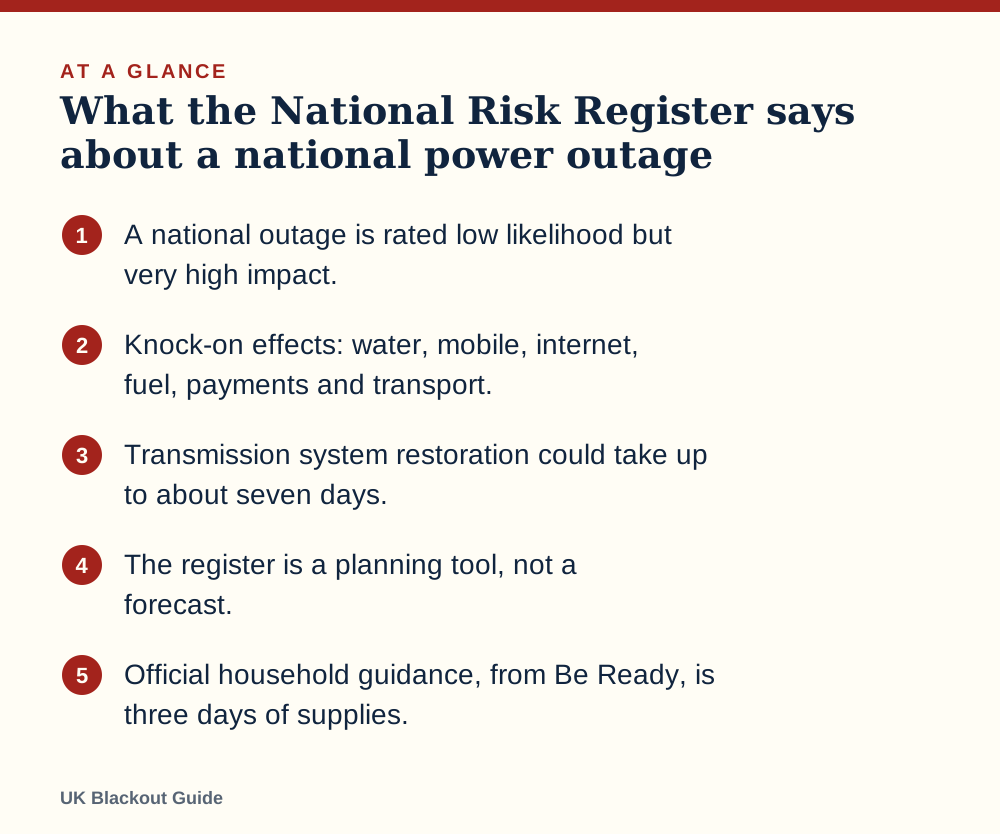
- A national outage is rated low likelihood but very high impact.
- Knock-on effects: water, mobile, internet, fuel, payments and transport.
- Transmission system restoration could take up to about seven days.
- The register is a planning tool, not a forecast.
- Official household guidance, from Be Ready, is three days of supplies.
What the register is for
The National Risk Register is published by the Cabinet Office. It sets out the most serious risks that could affect the UK, from severe weather to pandemics, and gives each one a rating for how likely it is and how much harm it would do.
Its readers are mainly the people who plan for emergencies: councils, emergency services, utilities and businesses. It tells them which scenarios to prepare for and roughly how bad each could be. It is a planning document. An entry in the register means a risk has been judged serious enough to prepare for. It does not mean the event is expected.
Low likelihood, very high impact
The entry for a national power outage combines two ratings that pull in opposite directions.
Low likelihood is the register's rating for the chance of it happening, and it is the official starting point on how likely a national blackout is in the UK. No national blackout has been forecast or announced.
Very high impact is its rating for the harm one would do, because of the knock-on effects the register describes on other essential services.
Plenty of ordinary precautions follow the same logic. People insure their homes against fire and wear seatbelts on every journey, and they are not expecting a fire or a crash when they do.
The six knock-on effects it names
The register is specific about what stops working in a blackout beyond the lights. Each item has a simple household answer.
| Service affected | What it means at home | The simple precaution |
|---|---|---|
| Water | Pumping and treatment need power, so supply may be disrupted | Stored water, 3 litres per person per day |
| Mobile | Masts depend on backup power that may only hold temporarily | A written list of contacts and a family plan |
| Internet | Routers and networks go down | A battery or wind-up FM radio for news |
| Fuel | Forecourt pumps are electric | Keep the car's tank above half |
| Payments | Card terminals and cash machines fail | Cash in notes and coins |
| Transport | Trains and traffic signals are affected | A plan for getting home, and for staying put |
The seven-day figure
The register says restoration of the transmission system could take up to about seven days. The transmission system is the high-voltage backbone that carries power across the country. Restarting it after a total shutdown has to be done in stages.
On the question of how long a national blackout could last, read 'up to about seven days' as the outer edge of the register's description. It does not say every home would be dark for a week, and it is not a prediction that such an outage will happen.
A separate rule, the 2026 grid restoration deadline, sets a faster target. Under the Electricity System Restoration Standard, the National Energy System Operator must by 31 December 2026 be able to restore 60% of demand in each region within 24 hours and all of Great Britain's demand within five days.
How government acts on the assessment
Planning for the scenario is on the public record. In 2023 the government ran a national power outage exercise, Exercise Mighty Oak, to rehearse the response.
On 22 October 2026 it launched the Be Ready campaign, which asks every household to be able to manage for three days. The campaign is presented as general preparedness and covers many kinds of emergency. The government has not said the campaign was prompted by this entry in the register, and Be Ready is not a forecast. Its kit list does include water, a radio, a power bank and cash.
Turning the register into a household plan
You do not need to read the register to act on it. The register describes a national outage as affecting several other services at once, so the practical step is having the basics in the house beforehand.
Start with the official three days: water, food that needs no cooking, a torch, a radio, a charged power bank, medication and cash. Build it gradually, or buy one of the ready-made emergency kits and fill the gaps, and check it every six months.
The government has not asked households to prepare for more than three days and has not suggested a longer outage is expected. Keeping more than that is optional planning beyond official guidance.
Common questions
Does the National Risk Register predict a blackout?
No. It assesses a national power outage as low likelihood but very high impact. It is a planning document, not a forecast.
How long does the register say a national outage could last?
It says restoration of the transmission system could take up to about seven days. That is a planning description, not a prediction.
Who publishes the National Risk Register?
The Cabinet Office publishes it as the government's public assessment of the most serious risks facing the UK.
Reviewed against these sources on 18 November 2026. If official advice has changed since, follow the official advice.
General information only. This page is not professional, safety, medical, legal or financial advice, and it is not official guidance. No national blackout has been forecast or announced, and nothing here suggests one is expected. We are independent and have no connection to the government or any energy company. Always check the official sources linked on this page. Full disclaimer
Keep reading
 Guide
How likely is a national blackout in the UK?
A national blackout in the UK is officially rated low likelihood but very high impact. Here is what that means, and how it compares with ordinary power cuts.
Read: How likely is a national blackout in the UK? Question
Is the UK going to have a blackout?
No national blackout is planned or predicted in the UK. The official risk rating is low likelihood. What the recent headlines mean and what is worth doing.
Read: Is the UK going to have a blackout? Question
Should I be worried about a UK blackout?
Should you be worried about a UK blackout? Official sources rate a national outage as low likelihood, and none is forecast. What they say and what to do.
Read: Should I be worried about a UK blackout? Guide
What stops working in a blackout, and in what order
What stops working in a blackout and when: heating, broadband and card payments go at once, mobile signal and water can follow. A timeline for UK homes.
Read: What stops working in a blackout, and in what