On this page
You do not need to be worried about a UK blackout on the strength of what officials have said. No blackout is planned or forecast, and the National Risk Register rates a national outage as low likelihood but very high impact. The government's Be Ready campaign asks for something small: be able to manage for three days.
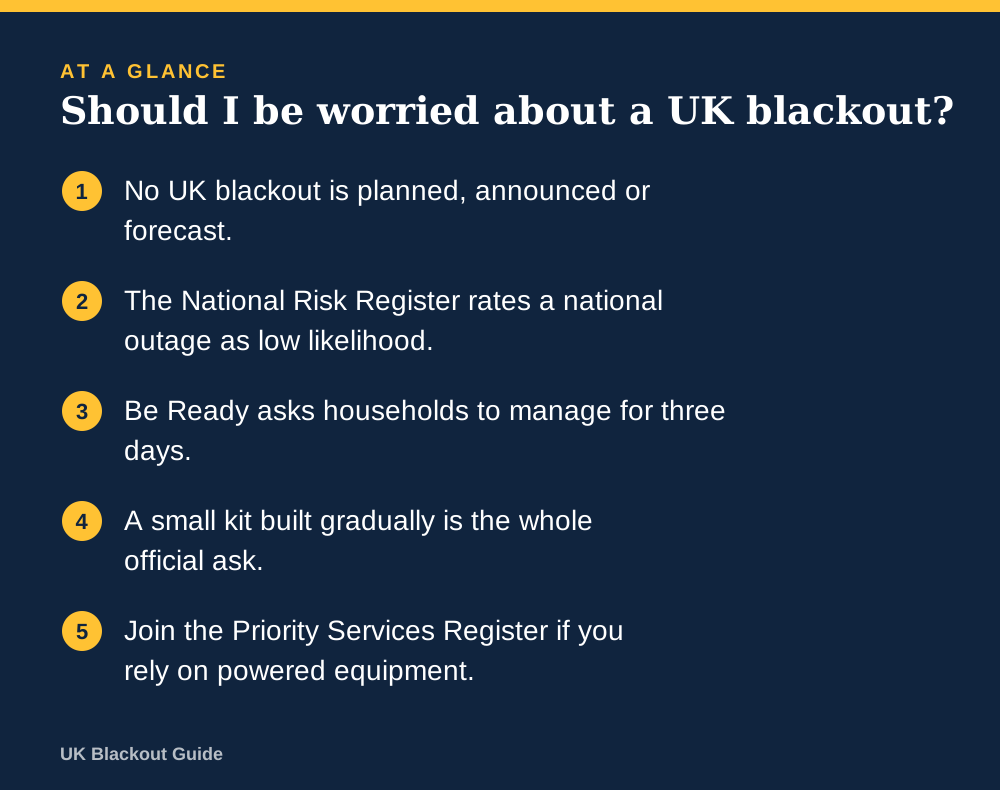
- No UK blackout is planned, announced or forecast.
- The National Risk Register rates a national outage as low likelihood.
- Be Ready asks households to manage for three days.
- A small kit built gradually is the whole official ask.
- Join the Priority Services Register if you rely on powered equipment.
What the official assessment says
Nothing official says you should be worried about a UK blackout. No blackout has been announced, planned or forecast, and no date for a UK blackout exists.
The National Risk Register, published by the Cabinet Office, describes a national power outage as low likelihood but very high impact, the official answer to how likely a UK blackout is. Those two halves belong together. The impact is why the government plans for it. The likelihood is why the Be Ready campaign, launched on 22 October 2026, is framed as general preparedness and not a forecast.
Why you are hearing about it now
The story of why blackouts are in the news is short. The volume of coverage rose after Be Ready launched, and again after a BBC report on 7 November 2026 about how it would keep broadcasting on FM radio during a long outage. Coverage rising is not the same as risk rising, and no official body has said the risk has changed.
Plans to recover are also part of the picture. NESO, which runs Great Britain's electricity system, must by 31 December 2026 have the capability to restore 60% of demand in each region within 24 hours and 100% within five days.
What preparing does for worry
A short, finished task tends to settle the mind better than more reading. For preparing for a blackout in the UK, the Be Ready list is deliberately modest: water (3 litres per person per day), food that needs no cooking, a torch with spare batteries, a battery or wind-up FM radio, a charged power bank, medication, warm bedding and some cash. The campaign says to build it gradually, so there is no need to buy everything this week.
The same kit covers the ordinary local power cuts that storms and faults cause every year, so it earns its place either way.
If you would rather not assemble it yourself, a ready-made emergency kit does the job in one purchase. Otherwise spread the cost over a few weeks.
If someone in your home depends on electricity
Some households have a practical reason to plan with more care: powered medical equipment, a baby, or an older relative. The Priority Services Register is free and gives extra support in a power cut. In England, Scotland and Wales you can join at thepsr.co.uk or through your supplier or network operator. Northern Ireland uses Customer Care Registers.
For medical equipment, ask your own clinician or equipment supplier what to do in a power cut and follow their advice.
If the worry is affecting your sleep or your day, that deserves attention in its own right. There are practical steps for coping with anxiety about blackouts, and your GP can help too.
Common questions
Is a UK blackout likely?
The National Risk Register describes a national power outage as low likelihood but very high impact. No official body has forecast one.
Should I be stockpiling?
No. Be Ready advises building a three-day kit gradually. It does not ask anyone to stockpile.
My child is anxious about blackouts. What should I say?
Keep it simple and factual: nobody has said one is coming, and your family has a torch, a radio and a plan. Showing them the kit often helps.
- Be Ready campaign, UK government
- National Risk Register, Cabinet Office
- National Energy System Operator (NESO)
- Priority Services Register
Reviewed against these sources on 18 November 2026. If official advice has changed since, follow the official advice.
General information only. This page is not professional, safety, medical, legal or financial advice, and it is not official guidance. No national blackout has been forecast or announced, and nothing here suggests one is expected. We are independent and have no connection to the government or any energy company. Always check the official sources linked on this page. Full disclaimer
Keep reading
 Explainer
The government's Be Ready campaign: what it asks households to do
The government's Be Ready campaign, launched 22 October 2026, asks every household to be able to manage for three days. The full kit list and what it means.
Read: The government's Be Ready campaign: what it Guide
How likely is a national blackout in the UK?
A national blackout in the UK is officially rated low likelihood but very high impact. Here is what that means, and how it compares with ordinary power cuts.
Read: How likely is a national blackout in the UK? Explainer
What the National Risk Register says about a national power outage
The National Risk Register rates a national power outage as low likelihood but very high impact. What it says would be disrupted, and for how long.
Read: What the National Risk Register says about a Explainer
The 'three-day blackout' claim, explained
The three day blackout claim explained: three days is how long Be Ready asks households to manage for. No official body has forecast a three day blackout.
Read: The 'three-day blackout' claim, explained