On this page
No official body has said there will be a three day blackout. The three days comes from the government's Be Ready campaign, launched on 22 October 2026, which asks every household to be able to manage for three days in any emergency. It is a preparedness target for your home, not a forecast of how long the power will be off.
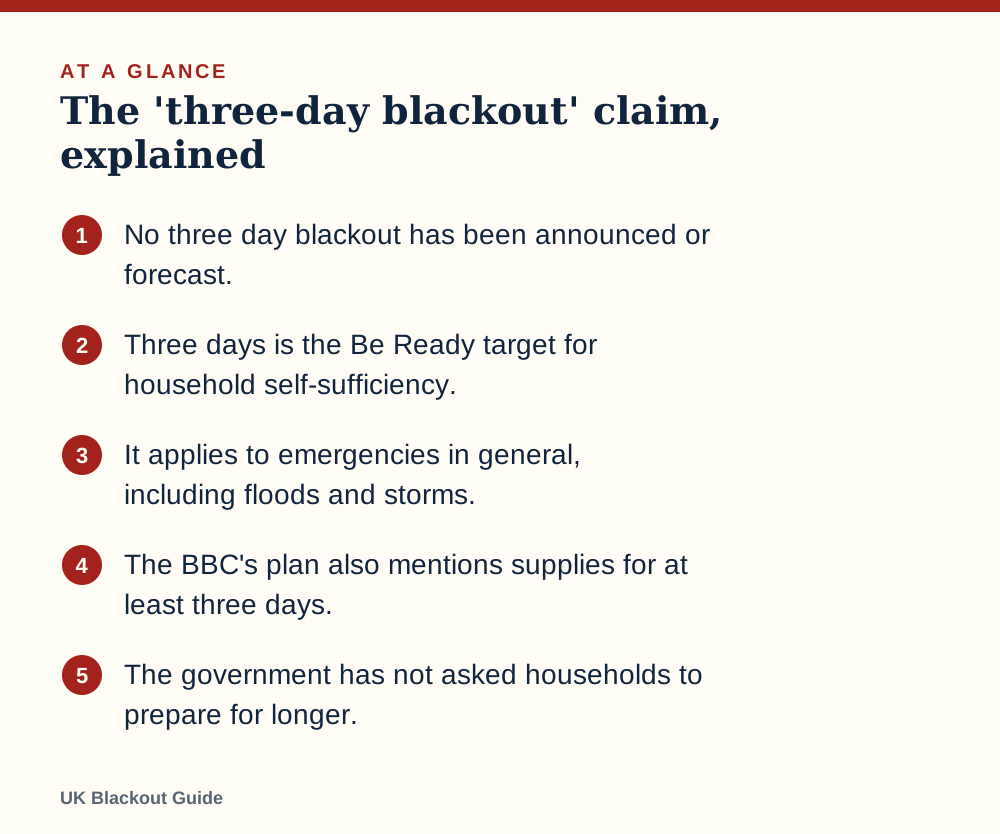
- No three day blackout has been announced or forecast.
- Three days is the Be Ready target for household self-sufficiency.
- It applies to emergencies in general, including floods and storms.
- The BBC's plan also mentions supplies for at least three days.
- The government has not asked households to prepare for longer.
Three days is a preparedness figure, not a forecast
There is no announced, planned or forecast three day blackout in the UK. The figure comes from the Be Ready campaign (beready.campaign.gov.uk), which the government launched on 22 October 2026. Be Ready asks households to be able to manage for three days.
That request is not tied to power cuts alone. It covers emergencies in general, and the campaign presents it as general preparedness, not a forecast. Nowhere does it say that a blackout lasting three days is expected.
How the figure turned into a headline
Two things happened close together. Be Ready launched with its three-day message on 22 October 2026. Then on 7 November 2026 the BBC reported on how it would keep broadcasting on FM radio during a long outage, from an emergency studio with generator-backed transmitters and supplies for at least three days.
Put side by side, "manage for three days" and "supplies for at least three days" became "three day blackout" in some headlines and posts, often alongside the term Black Sky. Neither source says that. One is advice to households. The other describes a broadcaster's contingency plan.
What official sources say about how long outages last
Official bodies have published some figures on duration, and they are worth reading exactly as written.
| Source | What it says |
|---|---|
| Be Ready campaign | Households should be able to manage for three days. |
| Rota power cuts | In a national energy shortage, planned cuts could last about three hours at a time, by load block letter. |
| Electricity System Restoration Standard | By 31 December 2026 NESO must be able to restore 60% of demand in each region within 24 hours and 100% within five days. |
| National Risk Register | A national outage is low likelihood but very high impact. Restoring the transmission system could take up to about 7 days. |
None of these is a prediction. The restoration standard is a capability NESO must have, and the Risk Register describes a planning scenario, the one behind our answer on how long a national blackout could last.
For comparison, the answer to how long power cuts usually last is far shorter for everyday faults.
What the government has not said
The government has not said a blackout will last three days. It has not given a date for one. It has not asked households to prepare for more than three days, and it has not suggested that an outage of any particular length is expected.
If you see a post that states "the government has confirmed a three day blackout", check it against the Be Ready website. The wording there is about being able to manage, and it sits alongside advice on flooding and severe weather.
What three days of supplies looks like
The Be Ready list is short. Per person, the biggest item is water: 3 litres a day for drinking, so 9 litres each for three days, with more for cooking and washing. Then food for three days that needs no cooking or fridge, a tin opener, a battery or wind-up torch with spare batteries, a battery or wind-up FM radio, a charged power bank, a first aid kit, medication, blankets and warm clothing, and some cash.
Be Ready advises building this gradually and checking it every six months. The items earn their place when you look at how three days without power would unfold hour by hour.
Some people prefer to buy the non-food basics in one go, as a ready-made emergency kit, and add water and food afterwards.
Whichever route you take, the aim is the same modest one the campaign sets: three days, without a trip to the shops.
Common questions
Did the BBC say there would be a three day blackout?
No. The BBC report of 7 November 2026 described how it would keep broadcasting in a long outage, with supplies for at least three days. It did not forecast an outage.
Should I prepare for more than three days?
The government has asked for three days and no longer. Anything beyond that is your own choice and goes further than official guidance.
Is 72 hours the same as the three-day advice?
Yes. A 72-hour kit is simply three days of supplies, which matches the Be Ready target.
- Be Ready campaign, UK government
- National Energy System Operator (NESO)
- National Risk Register, Cabinet Office
Reviewed against these sources on 18 November 2026. If official advice has changed since, follow the official advice.
General information only. This page is not professional, safety, medical, legal or financial advice, and it is not official guidance. No national blackout has been forecast or announced, and nothing here suggests one is expected. We are independent and have no connection to the government or any energy company. Always check the official sources linked on this page. Full disclaimer
Keep reading
 Guide
How likely is a national blackout in the UK?
A national blackout in the UK is officially rated low likelihood but very high impact. Here is what that means, and how it compares with ordinary power cuts.
Read: How likely is a national blackout in the UK? Question
Is the UK going to have a blackout?
No national blackout is planned or predicted in the UK. The official risk rating is low likelihood. What the recent headlines mean and what is worth doing.
Read: Is the UK going to have a blackout? Question
Should I be worried about a UK blackout?
Should you be worried about a UK blackout? Official sources rate a national outage as low likelihood, and none is forecast. What they say and what to do.
Read: Should I be worried about a UK blackout? Guide
What stops working in a blackout, and in what order
What stops working in a blackout and when: heating, broadband and card payments go at once, mobile signal and water can follow. A timeline for UK homes.
Read: What stops working in a blackout, and in what