On this page
Yes. A battery power station burns no fuel and produces no exhaust or carbon monoxide, so it is safe to use inside your home, unlike a generator. The risks are those of any large lithium battery: keep it dry, give it space to cool, use the supplied charger, and stop using it if it is damaged or swollen.
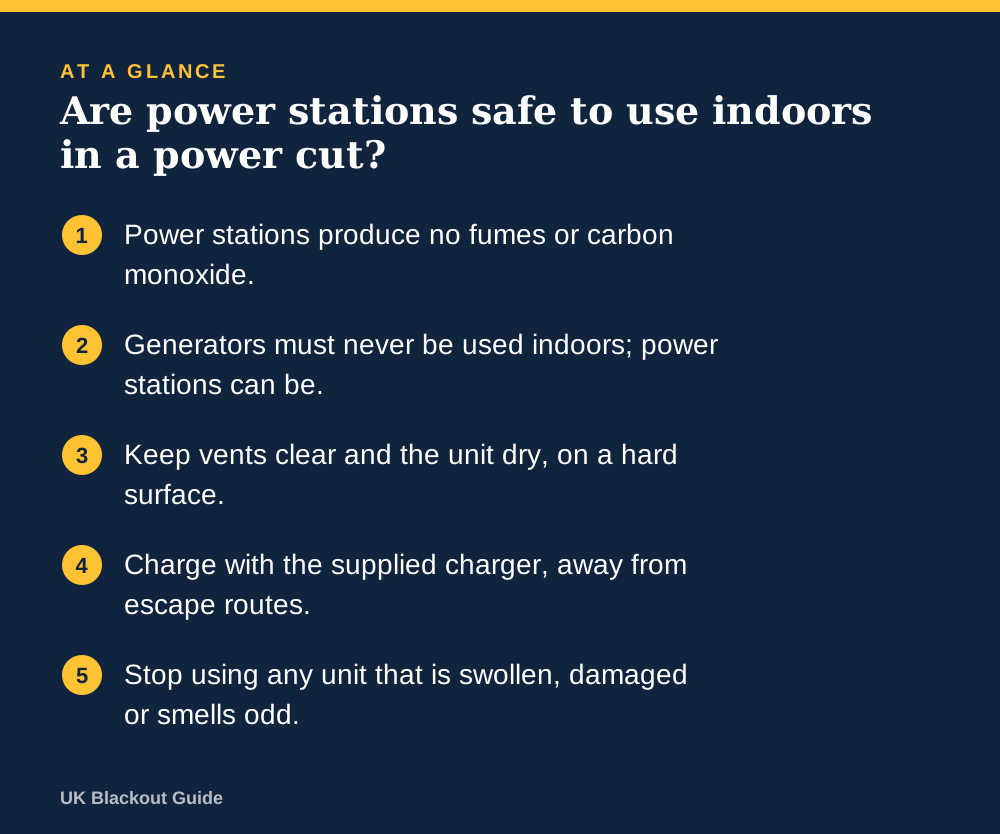
- Power stations produce no fumes or carbon monoxide.
- Generators must never be used indoors; power stations can be.
- Keep vents clear and the unit dry, on a hard surface.
- Charge with the supplied charger, away from escape routes.
- Stop using any unit that is swollen, damaged or smells odd.
Why a power station can come inside and a generator cannot
In the power station or generator choice, the two do the same job in very different ways. A generator burns petrol and its exhaust contains carbon monoxide, which has no smell and can kill. It must only ever run outdoors, never in a house, garage or tent.
A power station is a rechargeable battery with sockets on it. Nothing is burned, so there is nothing to breathe in. It is also quiet, with only a cooling fan under heavy load. That makes it the natural choice for flats and for overnight use.
Six rules for using one in the house
- Hard, level surface. A floor or table, not a bed, sofa or deep carpet that blocks the vents.
- Space to breathe. Leave a hand's width clear around the vents and never drape anything over the unit.
- Dry. Keep it away from sinks, baths, condensation and open windows in the rain. It delivers mains-voltage power.
- Away from heat. Not beside a radiator, fire, wood burner or gas heater, and not in direct sun.
- Within its rating. A kettle or fan heater will trip a small unit. Check what your appliances draw first.
- Tidy leads. In a dark house, trailing cables are a trip hazard. Run them along walls.
Plug appliances into the power station itself. Never try to feed a wall socket from it. The same back-feed danger applies as with a generator.
Charging and storing it safely
Use the charger and leads that came with the unit. Charge it on a hard surface, somewhere you would notice a problem, and not in a hallway or on the stairs where it could block your way out. Avoid charging it in a freezing garage, since lithium batteries should not be charged when very cold.
For storage, a cool, dry indoor cupboard is ideal. Top it up every three months or as the manual advises, and fit a smoke alarm on each floor if you have not already. Lithium battery fires in well-made products are rare, but they are fierce when they happen.
Stop using a power station that is swollen, cracked, has been dropped hard or soaked, gets hot when idle, or smells sweet or chemical. Move it outside if it is safe to do so. If a battery catches fire, get out, stay out and call 999, which is the first rule of fire safety in a power cut.
What to look for when buying
Battery chemistry is the main safety choice. Lithium iron phosphate cells, usually written LiFePO4 or LFP, are more stable under heat and damage than the other common lithium types, and they last for many more charge cycles.
Check for those features first on any of the best portable power stations, and only then compare capacity and sockets.
Common questions
Can I leave a power station running overnight indoors?
Yes, for light loads such as a router, a CPAP machine or a lamp. Keep it on a hard surface with clear vents, and have a working smoke alarm.
Do power stations give off carbon monoxide?
No. They burn nothing, so they produce no carbon monoxide or exhaust of any kind.
Can I keep a power station in a bedroom?
You can use one there, for example for medical equipment. Place it on the floor, away from bedding and curtains, and not between you and the door.
Reviewed against these sources on 18 November 2026. If official advice has changed since, follow the official advice.
General information only. This page is not professional, safety, medical, legal or financial advice, and it is not official guidance. No national blackout has been forecast or announced, and nothing here suggests one is expected. We are independent and have no connection to the government or any energy company. Anything involving electricity, gas, fuel or food safety should be checked with a qualified professional or the relevant official body before you act on it. Always check the official sources linked on this page. Full disclaimer
Keep reading
 Guide
Backup power for your home: every option compared
Power banks, power stations, generators, solar panels, cars and UPS units compared: what each can run in a UK power cut, for how long, and who needs which.
Read: Backup power for your home: every option Buying guide
Best portable power stations for power cuts
Portable power stations for UK power cuts, from a 75 Wh unit for the router to 2 kWh solar bundles, picked from Amazon UK listings with runtime sums.
Read: Best portable power stations for power cuts Guide
How many watts do household appliances use?
Typical wattages for household appliances, from phone chargers and routers to kettles and heaters, and how to use them to plan backup power.
Read: How many watts do household appliances use? Guide
Portable power stations explained
How portable power stations work, what watt-hours and watts mean, what one can and cannot run in a UK power cut, and the features that matter.
Read: Portable power stations explained