On this page
LiFePO4 (also written LFP) stands for lithium iron phosphate, a type of lithium battery. Compared with the lithium-ion cells in phones and older power stations, it is more stable when hot or damaged and survives many more charge cycles. It is heavier for the same capacity. For a power station that sits ready for years, it is the better choice.
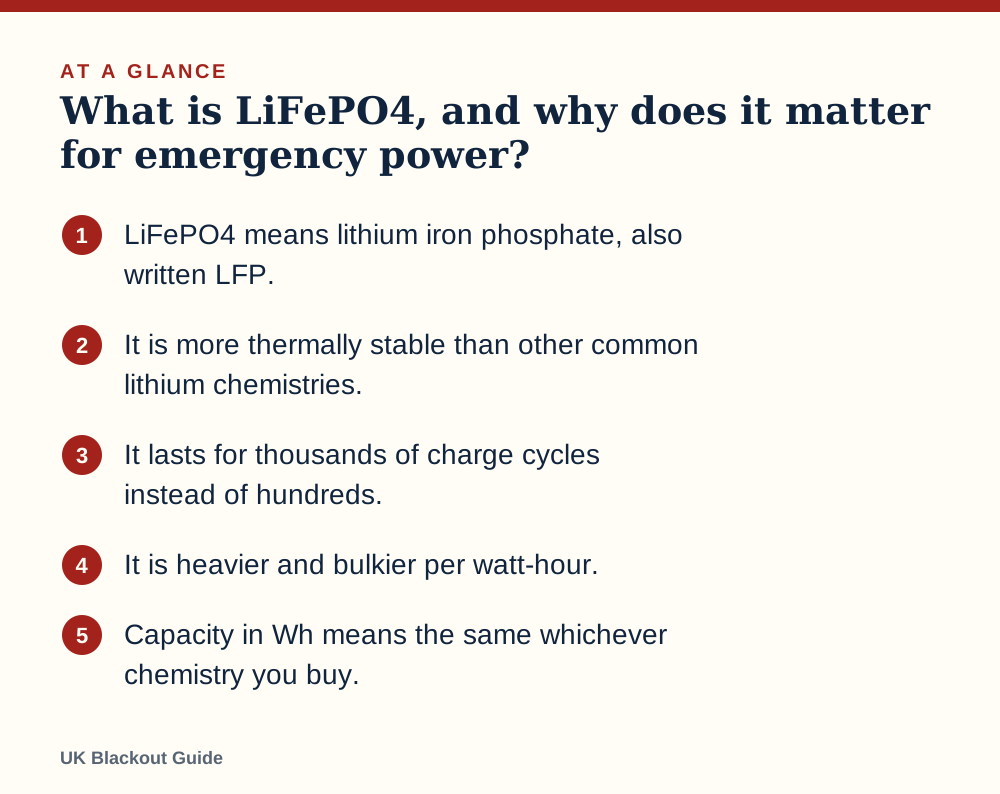
- LiFePO4 means lithium iron phosphate, also written LFP.
- It is more thermally stable than other common lithium chemistries.
- It lasts for thousands of charge cycles instead of hundreds.
- It is heavier and bulkier per watt-hour.
- Capacity in Wh means the same whichever chemistry you buy.
The name, decoded
Li is lithium, Fe is iron, and PO4 is phosphate. Together they describe the material used in one of the battery's electrodes. You will see it written as LiFePO4, LFP or lithium iron phosphate on product pages. They all mean the same thing.
It is a member of the lithium-ion family, but sellers use the name to set it apart from the chemistries based on nickel, manganese and cobalt (often written NMC) that power phones, laptops and many older power stations.
How it differs from standard lithium-ion
| LiFePO4 | Standard lithium-ion (NMC) | |
|---|---|---|
| Stability under heat or damage | Higher | Lower |
| Charge cycles before noticeable fade | Typically thousands | Typically hundreds |
| Weight for the same capacity | Heavier | Lighter |
| Coping with long periods at full charge | Better | Worse |
Exact figures vary by maker, so read the cycle life on the specification sheet. It is normally given as the number of full cycles before capacity falls to 80 per cent.
Why that matters for a blackout kit
An emergency power station has an unusual life. It spends months fully charged in a cupboard, then works hard for a few days. Standard lithium-ion cells age faster when kept full. LiFePO4 tolerates it better, so the capacity you paid for is more likely to be there in year eight.
The stability matters because the unit lives indoors, near where you sleep. No lithium battery is free of risk, and the usual rules for using a power station safely indoors still apply, but an LFP pack is less prone to overheating if abused.
Cycle life matters more if you will also use the unit every week, for camping or to store cheap overnight electricity. Thousands of cycles is many years of daily use.
The trade-offs
Weight is the main one. An LFP power station is noticeably heavier than an NMC one of the same capacity, which matters if you have to carry it upstairs or lift it into a car. Check the weight before buying, and whether it has a handle you can manage.
LiFePO4 cells should not be charged when they are below freezing. Stored indoors that is rarely a problem, but do not recharge one in an icy garage or shed. Price used to be a drawback and is now much less of one, and almost all of the portable power stations we recommend use LFP cells.
What LiFePO4 does not change
The chemistry does not alter the sums behind how portable power stations work. A 1,000 Wh power station gives about 850 Wh of usable energy whatever is inside, so it runs a 60 W fridge-freezer for about 14 hours or a 12 W router for about 70. It also does not change what the unit can power at once, which depends on the output in watts.
So choose size first and chemistry second, starting with what size power station you need.
Common questions
Is LiFePO4 the same as lithium-ion?
It is one type of lithium-ion battery. The label is used to distinguish it from the NMC-type cells found in phones, laptops and older power stations.
Do power banks use LiFePO4?
Rarely. Pocket power banks favour lighter chemistries because weight and size matter more. LiFePO4 is mainly found in power stations and home batteries.
Can a LiFePO4 battery catch fire?
Any battery can fail if badly damaged or faulty, but LiFePO4 is more resistant to overheating than other common lithium types. Buy from a reputable maker and follow the manual.
Reviewed against these sources on 18 November 2026. If official advice has changed since, follow the official advice.
General information only. This page is not professional, safety, medical, legal or financial advice, and it is not official guidance. No national blackout has been forecast or announced, and nothing here suggests one is expected. We are independent and have no connection to the government or any energy company. Anything involving electricity, gas, fuel or food safety should be checked with a qualified professional or the relevant official body before you act on it. Always check the official sources linked on this page. Full disclaimer
Keep reading
 Guide
Backup power for your home: every option compared
Power banks, power stations, generators, solar panels, cars and UPS units compared: what each can run in a UK power cut, for how long, and who needs which.
Read: Backup power for your home: every option Buying guide
Best portable power stations for power cuts
Portable power stations for UK power cuts, from a 75 Wh unit for the router to 2 kWh solar bundles, picked from Amazon UK listings with runtime sums.
Read: Best portable power stations for power cuts Guide
How many watts do household appliances use?
Typical wattages for household appliances, from phone chargers and routers to kettles and heaters, and how to use them to plan backup power.
Read: How many watts do household appliances use? Guide
Portable power stations explained
How portable power stations work, what watt-hours and watts mean, what one can and cannot run in a UK power cut, and the features that matter.
Read: Portable power stations explained