On this page
A car can charge phones and power banks through its USB or 12 V socket, and a small plug-in inverter lets it run a laptop or router. Run the engine outdoors only, never in a garage, and do not expect it to power kettles, heaters or a fridge through the dashboard socket.
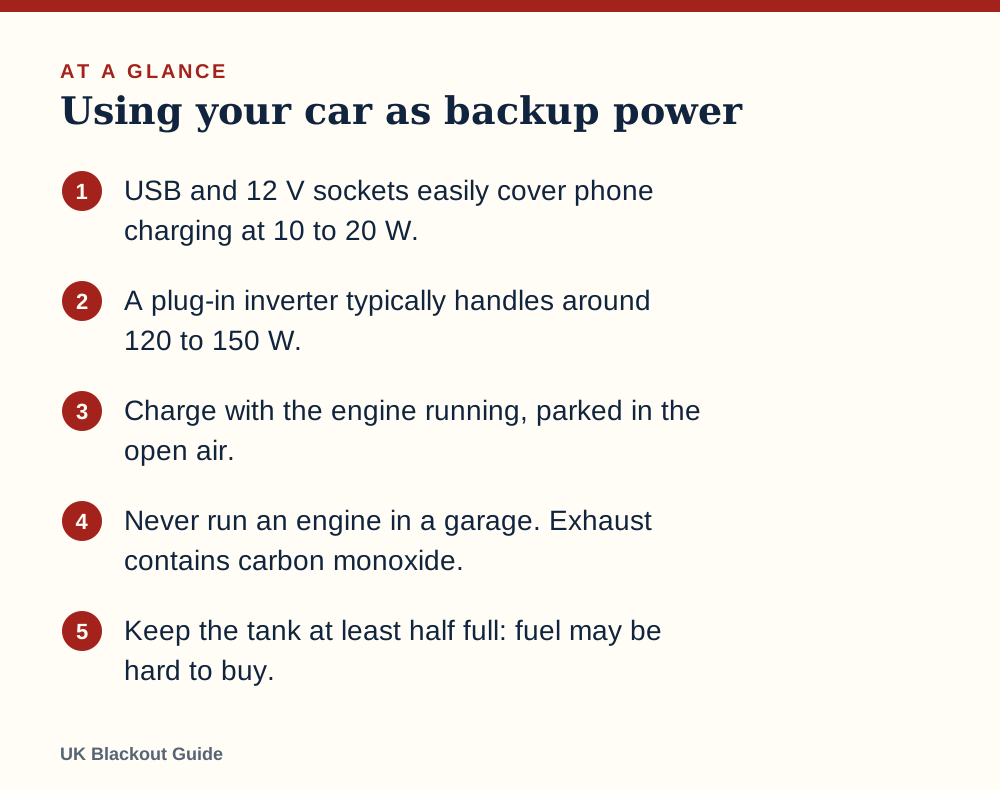
- USB and 12 V sockets easily cover phone charging at 10 to 20 W.
- A plug-in inverter typically handles around 120 to 150 W.
- Charge with the engine running, parked in the open air.
- Never run an engine in a garage. Exhaust contains carbon monoxide.
- Keep the tank at least half full: fuel may be hard to buy.
What your car can do when the mains is off
A car is a petrol or diesel generator with a 12 volt battery attached, and it is already on your drive. It offers four useful things in a power cut: phone charging, a little mains power through an inverter, a radio, and somewhere warm for a short spell.
It has limits. The dashboard socket supplies modest power, the starter battery is not built to be drained, and the engine makes the same deadly exhaust as any generator. Used with care, though, a car comfortably covers the communication side of a power cut for days.
Charging phones and power banks
Phone charging needs only 10 to 20 W. Built-in USB ports in many cars are on the slow side, so a good plug-in charger for the 12 V socket, like the car adaptors in our blackout phone charging shortlist, is worth keeping in the glovebox. With a fast one, a 30 minute drive can put a meaningful charge into a phone.
The efficient approach to charging a phone from a car is to charge power banks, not just phones. While the engine is running, plug in a bank and a phone together, then take the bank indoors and use it for the next day or two. That way one short engine run serves the whole household.
Running mains devices through an inverter
A car inverter converts the car's 12 V supply into 230 V mains, with a normal 13 amp socket on it. The small kind plugs into the dashboard socket.
That socket is protected by a fuse, and in most cars it can supply only around 120 to 150 W. Check your handbook for the exact rating. That is enough for:
- a laptop at 45 to 65 W
- a router at 10 to 15 W, if you run a lead from the car
- LED lamps at 5 to 10 W each
- a CPAP machine at 30 to 60 W without its humidifier, though follow the manufacturer's advice on power sources
It is nowhere near enough for a kettle at 2,000 to 3,000 W or a fan heater at 2,000 W, and it will not start a fridge-freezer, which needs a surge of 600 W or more. Plugging those in will blow the fuse.
Larger inverters clamp directly to the battery terminals and can deliver several hundred watts or more. These demand thick, short cables, correct fusing and the engine running, and are best set up with advice from an auto electrician.
Avoiding a flat battery
A car's starter battery is designed to deliver a huge burst for a few seconds, then be recharged at once. Draining it slowly with the engine off shortens its life, and if you go too far the car will not start, which is a much bigger problem than a flat phone.
Charging one phone with the engine off is generally fine on a healthy battery. For anything more, such as an inverter running a laptop, have the engine running. Many inverters include a low-voltage cut-off that switches them off before the battery gets too low, which is a useful backstop.
A jump starter pack is sensible insurance. It is a compact battery that can start a car with a flat battery without a second vehicle, and most double as a power bank with USB ports and a torch.
Engine fumes and where to park
Never run a car engine in a garage, even with the door open, or in any enclosed space. Exhaust contains carbon monoxide, which has no smell. Symptoms are headache, dizziness, nausea, breathlessness and collapse.
Park in the open, away from the house's doors, windows and air bricks, and make sure the exhaust pipe is not blocked by snow or pressed against a wall or hedge. Do not sleep in a car with the engine running.
A car can warm you up for twenty minutes on a bitter night, and that is a legitimate use. As a heating plan it is wasteful, though: you burn fuel you may not be able to replace. Blankets and layers indoors do more for less.
Fuel, radio and electric cars
The car is only a generator while there is fuel in it. In a wide outage, fuel is one of the services that can be disrupted, as we explain in whether petrol stations work in a power cut. Keeping the tank above half through the winter is a free piece of preparedness.
The car radio is a ready-made emergency receiver. A car radio works in a blackout for a long time on the battery alone and picks up FM, and often DAB.
Electric and hybrid cars hold far more energy, and some models offer vehicle-to-load, meaning a mains socket fed from the main battery. If yours has it, it works like a very large power station, which is the starting point for whether an electric car can power a house.
If you do drive, remember traffic lights and street lighting may be out, which changes the rules for driving safely during a power cut.
Common questions
How long can I charge a phone from a car with the engine off?
One phone charge takes very little from a healthy car battery. For repeated charging or anything larger, run the engine outdoors to avoid a car that will not start.
Can I run my fridge from the car?
Not from the dashboard socket. A fridge-freezer needs a 600 W or more starting surge, far above what the socket can supply.
Does idling the engine charge the battery?
It does, but slowly compared with driving. A short drive you needed to make anyway is a better time to charge devices than a long idle.
Is a modified sine wave inverter good enough?
It will charge most laptops and phones, but some electronics and medical devices need a pure sine wave. Check the device's manual.
Reviewed against these sources on 18 November 2026. If official advice has changed since, follow the official advice.
General information only. This page is not professional, safety, medical, legal or financial advice, and it is not official guidance. No national blackout has been forecast or announced, and nothing here suggests one is expected. We are independent and have no connection to the government or any energy company. Anything involving electricity, gas, fuel or food safety should be checked with a qualified professional or the relevant official body before you act on it. Always check the official sources linked on this page. Full disclaimer
Keep reading
 Question
Can I charge my phone from my car in a power cut?
Charging a phone from a car uses a tiny share of the car battery. How many charges you can take with the engine off, and how to avoid a flat battery.
Read: Can I charge my phone from my car in a power Buying guide
Best car inverters for power cuts
Car inverters for power cuts: six units from Amazon UK listings that run a laptop, router or lamp from your car's 12V socket, with the limits explained.
Read: Best car inverters for power cuts Buying guide
Best jump starters for emergencies that also charge phones
Jump starters for emergencies that also charge phones: seven packs from Amazon UK listings with a power bank and torch, sized by engine, for blackouts.
Read: Best jump starters for emergencies that also Buying guide
Best phone chargers for a blackout
Nine ways to keep a phone charged in a blackout: power banks, crank and solar chargers, car chargers and cables from Amazon UK, compared honestly.
Read: Best phone chargers for a blackout