On this page
Sometimes. A few electric cars have a built-in socket (vehicle-to-load) that can run appliances directly, and that works in a blackout with no installation. Powering the whole house needs a compatible car, a two-way charger and a system that isolates your home from the grid, fitted by an electrician. A standard home charger cannot do it.
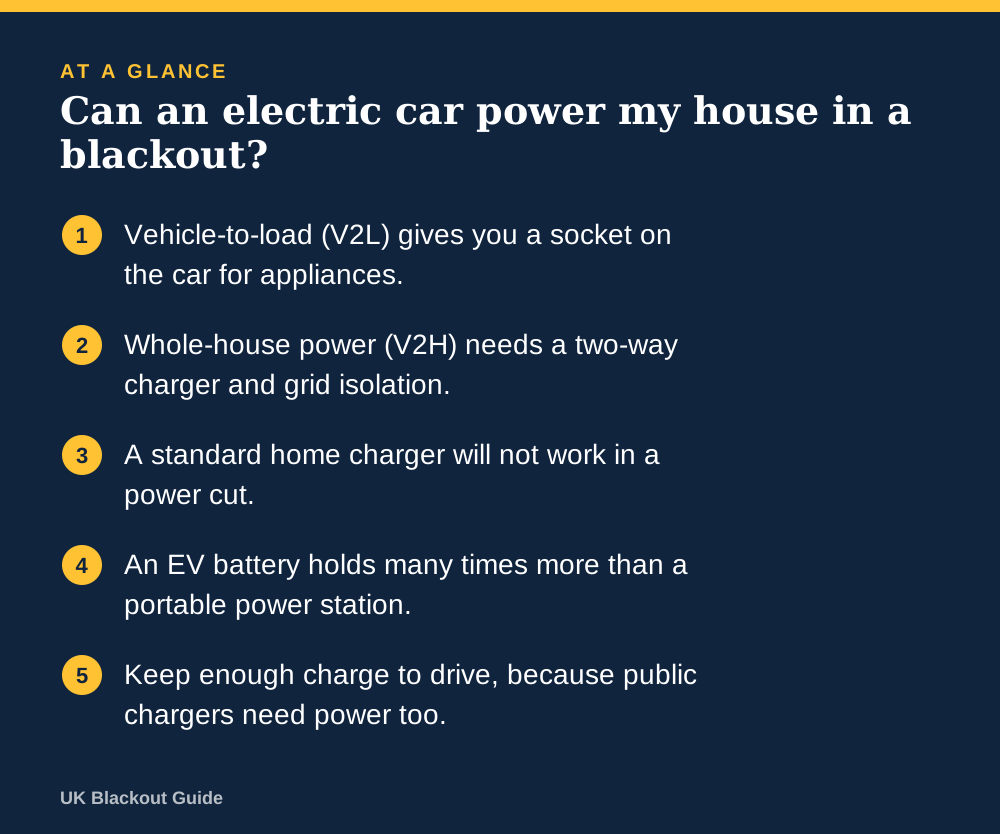
- Vehicle-to-load (V2L) gives you a socket on the car for appliances.
- Whole-house power (V2H) needs a two-way charger and grid isolation.
- A standard home charger will not work in a power cut.
- An EV battery holds many times more than a portable power station.
- Keep enough charge to drive, because public chargers need power too.
Three levels of capability
Whether your car can help depends on the model. Check the handbook or ask the dealer which of these it supports.
- None. Many electric cars can only take power in. Their 12 volt socket and USB ports still work for charging phones.
- Vehicle-to-load (V2L). The car has a mains socket inside, or an adapter that plugs into the charge port, giving you a 230 volt outlet with a limited output. You run an extension lead to your appliances.
- Vehicle-to-home (V2H). The car feeds your house wiring through a special two-way (bidirectional) charger. Only certain cars and chargers support this, and it is still uncommon in the UK.
V2L: the simple option that works today
If your car has V2L, it is in effect a very large power station on wheels. Park it outside, run a heavy-duty extension lead indoors, and plug in the fridge-freezer, lamps, router and chargers. No wiring is touched, so there is nothing to install.
The numbers are generous. Take a car with 60 kWh in its battery, and say you are willing to use a third of it: 20,000 Wh. Using the standard sum (watt-hours times 0.85, divided by watts), a 150 W load of fridge-freezer, router, lights and phone charging would run for about 113 hours. That is more than four days.
The socket has an output limit, so read the handbook before plugging in a kettle or heater. And treat the lead like any outdoor mains lead: keep the connections dry and out of puddles.
V2H: why the whole house is harder
Feeding your home's wiring raises the same safety problem as a generator or a home battery. If power flows back into the street cables during a cut, it can kill an engineer working on the fault. So a V2H system must disconnect the house from the grid before the car supplies it.
That takes a compatible car, a bidirectional charger and isolation equipment, all installed by a qualified electrician. A system designed only to trade energy with the grid may still shut down in a power cut, so ask the installer directly whether it provides backup when the mains is off. Home battery storage and blackouts covers the same question for fixed batteries.
Never try to feed a house socket from a car, a generator or a power station with a home-made lead, for the reasons in why you must never plug a generator into a socket.
Do not strand yourself
Your home charger needs mains power, and so do public chargers, so you probably cannot recharge the car during a power cut. Decide on a floor, such as half the battery, and stop drawing from the car when you reach it. In a wide outage the ability to drive to family, a pharmacy or a warm building is worth more than a cold freezer.
In winter, keeping the car plugged in and well charged whenever the mains is on is the easiest preparation. The same goes for petrol and diesel drivers, who can get modest power from an inverter, as using your car as backup power explains.
If your car cannot do it
Most households will rely on portable kit. A large power station gives you the V2L experience without the car: the best large power stations can run a fridge-freezer and essentials through a day or more.
Common questions
Does using my EV to power appliances damage the battery?
Light loads through V2L are gentle compared with driving. Check your handbook and warranty for any limits the maker sets on this kind of use.
Can I run an EV's V2L socket with the car in the garage?
An EV has no exhaust, so there is no carbon monoxide risk. Keep the lead and connections dry and do not trap the cable in a door.
Will my solar panels charge the car in a power cut?
Not usually. Most home solar shuts off when the grid fails unless the system has backup able to run independently.
Reviewed against these sources on 18 November 2026. If official advice has changed since, follow the official advice.
General information only. This page is not professional, safety, medical, legal or financial advice, and it is not official guidance. No national blackout has been forecast or announced, and nothing here suggests one is expected. We are independent and have no connection to the government or any energy company. Anything involving electricity, gas, fuel or food safety should be checked with a qualified professional or the relevant official body before you act on it. Always check the official sources linked on this page. Full disclaimer
Keep reading
 Guide
Backup power for your home: every option compared
Power banks, power stations, generators, solar panels, cars and UPS units compared: what each can run in a UK power cut, for how long, and who needs which.
Read: Backup power for your home: every option Guide
Which batteries to keep at home, and how to store them
Which battery sizes and types to keep at home for power cuts, how many spares you need, and how to store alkaline, rechargeable and lithium cells safely.
Read: Which batteries to keep at home, and how to Buying guide
Best car inverters for power cuts
Car inverters for power cuts: six units from Amazon UK listings that run a laptop, router or lamp from your car's 12V socket, with the limits explained.
Read: Best car inverters for power cuts Buying guide
Best generators for power cuts
Petrol inverter generators for UK power cuts, from 1,200 W to 5,500 W, chosen from Amazon UK listings, with the carbon monoxide and wiring rules.
Read: Best generators for power cuts