On this page
In a summer power cut, food and people overheat faster than you expect. Keep the fridge shut, since it only stays cold for around 4 hours unopened. Close curtains on the sunny side, drink water regularly, use a battery fan and damp cloths to cool down, and check on anyone elderly, very young or unwell.
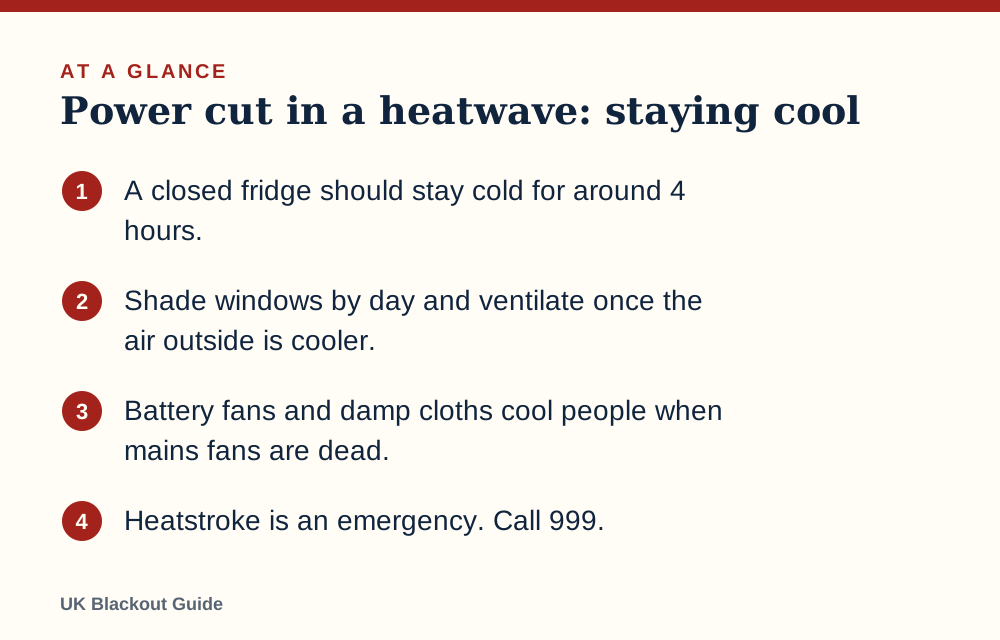
- A closed fridge should stay cold for around 4 hours.
- Shade windows by day and ventilate once the air outside is cooler.
- Battery fans and damp cloths cool people when mains fans are dead.
- Heatstroke is an emergency. Call 999.
Hot-weather cuts have a different set of problems
Most power cut advice assumes a dark, cold evening. In July, you have light until late and nobody needs a blanket. The problems are different ones: the fridge is fighting a warm kitchen, fans and air conditioning are off, and the people most affected by heat are the same people most affected by any emergency.
Summer cuts do happen. On 9 August 2019, a lightning strike followed by the loss of two generators disconnected about a million customers, most for under an hour. Summer thunderstorms and heavy demand on local equipment in hot spells can both cause faults.
Treat the fridge as a sealed box
The Food Standards Agency says a fridge should stay cold for around 4 hours if it is left unopened, and that it should run at 5°C or below. That four-hour figure for how long food lasts in a fridge without power is a guide. In a hot kitchen, expect the margin to be thinner, and be stricter about opening the door.
Take out the drinks you will want in one go at the start, then leave it shut. A full freezer typically stays frozen for about 48 hours unopened and a half-full one about 24.
If the cut looks set to run past four hours, a cool box buys time for the things that matter most, such as milk for a baby or tonight's dinner. Pack it tight with ice packs or bags of ice from the freezer, do it in one quick visit, and keep the box in the coolest, shadiest room.
Whatever you save, the FSA rule still applies afterwards: if in doubt, throw it out.
Medicines that need the fridge
Some medicines, including insulin, are normally stored in the fridge. Leave them there with the door closed for as long as it stays cool. After that, storing medicines without a fridge depends on the specific medicine, so check the patient leaflet and ask your pharmacist or clinician. Do not guess, and do not throw a medicine away or keep using a doubtful one without advice.
This is general guidance only, and that includes anything you read about keeping insulin cool without power. Your own clinician's instructions come first.
Stop the house heating up
Without fans, your best tool is shade. During the day, close curtains and blinds on any window in direct sun, and keep windows on the sunny side shut while the air outside is hotter than the air inside. It feels wrong, but it works.
Once the outside air cools in the evening, open windows on opposite sides of the house to pull a draught through, and open the loft hatch if you have one so hot air can rise out of the living space. Upstairs rooms are hottest. If the bedrooms are stifling, sleep downstairs.
Avoid adding heat. Cook as little as possible, and if you do light a gas hob with a match, keep it brief. A camping stove or barbecue stays outside, well away from open doors and windows.
Never use a barbecue, camping stove or generator indoors or in a garage, whatever the weather. They produce carbon monoxide, which has no smell and can kill.
Cool the people directly
Cooling a body is easier than cooling a building. Drink water regularly, before you feel thirsty. Wear loose, light clothing. Wet a flannel or tea towel with cold water and put it on the back of the neck, wrists or forehead, or stand your feet in a bowl of cool water.
Moving air makes damp skin cool much faster, and this is where a rechargeable fan is worth having. A small one draws very little power, so it will run for hours on its own battery and can be topped up from a power bank.
Use water sensibly. Mains water can be disrupted during and after a power cut, so fill a few bottles and jugs early. When you work out how much water to store, the planning figure is 3 litres of drinking water per person per day, and in hot weather you should allow more.
Who to watch, and the signs of heat illness
Babies and young children, older people, pregnant women and anyone with a heart, lung or kidney condition cope less well with heat. So do people who cannot easily move to a cooler room or fetch themselves a drink. Check on them often, as you would when looking after older relatives in an outage, and knock on the door of any neighbour who lives alone.
According to the NHS, signs of heat exhaustion include tiredness, dizziness, headache, feeling or being sick, heavy sweating, cramps, fast breathing and intense thirst. Move the person somewhere cool, get them to lie down and drink, and cool their skin with water and a fan. They should start to feel better within about half an hour.
If someone is still unwell after 30 minutes of cooling, or is confused, has a seizure, loses consciousness or has hot skin that is not sweating, this may be heatstroke. Call 999.
Do not forget animals. Pets in a power cut need shade, fresh water and a cool floor to lie on, and should never be left in a car or conservatory.
When it makes sense to go somewhere else
If the house is very hot and someone vulnerable is struggling, leaving for a few hours is a perfectly good plan. A shaded garden or park is often cooler than indoors. A friend or relative outside the affected area will have a working fridge and fan. Take medicines, water and a phone charger, and report the cut on 105 before you go so you can check for updates while you are out.
Common questions
Will my freezer thaw faster in hot weather?
The FSA figures of about 48 hours for a full freezer and 24 for a half-full one assume the door stays shut. A hot room reduces the margin, so do not open it.
Can I run a mains fan from a power bank?
No. An ordinary power bank only supplies USB devices. A USB or rechargeable fan is the practical option, or a portable power station for a mains fan.
Is it safe to sleep with windows open in a power cut?
Upstairs windows are generally fine. Use your judgement on ground-floor windows and keep accessible ones locked or on a restrictor.
Should I put food in the garden or a stream to keep it cool?
No. Outdoor temperatures in a heatwave are far above the 5°C a fridge should hold. Use a cool box with ice instead.
Reviewed against these sources on 18 November 2026. If official advice has changed since, follow the official advice.
General information only. This page is not professional, safety, medical, legal or financial advice, and it is not official guidance. No national blackout has been forecast or announced, and nothing here suggests one is expected. We are independent and have no connection to the government or any energy company. Always check the official sources linked on this page. Full disclaimer
Keep reading
 Buying guide
Best power cut essentials: the blackout kit worth buying
The blackout kit worth buying for a UK power cut: a battery torch, a lantern, a power bank, a wind-up radio, an automatic light and a flask, with picks.
Read: Best power cut essentials: the blackout kit Buying guide
Best surge protectors for power cuts
Surge protectors for power cuts: extension leads that guard a TV, computer or router from the spike when the mains returns, chosen from Amazon UK listings.
Read: Best surge protectors for power cuts Question
Can a power cut damage appliances?
A power cut rarely harms appliances by itself. The risk comes from surges and flickering when supply returns, and from computers losing power mid-task.
Read: Can a power cut damage appliances? Question
Can I charge an electric car in a power cut?
You cannot charge an electric car at home in a power cut, as the charger needs mains power. Public chargers outside the affected area will still work.
Read: Can I charge an electric car in a power cut?