On this page
A home first aid kit should hold plasters, sterile dressings in several sizes, bandages, tape, gauze, antiseptic wipes, disposable gloves, scissors, tweezers, a thermometer, a foil blanket and something for burns. Add basic pain relief, your household's own medicines and a written list of medication and contacts. Keep a torch with it and check the dates every six months.
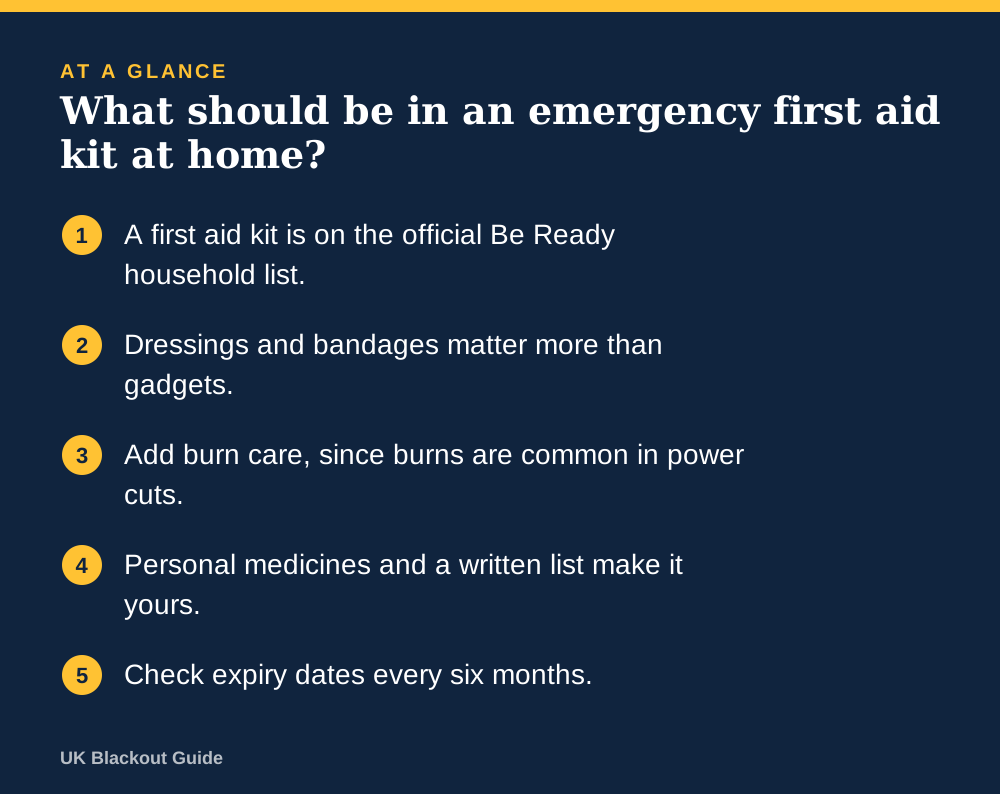
- A first aid kit is on the official Be Ready household list.
- Dressings and bandages matter more than gadgets.
- Add burn care, since burns are common in power cuts.
- Personal medicines and a written list make it yours.
- Check expiry dates every six months.
The core contents
The government's Be Ready kit list, set out in our full emergency kit list, names a first aid kit and essential medication without spelling out the contents. The list below follows the kind of items the NHS and first aid charities suggest for a home kit.
| For | Items |
|---|---|
| Small cuts and grazes | Plasters in assorted sizes, antiseptic or cleansing wipes, sterile gauze pads |
| Larger wounds | Sterile wound dressings (small, medium, large), crepe bandages, microporous tape |
| Sprains and support | Crepe or elastic bandage, two triangular bandages, safety pins |
| Burns and scalds | Burn dressings or burn gel sachets, cling film |
| Eyes | Sterile eye pad, sealed eyewash pods |
| Tools | Scissors, tweezers, disposable gloves, digital thermometer |
| Warmth | Foil blanket |
Burn care deserves its place. Power cuts bring candles, camping stoves and pans of hot water into play, and the first response to a burn is 20 minutes under cool running water. Dressings and cling film are for afterwards.
Medicines to keep alongside it
A small stock of everyday medicines saves a trip to a chemist that may be shut or unable to take cards. Typical choices are pain relief such as paracetamol or ibuprofen, antihistamines, rehydration sachets and an antiseptic cream. Keep children's versions if you have children.
Follow the instructions on each pack, and ask your pharmacist what is suitable for the people in your house, particularly for children, in pregnancy or alongside prescribed medicines. Store all medicines out of the reach of children.
Then add what is specific to you: a few days of regular prescription medicines, a spare inhaler or adrenaline pen if prescribed, and a written list of each person's medicines, doses and allergies with your GP's number. Be Ready asks every household to keep that list on paper, because your phone may be flat when you need it.
Extras that earn their space in a power cut
- A head torch, kept on top of the kit. Dressing a wound needs two hands.
- Hand sanitiser and wet wipes, since mains water can be disrupted during and after a power cut.
- A printed first aid leaflet. Do not rely on searching online.
- Instant cold packs for sprains when the freezer is out of bounds.
- A notepad and pen to record times and symptoms for 111 or a paramedic.
Knowing how to use the contents matters more than owning them. Learn the first aid basics for emergencies: the injuries most likely in a power cut and when to call 999 or NHS 111.
Buy ready-made or build your own
A ready-made first aid kit is the quick route and usually costs less than buying each item separately. Look at the contents list, not the piece count on the front. A '200-piece' kit can be mostly small plasters and safety pins.
Top up whichever you buy with your own medicines and the power cut extras above.
Where to keep it and when to check it
Keep the kit somewhere cool, dry and known to every adult and older child in the house. A kitchen cupboard beats a steamy bathroom. A second small kit in the car is useful.
Sterile dressings, wipes and medicines all carry expiry dates. Go through the kit every six months, replace anything used or out of date and check the torch, as part of checking your emergency kit every six months.
Common questions
Do first aid kits go out of date?
Yes. Sterile dressings, wipes and medicines have expiry dates, and adhesive on plasters weakens with age. Check every six months.
Should I keep medicines inside the first aid kit?
You can, provided the kit is stored out of the reach of children. Many families keep medicines in a separate locked or high cupboard next to it.
Is a foil blanket really needed at home?
It is small, cheap and useful for keeping an injured or cold person warm while you wait for help, especially in a house with no heating.
Reviewed against these sources on 18 November 2026. If official advice has changed since, follow the official advice.
General information only. This page is not professional, safety, medical, legal or financial advice, and it is not official guidance. No national blackout has been forecast or announced, and nothing here suggests one is expected. We are independent and have no connection to the government or any energy company. Nothing here is medical advice: follow your own clinician, pharmacist or equipment supplier. Always check the official sources linked on this page. Full disclaimer
Keep reading
 Buying guide
Best first aid kits for home emergencies
First aid kits for home emergencies and power cuts, chosen from Amazon UK listings on burn care, foil blankets, easy-to-find cases and buyer ratings.
Read: Best first aid kits for home emergencies Guide
First aid basics worth learning now
The first aid most likely to be needed in a power cut: burns, cuts, falls, cold and carbon monoxide, plus when to call 999 or NHS 111 and how to get trained.
Read: First aid basics worth learning now Guide
Babies and toddlers in a power cut
A practical plan for a power cut with a baby or toddler: feeds, safe warmth, sleep, night light, nappies and the baby items to add to your household kit.
Read: Babies and toddlers in a power cut Buying guide
Best battery smoke alarms that work in a power cut
Battery smoke alarms that work in a power cut, chosen from Amazon UK listings on sealed battery life, stated standards, pack size and buyer ratings.
Read: Best battery smoke alarms that work in a