On this page
Power cuts cause a predictable set of injuries: burns from candles, stoves and hot water, cuts and falls in the dark, cold-related illness and carbon monoxide poisoning. Learn the first response to each, keep a stocked first aid kit with a torch beside it, and call 999 for anything life-threatening. A short course is the best preparation.
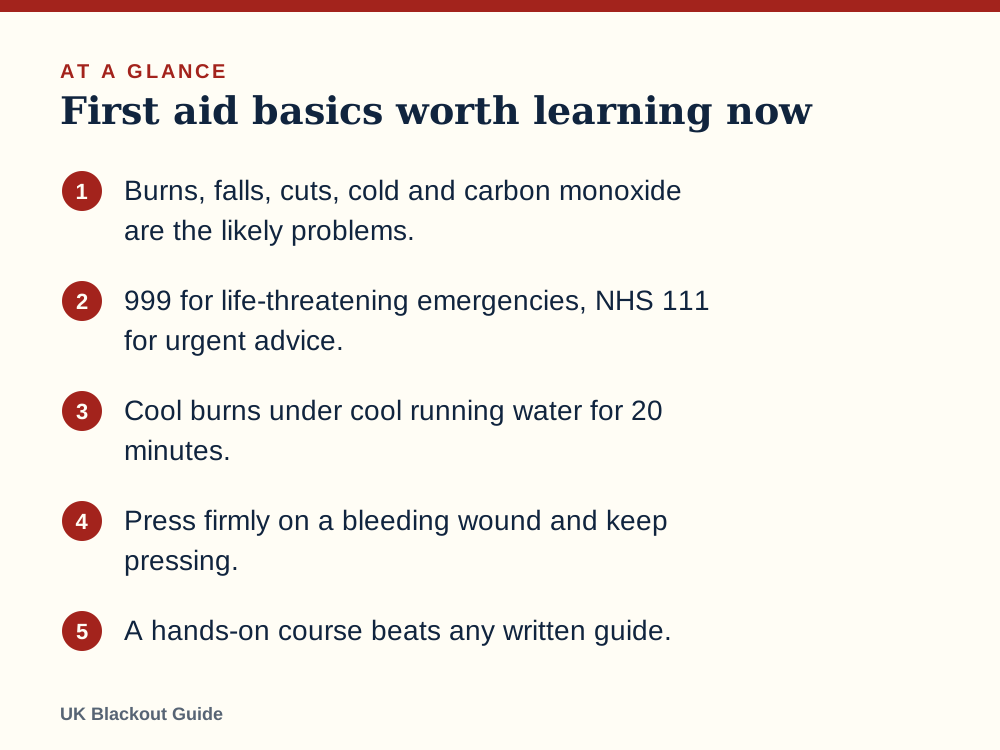
- Burns, falls, cuts, cold and carbon monoxide are the likely problems.
- 999 for life-threatening emergencies, NHS 111 for urgent advice.
- Cool burns under cool running water for 20 minutes.
- Press firmly on a bleeding wound and keep pressing.
- A hands-on course beats any written guide.
Why power cuts produce their own injuries
People do unfamiliar things in a power cut. They carry pans of boiling water by torchlight, light candles they have not used for years, walk downstairs in the dark and cook on camping stoves. The injuries follow from that.
This page is general information to help you act in the first minutes. It is not a substitute for training or for professional care. In a medical emergency call 999 and follow what the call handler tells you.
Getting help when the phones are unreliable
Call 999 or 112 for anything life-threatening: unconsciousness, breathing difficulty, chest pain, severe bleeding, signs of stroke, serious burns. An emergency call from a mobile can roam onto any network that has signal, so try even when your phone shows no bars for your own provider.
For urgent problems that are not life-threatening, call NHS 111. If you cannot speak or hear on a call, you can text 999, but you must register first by texting the word 'register' to 999. Do that today.
Mobile masts may only work for a limited time on backup power, so calling 999 in a power cut can mean trying a neighbour's phone, or going to a fire or police station in person, if the first attempt fails.
Burns and scalds
Burns are the classic power cut injury, from candles, stoves, flasks and kettles boiled on a hob.
- Cool the burn under cool or lukewarm running water for 20 minutes. Do not use ice, creams or butter.
- Remove clothing and jewellery near the burn unless it is stuck to the skin.
- Cover it loosely with cling film laid over the burn, or a clean plastic bag for a hand.
- Keep the person warm, since cooling a burn can chill the whole body.
If the mains water is off, use any clean cool water you have stored, poured steadily. Get medical advice for any burn larger than the person's hand, any deep or white burn, burns to the face, hands or genitals, chemical or electrical burns, and all burns in babies and young children.
Prevention is easier than treatment, and basic candle safety starts with using battery lights where you can.
Cuts and bleeding
Opening tins by torchlight and clearing broken glass in the dark produce cuts. For a bleeding wound, press firmly on it with a clean dressing or cloth and keep the pressure on. If blood soaks through, add another pad on top without removing the first.
Call 999 if bleeding is severe, will not stop after ten minutes of firm pressure, or is spurting. For a minor cut, rinse with clean water, dry it and cover with a plaster or dressing.
A head torch makes all of this far easier because it leaves both hands free. Keep one with your kit.
Falls and head injuries
Stairs, pets and trailing blankets are harder to see by torchlight. If someone falls and is in severe pain, cannot move a limb, or the limb looks misshapen, do not move them more than you must. Keep them warm with blankets and call 999 or 111 as the situation demands.
After a bang on the head, call 999 if the person was knocked out, is vomiting repeatedly, is confused, has a fit or has clear fluid from the nose or ears. Otherwise watch them closely for the next day and use 111 for advice.
Sprains respond to rest and a cold compress wrapped in cloth. In a winter cut, a cloth soaked in cold water does the job.
Cold, and the gas you cannot smell
Hypothermia means body temperature below 35°C. The NHS lists shivering, cold pale skin, slurred speech, confusion and tiredness as signs of hypothermia. Call 999, move the person somewhere warmer if you can, replace any wet clothes and wrap them in blankets, including the head. Give a warm drink if they are fully awake. Do not use a hot bath or rub their limbs.
Headache, dizziness, nausea, breathlessness or collapse in a home where a generator, stove, barbecue or heater is burning may be carbon monoxide poisoning. Get everyone into fresh air at once and call 999. The gas emergency line is 0800 111 999.
Carbon monoxide in a power cut is hard to spot, because the gas has no smell and the symptoms are easy to mistake for flu or tiredness.
If someone is unresponsive
Shout for help and call 999 on speakerphone. The call handler will tell you exactly what to do, including how to give chest compressions, and will stay on the line. You do not need to remember a procedure. You need to make the call and follow the voice.
If the person is breathing normally but unresponsive, the handler will usually ask you to roll them onto their side.
Stock a kit and book a course
A first aid kit is on the official Be Ready list. Keep it somewhere every adult knows, with a torch on top.
Check yours against what should be in a first aid kit, then book a course. The British Red Cross, St John Ambulance and St Andrew's First Aid all run short sessions, and the Red Cross has a free app that works offline. An hour of practice on a manikin will stay with you longer than anything you read.
Common questions
Can I use bottled water to cool a burn?
Yes. If the taps are off, pour any clean, cool water steadily over the burn for 20 minutes. Do not use ice.
Should I drive someone to hospital in a power cut?
For life-threatening emergencies call 999 first. Traffic lights and streetlights may be out, which makes driving slower and riskier than usual.
Do first aid apps work without the internet?
Some do, including the British Red Cross first aid app once it is downloaded. Install and open it before you need it.
What if I cannot get through to 999?
Keep trying, try another phone or a landline, and send someone to the nearest neighbour with a working phone or to a fire, police or ambulance station.
Reviewed against these sources on 18 November 2026. If official advice has changed since, follow the official advice.
General information only. This page is not professional, safety, medical, legal or financial advice, and it is not official guidance. No national blackout has been forecast or announced, and nothing here suggests one is expected. We are independent and have no connection to the government or any energy company. Nothing here is medical advice: follow your own clinician, pharmacist or equipment supplier. Always check the official sources linked on this page. Full disclaimer
Keep reading
 Buying guide
Best first aid kits for home emergencies
First aid kits for home emergencies and power cuts, chosen from Amazon UK listings on burn care, foil blankets, easy-to-find cases and buyer ratings.
Read: Best first aid kits for home emergencies Question
What should be in an emergency first aid kit at home?
A plain list of what a home first aid kit should contain for power cuts and other emergencies, what to add for your household and how to keep it in date.
Read: What should be in an emergency first aid kit Buying guide
Best battery smoke alarms that work in a power cut
Battery smoke alarms that work in a power cut, chosen from Amazon UK listings on sealed battery life, stated standards, pack size and buyer ratings.
Read: Best battery smoke alarms that work in a Buying guide
Best CPAP battery backups for power cuts
CPAP battery backups for a power cut at night, chosen from Amazon UK listings on stated watt-hours, voltage and machine compatibility, with runtime maths.
Read: Best CPAP battery backups for power cuts