On this page
Torches are the better choice. The government's Be Ready advice says torches are safer than candles, and an LED torch or lantern is also brighter, can be carried, and will not start a fire if it is knocked over or forgotten. Keep candles only as a last-resort backup, and use them with care.
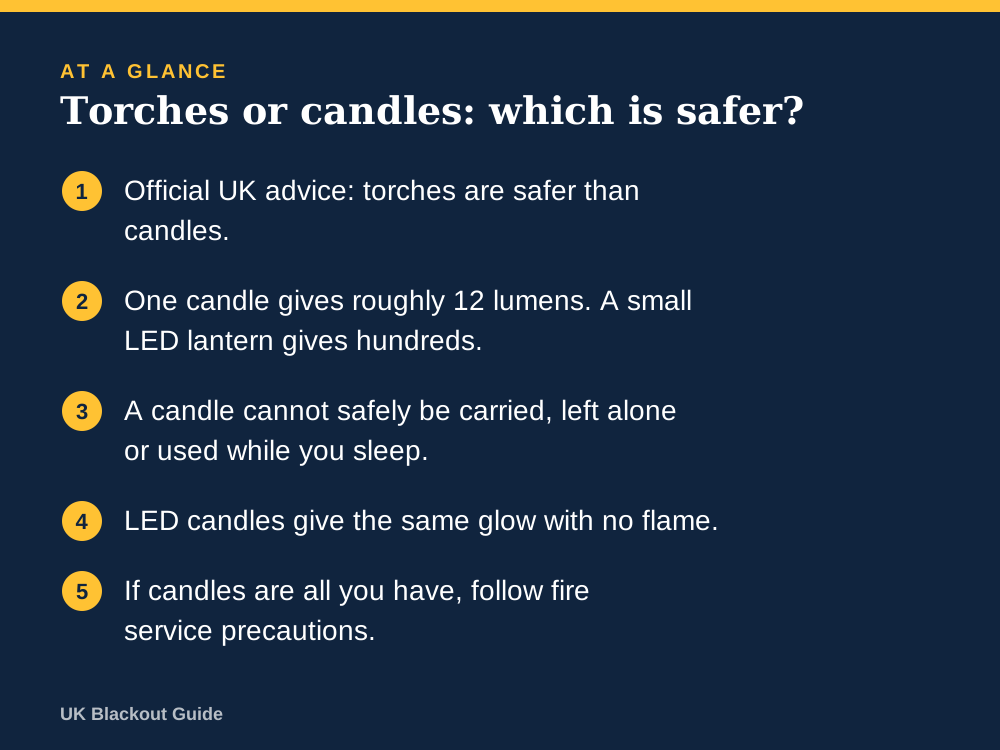
- Official UK advice: torches are safer than candles.
- One candle gives roughly 12 lumens. A small LED lantern gives hundreds.
- A candle cannot safely be carried, left alone or used while you sleep.
- LED candles give the same glow with no flame.
- If candles are all you have, follow fire service precautions.
What the official advice says
The Be Ready kit list asks for a battery or wind-up torch with spare batteries, and adds that torches are safer than candles. It does not list candles at all.
The reason is simple. A power cut puts a household in unfamiliar conditions: dark rooms, people moving about with their hands full, children excited or unsettled, pets underfoot. Adding naked flames to that works against fire safety during a power cut. It raises the risk of a fire at the same moment that smoke is harder to see and help may be slower to reach you.
How the two compare side by side
| LED torch or lantern | Candle | |
|---|---|---|
| Light output | Tens to hundreds of lumens, adjustable | About 12 lumens, fixed |
| Fire risk | Very low | Naked flame |
| Can you carry it | Yes | Not safely |
| Safe to leave on unattended | Yes | No |
| Around children and pets | Fine | Needs constant supervision |
| Running out | Recharge or swap batteries | Burns down and is gone |
| Heat | None to speak of | A little, far too little to warm a room |
The brightness gap is wider than most people expect. A standard candle gives off roughly 12 lumens, the measure of light output, about what a keyring light manages. You would need dozens of candles to match one modest lantern, and every extra candle is another flame to watch.
Why a torch is the more practical tool
Safety aside, a torch for power cuts simply does more. You can take it to the fuse box, up the stairs and out to the car. You can stand it on its end to bounce light off the ceiling. You can hand it to a child.
Modern LED torches also run for a long time. LEDs turn most of their power into light, so a torch on a low setting can last for many evenings on one set of batteries. Spare AA or AAA cells keep for years in a drawer, and the advice on batteries worth keeping at home explains which types store best.
For lighting a whole room, a lantern does better than any torch, and lighting a home without power usually takes both.
The case people make for candles
Candles are cheap, they need no batteries, and most homes already have some. Those are fair points. A box of tea lights at the back of a cupboard is better than sitting in the dark.
Two other arguments hold up less well. Candles are sometimes kept for warmth, but a candle flame gives off far too little heat to make a difference to a cold room, and trying to heat with flames indoors brings fire and carbon monoxide risks. Layers and blankets work better, as the advice on keeping warm sets out. Candles are also said to last longer than batteries, yet a single set of cells in an LED light on low will usually outlast several candles.
The honest case for candles is atmosphere. A flickering light is comforting on a long dark evening, and that matters, especially with children in the house.
LED candles give the glow without the flame
If comfort is the reason you reach for candles, battery LED candles do the same job. They flicker, they give a warm light, and they can be left on a windowsill, in a child's room or next to a sleeping pet without a second thought.
They are not bright enough to read by, so treat them as background light alongside a lantern. For marking a route to the bathroom, glow sticks are another flame-free option, and their limits are covered in whether glow sticks are useful in a power cut.
If candles are all you have
Sometimes the torch is flat and the candles are what is left. Used carefully, for a short time, by an adult who stays in the room, a candle is a reasonable stopgap, provided you know how to use candles safely in a power cut.
Stand candles in a proper holder on a flat, heat-resistant surface, well away from curtains, furniture and anything hanging above. Never leave one burning in an empty room or while you sleep. Keep them out of reach of children and pets, and do not walk around carrying one.
Then add a torch and spare batteries to your shopping list, so that next time the candles can stay in the cupboard and you are not left asking whether to use your phone as a torch.
Common questions
Are tea lights safer than tall candles?
They are harder to knock over, but they are still naked flames and their metal cups get hot enough to damage plastic and other surfaces. Put them in a holder on something heat resistant.
Do candles use up the oxygen in a room?
A few candles in a normal room will not use a dangerous amount of oxygen. The real hazard is fire from the flame touching something or being left unattended.
Is an oil lamp or hurricane lamp better than a candle?
The flame is enclosed, which helps, but it is still a flame, it involves storing and pouring fuel, and it should not be left burning unattended. An LED lantern is safer and brighter.
How many torches do I need to replace candles?
A lantern for the main room and a torch or head torch per person covers most homes.
Reviewed against these sources on 18 November 2026. If official advice has changed since, follow the official advice.
General information only. This page is not professional, safety, medical, legal or financial advice, and it is not official guidance. No national blackout has been forecast or announced, and nothing here suggests one is expected. We are independent and have no connection to the government or any energy company. Always check the official sources linked on this page. Full disclaimer
Keep reading
 Buying guide
Best LED candles for power cuts
Battery LED candles and tea lights for a flame-free glow in a power cut, picked from Amazon UK listings for timers, pack size and buyer ratings.
Read: Best LED candles for power cuts Buying guide
Best torches for power cuts
Seven LED torches from Amazon UK for power cuts: battery, wind-up and rechargeable picks, with a plain warning about impossible lumen claims.
Read: Best torches for power cuts Question
How many torches should a household have for a power cut?
How many torches a UK household should keep for power cuts, worked out by people and by places in the home, with examples for flats and families.
Read: How many torches should a household have for Question
Should I use my phone as a torch in a power cut?
Whether to use your phone as a torch in a power cut, how much battery it costs, and why a cheap separate torch is the better plan for longer cuts.
Read: Should I use my phone as a torch in a power