On this page
- The two risks to plan around are cold and falls
- Lights that come on by themselves
- Warmth that needs no power
- A radio and a phone that will still work
- Medication, equipment and things that run on mains
- Free support worth signing up for now
- Make everything easy to reach and easy to use
- Checklist
- Common questions
An older person's emergency kit should focus on warmth, preventing falls in the dark, medication and staying in contact. Alongside the standard three-day list, add automatic power cut lights, a simple radio with large controls, extra blankets, a week's medication in hand, and registration on the free Priority Services Register.
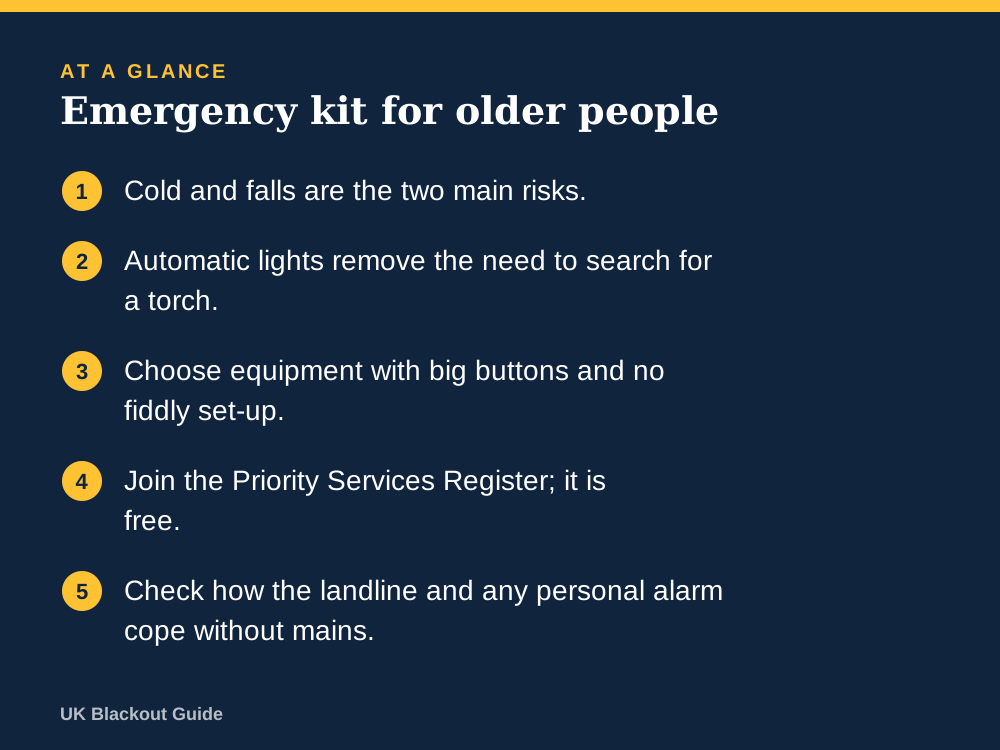
- Cold and falls are the two main risks.
- Automatic lights remove the need to search for a torch.
- Choose equipment with big buttons and no fiddly set-up.
- Join the Priority Services Register; it is free.
- Check how the landline and any personal alarm cope without mains.
The two risks to plan around are cold and falls
For a fit adult, a power cut is mostly an inconvenience. For someone older, especially living alone, two things turn it into a real hazard: a cold house and moving around in the dark.
The NHS advises heating the rooms you use to at least 18°C, and older people feel the effects of cold sooner. A trip on the stairs at night is more likely when the landing light is dead. The kit below is the standard three-day emergency kit with extra weight put on those two problems.
If you are setting this up for a parent or neighbour, supporting older relatives in a power cut also means having a few conversations in advance.
Lights that come on by themselves
The best light for an older person is one they do not have to find. Automatic power cut lights plug into a socket, stay charged, and switch on the moment the mains fails. Put one in the bedroom, one on the landing or hall, and one near the bathroom.
Many lift out of the socket to become a hand torch.
Back these up with a lantern for the living room and a torch on the bedside table. Avoid candles altogether. Official advice is that torches are safer, and a dropped candle or a sleeve near a flame is a serious fire risk.
Warmth that needs no power
Most heating stops in a power cut, including gas central heating, which needs electricity for its pump and controls. Plan to heat the person, not the house.
Keep two or three warm blankets for power cuts where they can be reached without stairs or a stepladder. Wool and thick fleece hold warmth well, and there are lighter options for people who find heavy bedding hard to manage.
Add a hat, bed socks, gloves and thermal underlayers, and stay in one room with the door and curtains closed. A vacuum flask filled with a hot drink before a planned cut helps too.
Signs of hypothermia include shivering, cold pale skin, slurred speech, confusion and tiredness. If you see these, call 999.
A radio and a phone that will still work
A battery FM radio brings news and company. Choose one that is simple: a large tuning dial or preset buttons, a clear volume knob and a loud speaker. Tune it to a local or BBC station now, so in a cut it only needs switching on.
The landline needs checking. Digital landlines run through a broadband router and need mains power, so they stop in a power cut unless there is a battery backup. Providers may give people who depend on a landline a free landline backup battery lasting at least one hour. Ask the provider.
Keep a mobile phone charged, with a power bank beside it. If there is a personal alarm pendant or other telecare device, ask the supplier how it behaves in a power cut.
Medication, equipment and things that run on mains
Try to keep at least a week of regular medication in hand, by reordering before the last few days. Write a list of every medicine, dose and time, plus GP and pharmacy numbers, and keep a copy in the kit and another on the fridge.
Then walk round the home and note anything that plugs in and matters: a stairlift, riser recliner chair, adjustable bed, oxygen concentrator, CPAP machine, mobility scooter charger. Some have battery backup and some do not, and whether stairlifts work in a power cut is a good example of what to check. For anything medical, follow the advice of the clinician or equipment supplier.
Spare hearing aid batteries, spare glasses and denture supplies are small items that make three days far easier.
Free support worth signing up for now
The Priority Services Register is free in England, Scotland and Wales. Older people qualify, as do those who rely on powered medical equipment. Being registered means your network operator knows you may need extra help during a cut. Northern Ireland has Customer Care Registers that do a similar job.
Write 105, the free power cut line, in large numbers by the phone (03457 643643 in Northern Ireland). Agree with a neighbour or relative that they will call round if the power is off for more than a couple of hours.
Make everything easy to reach and easy to use
A kit on top of a wardrobe is no kit at all. Keep it at waist height in the room where most time is spent, in a box that opens without a struggle.
Choose food that needs no cooking and opens easily: ring-pull tins, pouches, biscuits, long-life milk in small cartons. Smaller water bottles are easier to lift and pour than 5 litre ones. Label things in large print, and practise once: switch off the lights one evening and check everything can be found and operated.
Checklist
Emergency kit for older people
- Automatic power cut lights in bedroom, hall and near the bathroom
- Torch on the bedside table
- Two or three blankets within easy reach
- Simple battery FM radio, already tuned
- A week of medication and a written list of doses
- Charged mobile phone and power bank
- Landline backup battery arranged with the provider
- Priority Services Register sign-up
- 105 written large by the phone
- Ring-pull tins and small water bottles
Common questions
Is the Priority Services Register really free?
Yes. It is a free service in England, Scotland and Wales, and you can join through your supplier or network operator. Northern Ireland uses Customer Care Registers.
Should an older person stay at home in a power cut?
Usually, if they are warm, have what they need and someone is checking on them. If the home is getting dangerously cold or essential equipment has stopped, staying with family or friends is safer.
Are hot water bottles safe to use?
They can be, if filled carefully with hot (not boiling) water and in good condition. People with reduced sensation or thin skin should take particular care and may prefer extra layers instead.
What is the simplest single thing to buy first?
A plug-in automatic power cut light for the route between bed and bathroom, because it works without anyone needing to do anything.
Reviewed against these sources on 18 November 2026. If official advice has changed since, follow the official advice.
General information only. This page is not professional, safety, medical, legal or financial advice, and it is not official guidance. No national blackout has been forecast or announced, and nothing here suggests one is expected. We are independent and have no connection to the government or any energy company. Always check the official sources linked on this page. Full disclaimer
Keep reading
 Guide
Looking after older relatives in a power cut
How to prepare an older relative's home for a power cut and what to do during one: warmth, light, falls, phones, medicines and when to bring them to you.
Read: Looking after older relatives in a power cut Question
What does the government say to keep at home for a power cut?
What to buy for the blackout, according to the government: the Be Ready list of water, food, a torch, an FM radio, a power bank, medication and cash.
Read: What does the government say to keep at home Question
Why are shops selling out of torches and emergency radios?
Why some shops are reported to be selling out of torches and radios after the Be Ready launch, what the official advice is, and what to buy in their place.
Read: Why are shops selling out of torches and Guide
Blackout shopping list: what to buy first, and what can wait
What to buy for the blackout, in order: a shopping list based on the government's Be Ready kit, with what to buy first, what can wait and what to skip.
Read: Blackout shopping list: what to buy first,