On this page

Many telecare alarms keep working in a power cut for a while, because the base unit usually has a backup battery. The weak point is often the phone line. Alarms that dial out through a digital landline stop when the router loses power. Ask your alarm provider how yours connects and how long its battery lasts, and tell your phone provider you have telecare.
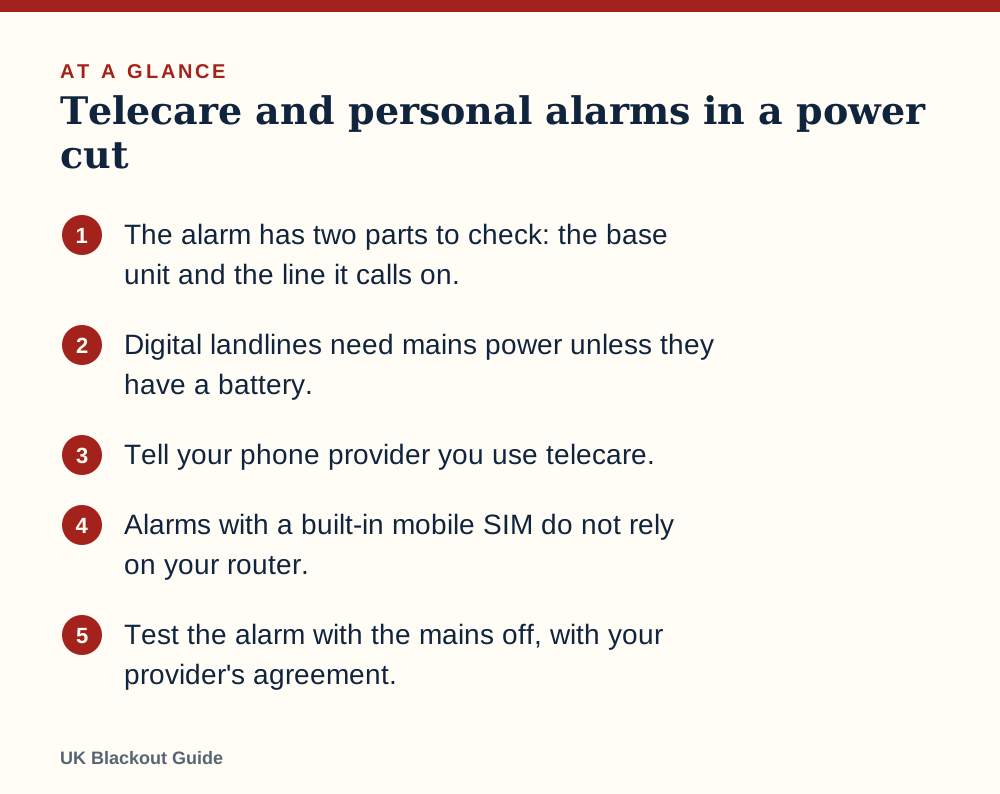
- The alarm has two parts to check: the base unit and the line it calls on.
- Digital landlines need mains power unless they have a battery.
- Tell your phone provider you use telecare.
- Alarms with a built-in mobile SIM do not rely on your router.
- Test the alarm with the mains off, with your provider's agreement.
How a telecare alarm reaches help
A pendant or wrist button does not call anyone by itself. It sends a short radio signal to a base unit plugged in somewhere in the home. The base unit then contacts a monitoring centre, where an operator speaks to you through its loudspeaker and decides who to send.
So there are three links in the chain: the button, the base unit and the connection out of the house. A power cut affects each differently.
| Link | Powered by | In a power cut |
|---|---|---|
| Pendant or fall detector | Its own small battery | Keeps working |
| Base unit | Mains, usually with a backup battery | Typically runs on its battery for a limited time |
| Connection out | Phone line, broadband or mobile network | Depends on the type. This is where most failures happen |
Why the phone line is the weak point
Older alarms were designed for the traditional copper phone network, which carried its own power from the exchange. The base unit could dial out in a power cut as long as its battery held.
The UK is replacing that network with digital landlines that run through a broadband router. A router needs mains electricity. When it goes off, the line goes with it, and an alarm that relies on that line has no way to call.
Newer alarms get round this by carrying their own mobile SIM, often one that can use more than one network. They do not need your router or landline at all. They do need a working mobile mast, and masts may only run for a limited time on backup power in a wide outage, as covered in whether mobile phones work in a power cut.
Questions to put to your alarm provider
Ring the company or council service that runs the alarm and ask these directly. Write the answers down. If you are preparing an older relative's home for a power cut, make the call with them.
- Does my base unit connect by landline, broadband or mobile network?
- Does it have a backup battery, and how long is it designed to last?
- Does the monitoring centre get a warning when my unit loses mains power or its battery runs low?
- What will you do if you get that warning and cannot reach me?
- Is my equipment compatible with a digital landline, and if not, will you replace it?
A good provider will have clear answers. If the unit is an old analogue model on a line that has been switched to digital, ask for it to be checked or swapped, since some older units do not work reliably on digital lines even with the power on.
Tell your phone and broadband provider
Phone companies are expected to take extra care with customers who depend on a landline, and telecare users are the clearest example. Tell your provider that someone in the home has a telecare alarm. They may delay a digital switchover until the alarm is confirmed to work, and they may supply a free backup battery for the landline that keeps the line going for at least an hour. Ask, even if you have already been switched.
Adding your own backup
One hour does not cover a long evening cut. You can extend it yourself with a mini UPS router battery backup, a small battery that sits between the router and its power adaptor and takes over the instant the mains fails. Routers draw only around 10 to 15 watts, so a compact unit can keep one going for several hours.
If the home has fibre, there is often a second box on the wall where the fibre comes in. That needs power as well, or the router has nothing to talk to. Back up both.
You can work out how long a UPS will run a router from its capacity and the router's draw. Bear in mind that the provider's own street equipment also needs power, so a backed-up router is a strong improvement but not a guarantee in a wide outage.
A second way to call for help
No single device should be the only route to help. Keep a charged mobile phone within reach, set to loud, with emergency contacts on the lock screen. Emergency calls can roam onto any network with signal.
Where a traditional copper line is still in place, a plain corded phone needs no mains power.
People matter as much as equipment here. Ask a nearby neighbour to knock during any power cut, and join the Priority Services Register so the network operator knows the household may need support.
Test it once, properly
Most providers ask you to press the button once a month. Once a year, do a fuller test with their agreement. Tell the monitoring centre first, switch off the mains at the base unit and router, wait a few minutes and press the pendant.
If the call connects, you know where you stand. If it does not, you have found the gap on a quiet afternoon, with time to fix it.
Common questions
Will my pendant alarm work if the electricity goes off?
The pendant itself will, and most base units have a backup battery. Whether the call gets out depends on how the unit connects, so ask your provider.
Do fall detectors need wifi?
Most home telecare fall detectors talk to the base unit by radio, not wifi. Some standalone GPS alarms use the mobile network directly.
Who pays for a landline battery backup?
Phone providers may supply one free to customers who depend on their landline, including telecare users. Ask your provider.
How will the monitoring centre know my power is off?
Many base units send an alert when they lose mains power or run low on battery, but not all. Ask your provider whether yours does.
Reviewed against these sources on 18 November 2026. If official advice has changed since, follow the official advice.
General information only. This page is not professional, safety, medical, legal or financial advice, and it is not official guidance. No national blackout has been forecast or announced, and nothing here suggests one is expected. We are independent and have no connection to the government or any energy company. Nothing here is medical advice: follow your own clinician, pharmacist or equipment supplier. Always check the official sources linked on this page. Full disclaimer
Keep reading
 Question
Can I get a free backup battery for my landline for power cuts?
Who can get a free battery backup for a digital landline, how to ask your phone provider, how long it lasts and what to do if you do not qualify for one.
Read: Can I get a free backup battery for my Buying guide
Best battery smoke alarms that work in a power cut
Battery smoke alarms that work in a power cut, chosen from Amazon UK listings on sealed battery life, stated standards, pack size and buyer ratings.
Read: Best battery smoke alarms that work in a Buying guide
Best CPAP battery backups for power cuts
CPAP battery backups for a power cut at night, chosen from Amazon UK listings on stated watt-hours, voltage and machine compatibility, with runtime maths.
Read: Best CPAP battery backups for power cuts Buying guide
Best rechargeable fans for a summer power cut
Rechargeable fans that run from their own battery in a summer power cut and top up from a power bank. Seven Amazon UK listings compared on stated runtime.
Read: Best rechargeable fans for a summer power cut