On this page
A power cut on its own is not something most home policies pay out for, but some of its consequences can be covered, depending on your policy: spoiled freezer food, electrical damage from a surge, burst pipes after the heating fails, or the cost of staying elsewhere. Cover, limits and excesses vary between insurers, so read your own schedule before you need it.
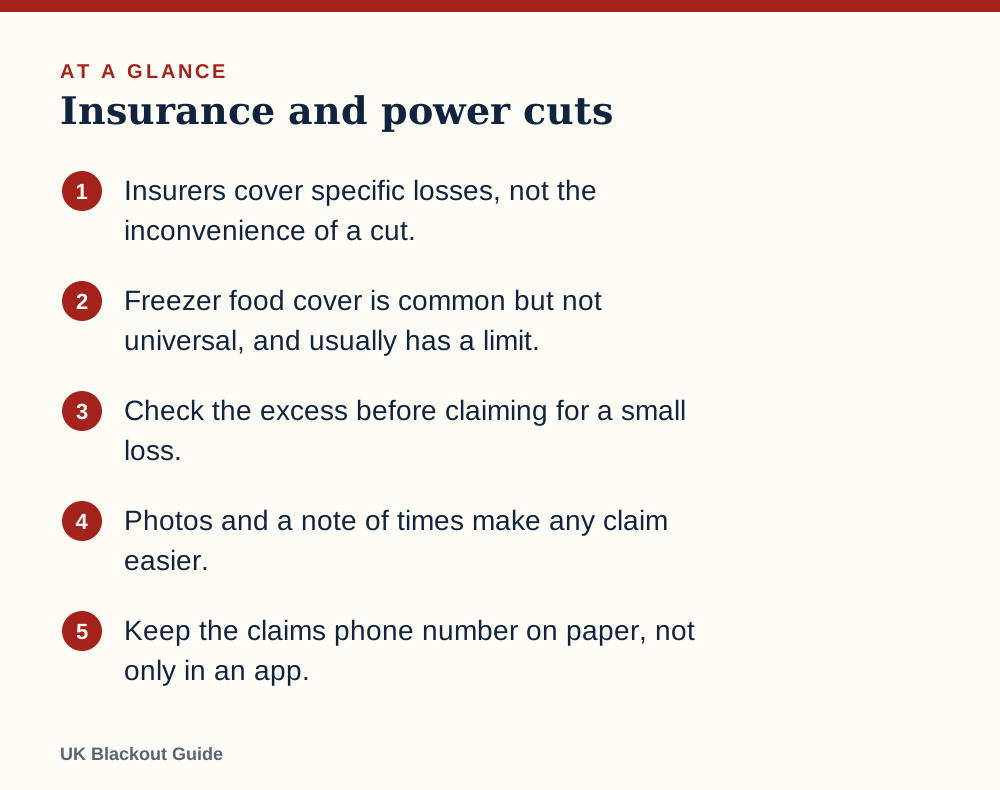
- Insurers cover specific losses, not the inconvenience of a cut.
- Freezer food cover is common but not universal, and usually has a limit.
- Check the excess before claiming for a small loss.
- Photos and a note of times make any claim easier.
- Keep the claims phone number on paper, not only in an app.
Insurance covers consequences, not the cut itself
There is no standard "power cut cover" on a household policy. What insurers deal with is loss or damage to things, from causes the policy lists. A power cut can set off several of those causes at once.
So the useful question to ask of your policy is narrower: if the electricity is off for two days, which of the things that go wrong are insured? The answer sits in two documents. The schedule lists what you bought and the limits. The policy booklet defines each cover and its exclusions.
We cannot tell you what your policy says, and nothing here is advice on which policy to buy. What follows is a list of the areas to look up.
Four parts of a home policy to look up
Freezer and fridge contents. Whether insurance covers freezer food varies. Many contents policies include food spoiled by a rise in temperature, sometimes as standard and sometimes as an optional extra. Look for the limit, whether it applies to cuts caused deliberately by the supply company, and whether the freezer's age matters.
Electrical damage. A television or computer damaged by a surge when power returns may fall under accidental damage cover, which is often an add-on. Some policies exclude electrical or mechanical breakdown. Preventing the damage is cheaper, as our guide to protecting appliances from surges explains.
Escape of water. In a winter cut with the heating off, pipes can freeze and burst unless you take steps to keep pipes from freezing. Buildings and contents policies usually list escape of water, but may apply conditions if the home was left unoccupied.
Alternative accommodation. This normally applies when insured damage makes the home unfit to live in. A cold, dark but undamaged house may not meet that test. Ask your insurer how they treat it.
Check the excess before you claim
Every claim has an excess, the first part of the loss that you pay yourself. If the food in your freezer was worth less than the excess, there is nothing to claim.
A claim can also affect your renewal price and any no-claims discount. For a modest loss, it is reasonable to ask the insurer how a claim would be treated before you decide to make one. Asking the question is not the same as claiming, but check how your insurer records such calls.
Keeping the loss small in the first place helps more than any policy. A full freezer typically stays frozen for about 48 hours if the door stays shut, according to the Food Standards Agency, and our steps for saving a freezer in a long cut can stretch your chances.
Evidence to gather while the power is off
Insurers ask for proof of what happened and what was lost. Collecting it takes ten minutes and is much easier at the time than a fortnight later.
- Note when the power went off and came back. Your network operator's website or text updates are useful confirmation.
- Photograph spoiled food before you throw it away, and list the main items with rough values.
- Photograph any damaged appliance, including its model label, and keep it until the insurer says otherwise.
- Keep receipts for anything you had to buy or pay for as a result.
A fridge-freezer thermometer that records the highest temperature reached gives you a firm answer on food safety, and supports a claim. If in doubt about any food, throw it out.
Insurance and compensation are separate
Do not confuse an insurance claim with compensation from your network operator. Under Ofgem's Guaranteed Standards, the operator may owe you a fixed payment if an unplanned cut lasts longer than a set time. That payment does not depend on having insurance and is not based on your losses.
You can pursue both. How power cut compensation works explains the claim process and where to find the current rules.
Cars, home businesses and equipment you add
Working from home. A standard home policy is written for domestic use. Business equipment, stock and lost income are usually outside it unless you have told the insurer or hold separate business cover.
Generators and fuel. If you buy a generator or store petrol, check whether your insurer needs to know. The Health and Safety Executive allows up to 30 litres of petrol at home in suitable containers without notifying anyone, but your policy may have its own conditions. How much petrol you can store at home has the storage rules.
Cash at home. Contents policies normally limit how much cash is covered. If you keep an emergency float, compare it with that limit. A lockable box is sensible either way, and our cash box picks show the options.
Cars. Motor policies are largely unaffected by a power cut, though driving with traffic lights out needs care.
Do this before the next cut
Find your schedule tonight. Write the policy number and the claims phone number on your paper contact sheet, because an insurer's app is no use with a flat phone. Put a copy of the schedule with the other documents worth copying.
Then look up the four areas above and note the limits. If something you assumed was covered is not, you can ask your insurer about adding it at renewal, or simply plan around the gap.
Common questions
Does home insurance pay out for a power cut?
Not for the cut itself. Some policies pay for specific results of one, such as spoiled freezer food or surge damage, subject to limits and the excess.
Will my insurer pay for a hotel if my house is too cold?
Alternative accommodation cover usually depends on insured damage making the home uninhabitable. Ask your insurer how they treat a home with no heating but no damage.
Should I tell my insurer I have a portable power station or generator?
Check your policy conditions or ask. Requirements differ, and it is better to know before a claim than after.
Reviewed against these sources on 18 November 2026. If official advice has changed since, follow the official advice.
General information only. This page is not professional, safety, medical, legal or financial advice, and it is not official guidance. No national blackout has been forecast or announced, and nothing here suggests one is expected. We are independent and have no connection to the government or any energy company. Always check the official sources linked on this page. Full disclaimer
Keep reading
 Buying guide
Best cash boxes for emergency cash at home
Lockable cash boxes for keeping emergency notes and coins ready at home for when card payments fail in a power cut. Eight Amazon UK listings compared.
Read: Best cash boxes for emergency cash at home Buying guide
Best fireproof document bags for emergency paperwork
Fire-resistant document bags for emergency paperwork: keep passports, policies, contacts and cash ready to grab. Seven Amazon UK listings compared.
Read: Best fireproof document bags for emergency Buying guide
Best multi-tools for home emergencies
Multi-tools for home emergencies: pliers, screwdrivers and a tin opener for the small jobs a power cut throws up. Seven Amazon UK listings compared.
Read: Best multi-tools for home emergencies Question
Do smart locks work in a power cut?
Most smart locks run on batteries and still lock and unlock in a power cut, but remote app control stops. What keeps working and how to avoid a lockout.
Read: Do smart locks work in a power cut?