On this page
You can store up to 30 litres of petrol at home without notifying anyone, according to the Health and Safety Executive. It must be in suitable containers (plastic ones up to 10 litres, metal ones up to 20 litres) and kept in a garage or shed, never in the living space of your home.
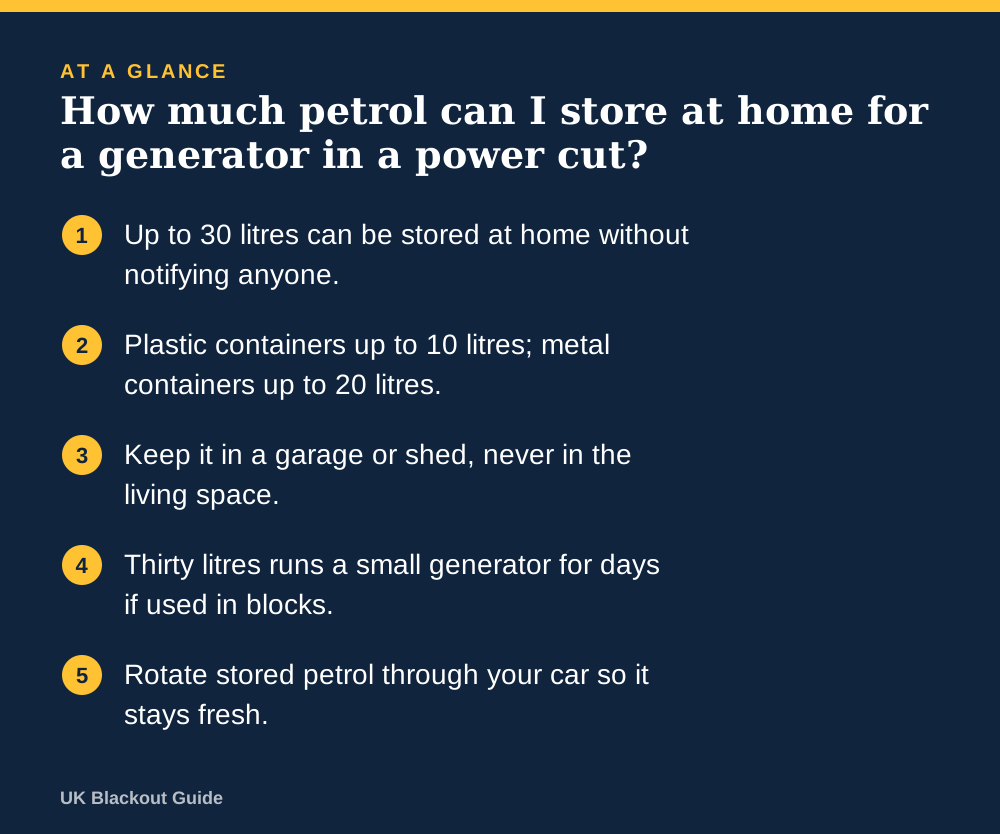
- Up to 30 litres can be stored at home without notifying anyone.
- Plastic containers up to 10 litres; metal containers up to 20 litres.
- Keep it in a garage or shed, never in the living space.
- Thirty litres runs a small generator for days if used in blocks.
- Rotate stored petrol through your car so it stays fresh.
The three parts of the rule
The HSE guidance for households comes down to quantity, container and place.
- Quantity: up to 30 litres without notifying anyone.
- Container: suitable portable containers made for petrol. Plastic containers can be up to 10 litres each, metal ones up to 20 litres each.
- Place: a garage or shed, not the living space of the home.
Storing more than 30 litres brings extra legal requirements. If you think you need more, read the HSE's petrol storage guidance before you buy another can. For most households preparing for power cuts, 30 litres is plenty.
What counts as a suitable container
Use containers designed and sold for petrol, with a secure cap and clear labelling. A green plastic 5 or 10 litre can or a metal 20 litre jerry can from a motoring shop is what the rule has in mind.
Old water bottles, milk cartons and paint tins are not suitable. Petrol attacks some plastics, vapour escapes from poor seals, and an unlabelled bottle of clear liquid is a danger to everyone in the house. Leave a little air space in each can and keep the caps tight.
A sensible way to reach 30 litres would be one 20 litre metal can and one 10 litre plastic can, or three 10 litre plastic cans, which are much easier to lift and pour.
Where to keep it and where not to
Petrol vapour is heavier than air and catches fire easily, so the store must be outside the rooms you live in. A detached garage or a shed is best. Keep the cans out of direct sun, away from boilers, freezers, tools that spark and anything with a pilot light, and out of the reach of children.
Do not keep petrol in the house, under the stairs, in a cellar or in a loft. In a flat with no garage or shed, you have no suitable place to store petrol, and a battery power station is the better form of backup. Whether it is safe to store fuel at home looks at the risks in more detail.
Never refuel a generator indoors or while it is hot, a basic rule of safe generator use, and never smoke or use a naked flame near stored petrol. In a power cut, use a torch in the garage, not a candle.
How far 30 litres goes in a power cut
A small inverter generator on a light load uses roughly half a litre an hour. Run constantly, 30 litres would last about two and a half days. Run in three two-hour blocks a day, enough to keep a fridge-freezer cold and recharge phones and lanterns, the same petrol lasts about ten days. How much fuel a generator uses shows how to work this out for your own model.
You may not be able to buy more during a wide outage, because petrol station pumps need mains electricity. Keeping the car's tank above half is a simple habit that gives you a second reserve for travel.
Petrol does not keep indefinitely. Every few months, pour your oldest can into the car and refill it, so nothing in the store is ever very old. If you are choosing a generator to go with your fuel store, the best generators for power cuts lists economical inverter models.
Common questions
Do I need to tell anyone if I store petrol at home?
Not for up to 30 litres. Above that, extra legal requirements apply, so check the HSE guidance first.
Can I store petrol in a flat?
Not safely. The rules say petrol must be kept in a garage or shed and not in the living space. Without one, choose battery backup instead of a generator.
Are the rules the same for diesel?
The limits described here are for petrol. Check HSE guidance for other fuels, and store any fuel outside the living space in containers made for it.
Reviewed against these sources on 18 November 2026. If official advice has changed since, follow the official advice.
General information only. This page is not professional, safety, medical, legal or financial advice, and it is not official guidance. No national blackout has been forecast or announced, and nothing here suggests one is expected. We are independent and have no connection to the government or any energy company. Anything involving electricity, gas, fuel or food safety should be checked with a qualified professional or the relevant official body before you act on it. Always check the official sources linked on this page. Full disclaimer
Keep reading
 Guide
Backup power for your home: every option compared
Power banks, power stations, generators, solar panels, cars and UPS units compared: what each can run in a UK power cut, for how long, and who needs which.
Read: Backup power for your home: every option Guide
Which batteries to keep at home, and how to store them
Which battery sizes and types to keep at home for power cuts, how many spares you need, and how to store alkaline, rechargeable and lithium cells safely.
Read: Which batteries to keep at home, and how to Buying guide
Best car inverters for power cuts
Car inverters for power cuts: six units from Amazon UK listings that run a laptop, router or lamp from your car's 12V socket, with the limits explained.
Read: Best car inverters for power cuts Buying guide
Best generators for power cuts
Petrol inverter generators for UK power cuts, from 1,200 W to 5,500 W, chosen from Amazon UK listings, with the carbon monoxide and wiring rules.
Read: Best generators for power cuts