On this page
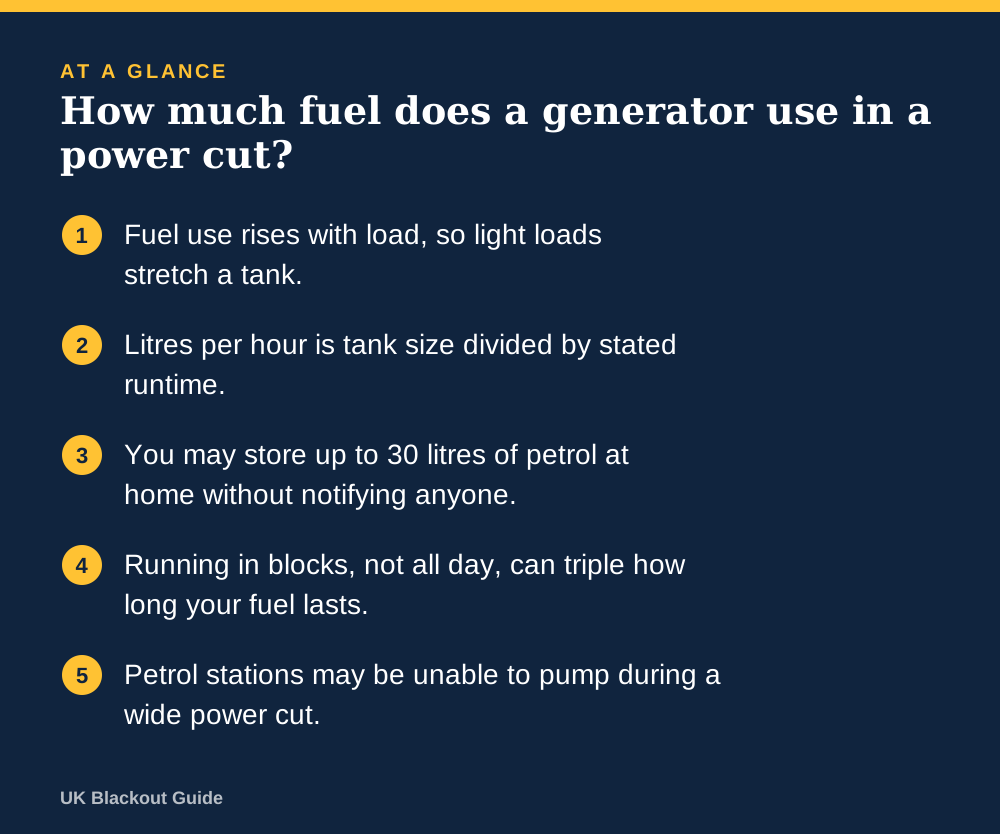
It depends on the generator's size and how hard it is working. As a rough guide, a small 2,000 W inverter generator uses somewhere between half a litre and one litre of petrol an hour, and less at light loads. Divide the tank size by the stated runtime on the spec sheet to get the real figure for your model.
- Fuel use rises with load, so light loads stretch a tank.
- Litres per hour is tank size divided by stated runtime.
- You may store up to 30 litres of petrol at home without notifying anyone.
- Running in blocks, not all day, can triple how long your fuel lasts.
- Petrol stations may be unable to pump during a wide power cut.
Work it out from the spec sheet
Manufacturers rarely print litres per hour. They give a tank size and a runtime at a stated load, usually 25 or 50 per cent, the two figures given for each of our best generators for power cuts. Divide one by the other.
Say the sheet for a 2,000 W inverter generator gives a 4 litre tank and 8 hours at 25 per cent load. That is 0.5 litres an hour while supplying about 500 W. If the same sheet gives 4 hours at 50 per cent load, that is 1 litre an hour at 1,000 W. Your own model's numbers will differ, so run the sum with its figures.
Larger open-frame generators use noticeably more, partly because their engines are bigger and partly because many run at a fixed speed whatever the load. Sizing one to your real needs, as in our home backup generator explainer, keeps that in check.
Why the load matters so much
An inverter generator with an economy mode slows its engine when demand is low. Supplying a fridge-freezer (40 to 80 W on average), a router (10 to 15 W) and a few LED lamps (5 to 10 W each) is a very light load, and fuel use falls towards the bottom of the range.
Plug in a 2,000 W fan heater or a 3,000 W kettle and the engine works flat out, if it can supply them at all. Keeping heating appliances off the generator is the single biggest fuel saving. How many watts typical appliances use will help you plan a sensible load.
How long your stored petrol will last
Under the HSE rules on how much petrol you can legally store at home, you can keep up to 30 litres without notifying anyone, in suitable containers and not in the living space.
| Pattern of use | Fuel a day at 0.5 l/hour | 30 litres lasts |
|---|---|---|
| Running 24 hours a day | 12 litres | 2.5 days |
| 12 hours a day | 6 litres | 5 days |
| Three 2-hour blocks | 3 litres | 10 days |
The last row is the one to aim for. A fridge-freezer holds its temperature between sessions if the doors stay shut, and two hours is enough to recharge phones, power banks and lanterns. Running in blocks is also kinder to the neighbours.
Planning for a long outage
Do not count on topping up. Forecourt pumps need electricity, so petrol stations may not be able to serve in a wide-area cut, and card payments may be down too. The fuel you have at the start may be all you get for a while.
Petrol also goes stale in storage, so rotate it: pour the oldest can into the car every few months and refill the can. Start the generator briefly a few times a year so you know it runs.
Run a generator outdoors only, well away from doors and windows. Carbon monoxide has no smell and can kill. Let the engine cool before refuelling.
If the fuel logistics put you off, a power station may suit you better than a generator.
Common questions
Does a generator use fuel when nothing is plugged in?
Yes. An idling engine still burns petrol, though an inverter model in economy mode uses much less. Switch it off between sessions.
Is a bigger generator less efficient for small loads?
Generally yes. A large engine running a small load wastes fuel. Size the generator to what you will really run.
Can I refuel a generator while it is running?
No. Switch it off and let it cool first. Petrol spilled on a hot engine or exhaust can ignite.
Reviewed against these sources on 18 November 2026. If official advice has changed since, follow the official advice.
General information only. This page is not professional, safety, medical, legal or financial advice, and it is not official guidance. No national blackout has been forecast or announced, and nothing here suggests one is expected. We are independent and have no connection to the government or any energy company. Anything involving electricity, gas, fuel or food safety should be checked with a qualified professional or the relevant official body before you act on it. Always check the official sources linked on this page. Full disclaimer
Keep reading
 Guide
Backup power for your home: every option compared
Power banks, power stations, generators, solar panels, cars and UPS units compared: what each can run in a UK power cut, for how long, and who needs which.
Read: Backup power for your home: every option Buying guide
Best generators for power cuts
Petrol inverter generators for UK power cuts, from 1,200 W to 5,500 W, chosen from Amazon UK listings, with the carbon monoxide and wiring rules.
Read: Best generators for power cuts Guide
Generator safety: carbon monoxide, fuel and wiring
How to use a generator safely in a power cut: where to put it, carbon monoxide, storing and handling petrol, wet weather and house wiring rules.
Read: Generator safety: carbon monoxide, fuel and Guide
Generators for home backup: types, cost and safety
The types of generator for home backup in the UK, what they really cost to own, how much they can run, and the safety rules you must follow.
Read: Generators for home backup: types, cost and