On this page
A blackout is a loss of electricity across a wide area, such as a region or a whole country, rather than a few streets. A power cut is the everyday term for any loss of supply, usually local and short. A brownout is a drop in voltage where the power stays on but weakens. The National Risk Register rates a national outage as low likelihood.
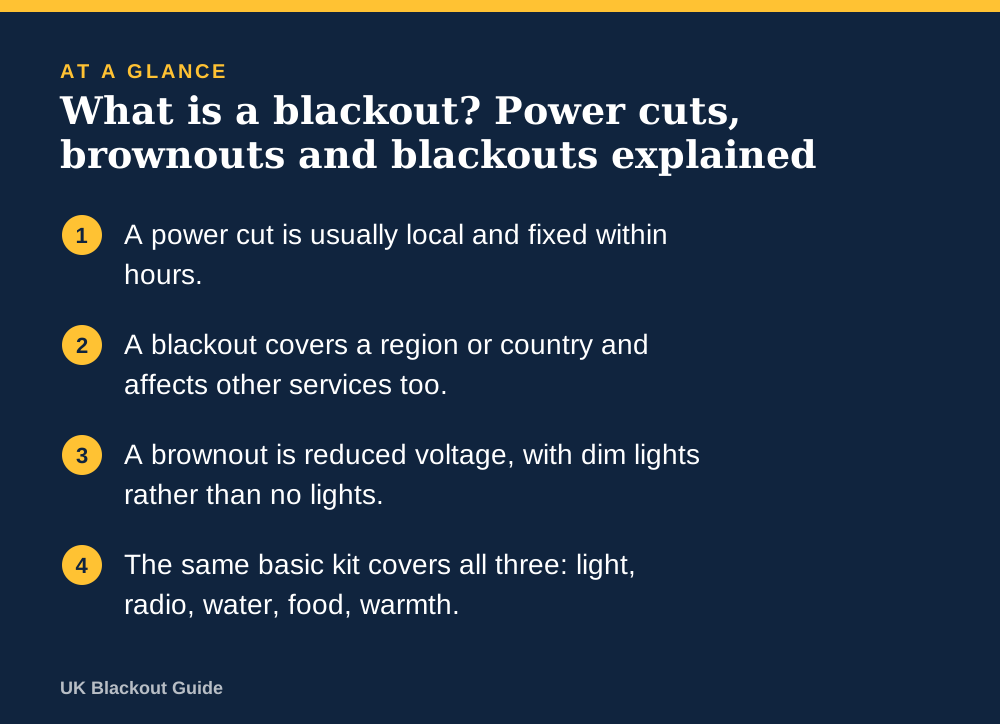
- A power cut is usually local and fixed within hours.
- A blackout covers a region or country and affects other services too.
- A brownout is reduced voltage, with dim lights rather than no lights.
- The same basic kit covers all three: light, radio, water, food, warmth.
Three words that get mixed up
News reports use power cut, outage, brownout and blackout as if they were the same thing. They describe different sizes of problem, and the size is what decides how you cope.
| Term | What happens | Typical scale |
|---|---|---|
| Power cut (or outage) | Supply stops completely | A house, a street, a town |
| Rota power cut | Supply is switched off on purpose, by area, on a timetable | Blocks of homes in turn, about three hours at a time |
| Brownout | Supply continues at lower voltage | Anything from a neighbourhood to a region |
| Blackout | Supply stops across a wide area | A region or a whole country |
There is no legal definition that separates a big power cut from a small blackout. In everyday use, people say blackout once the area affected is so large that help cannot simply arrive from the next town. A shorter comparison is in our answer on how a power cut differs from a blackout.
Power cuts are local faults
Most power cuts in the UK start with a fault on the local network: a cable damaged by roadworks, a tree on an overhead line, a blown fuse at a substation. Your network operator sends engineers, and most homes are back on within hours.
During a local cut, everything outside the affected area carries on. Mobile masts a few miles away still work, shops in the next town are open and the water keeps flowing. That is the main reason an ordinary power cut is an inconvenience rather than an emergency. The causes are covered in more detail in what causes power cuts in the UK.
Rota power cuts are a special case. In a national energy shortage, supply could be switched off deliberately in turn, by load block letter, for about three hours at a time. They are planned and announced, and they are explained in our guide to rota cuts and load blocks.
Brownouts are weak power, and rare here
In a brownout the electricity stays on but the voltage sags. Filament and halogen lamps dim, motors run slower and some electronics switch themselves off. The name comes from the way old light bulbs faded to a dull brown-orange glow.
Brownouts are a familiar part of life in some countries with stretched grids. In Great Britain they are unusual. A small, controlled voltage reduction is one of the tools a grid operator can use to trim demand, and most households would not notice it.
If your lights dim sharply and stay dim, switch off sensitive equipment such as computers and televisions until the supply steadies, then report it on 105.
A blackout is defined by what else fails
Once the area without power gets large enough, the services that normally cushion a power cut begin to struggle too. Mobile masts run on backup power for a limited time. Card machines and cash machines need electricity and a data connection. Water pumping, fuel pumps and trains all depend on the grid somewhere along the line.
The government's National Risk Register describes a national power outage as low likelihood but very high impact, with knock-on effects on water, mobile, internet, fuel, payments and transport. You may also see the term Black Sky for a prolonged, wide-area outage of this kind, which we explain in what a Black Sky event means.
The order in which services tend to drop away is set out in what stops working in a blackout. Knowing that order is more useful than any single gadget.
What has happened in the UK
Local power cuts happen every day somewhere in the country. Larger events are on record too. On 9 August 2019 a lightning strike followed by the loss of two generators disconnected about 1 million customers, most for under an hour. Storm Arwen in November 2021 cut power to about 1 million customers, and some rural homes were off for more than a week.
A full national blackout is a different matter. The National Risk Register describes a national outage as low likelihood but very high impact, and no national blackout has been forecast or announced. The system operator, NESO, is required to have the capability by 31 December 2026 to restore 60% of demand in each region within 24 hours and all of Great Britain's demand within five days. What the rating means is set out in how likely a national blackout really is.
What the difference means at home
For the first few hours, a blackout and a power cut look identical from your sofa. The lights are off and you do not know why. The steps are the same too: check your fuse box, check with a neighbour, call 105, and follow the basic power cut routine.
The difference is how long you may need to manage alone. The government's Be Ready campaign asks households to be able to manage for three days, as general preparedness and not a forecast. Start with light. Be Ready's own advice is that torches are safer than candles, and one torch per person is a sensible target. Our round-up of torches for power cuts sets out the options.
The second item is information. Your broadband router stops with the mains, and Be Ready says mobile networks may work only temporarily in some areas on backup power. The BBC has described how it would keep broadcasting on FM from an emergency studio with generator-backed transmitters. A battery or wind-up set, like those in our guide to wind-up radios, is how you would hear it.
After light and news come water, food and warmth. The full emergency kit list covers those in the order most households should buy them.
Common questions
Is an outage the same as a power cut?
Yes. Outage is the term network companies and engineers use, and power cut is the everyday British phrase. Both mean the supply has stopped.
Can a brownout damage appliances?
Low voltage can strain motors and upset electronics. If your lights dim noticeably and stay dim, switch off sensitive equipment until the supply recovers.
Does a blackout mean the gas goes off too?
Not directly, but most gas boilers need electricity for their controls and pump, so central heating usually stops when the power does.
Who decides when a power cut becomes a blackout?
Nobody. There is no official threshold. Blackout is a common word for a power cut that covers a very wide area.
- Be Ready campaign, UK government
- National Risk Register, Cabinet Office
- National Energy System Operator (NESO)
- Power Cut 105
Reviewed against these sources on 18 November 2026. If official advice has changed since, follow the official advice.
General information only. This page is not professional, safety, medical, legal or financial advice, and it is not official guidance. No national blackout has been forecast or announced, and nothing here suggests one is expected. We are independent and have no connection to the government or any energy company. Always check the official sources linked on this page. Full disclaimer
Keep reading
 Explainer
How the BBC plans to keep broadcasting in a blackout
A BBC report on 7 November 2026 set out how it would keep broadcasting on FM radio through a long blackout. What it said and what radio you need to hear it.
Read: How the BBC plans to keep broadcasting in a Explainer
The government's Be Ready campaign: what it asks households to do
The government's Be Ready campaign, launched 22 October 2026, asks every household to be able to manage for three days. The full kit list and what it means.
Read: The government's Be Ready campaign: what it Explainer
'Black Sky' planning: what the reports actually say
What the autumn 2026 'Black Sky' reports are based on: the Be Ready launch, a BBC report on emergency broadcasting, and long-standing national risk planning.
Read: 'Black Sky' planning: what the reports Question
Do mobile phones work in a power cut?
Your mobile keeps working while its battery lasts, but masts rely on backup power that may only hold temporarily. What to expect and how to stay in touch.
Read: Do mobile phones work in a power cut?