On this page
The Microsoft 365 outage began at 4.20pm UK time on Thursday 12 November 2026 and lasted just under 24 hours. Outlook email was hit hardest, with Teams and Copilot partly affected. Microsoft's preliminary report blames a hidden software defect in its network gateway servers, exposed by extra load and reduced capacity. Microsoft said it was not a cyber attack.
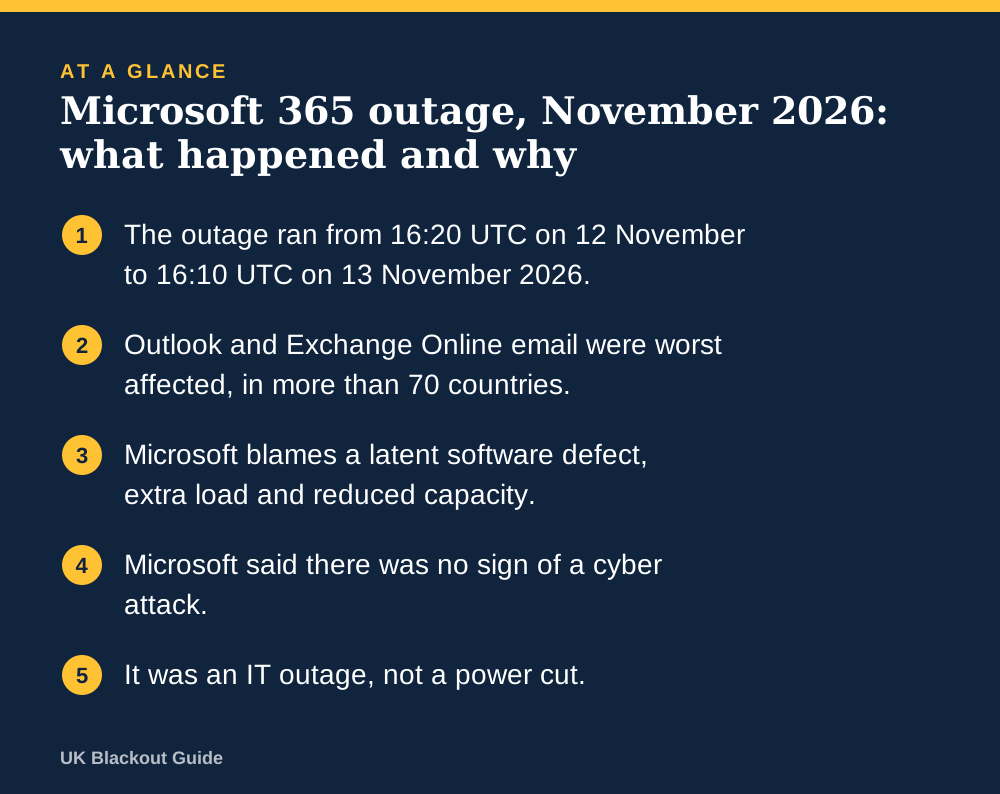
- The outage ran from 16:20 UTC on 12 November to 16:10 UTC on 13 November 2026.
- Outlook and Exchange Online email were worst affected, in more than 70 countries.
- Microsoft blames a latent software defect, extra load and reduced capacity.
- Microsoft said there was no sign of a cyber attack.
- It was an IT outage, not a power cut.
What happened to Microsoft 365
On the afternoon of Thursday 12 November 2026, people around the world found they could not open their Outlook mailboxes on the web, in the desktop app or on their phones. Al Jazeera reported that within about an hour Downdetector had fault reports from 74 countries and territories.
The fault was in Exchange Online, the email service behind Outlook. Other Microsoft 365 services that lean on it, including Copilot, Teams, SharePoint and OneDrive, were partly disrupted. Teams chats and meetings mostly kept working. It followed the Azure outage of July 2026, which lasted about five hours and mainly affected Microsoft 365 users in North America.
When it started and how long it lasted
Microsoft's preliminary incident report, summarised by Office Watch, gives a start time of 4.20pm UTC on 12 November and says customers were no longer seeing active impact at 4.10pm UTC on 13 November. UTC is the same as UK time in November, so the outage lasted just under 24 hours.
Recovery came in stages on the Friday. According to the same summary, Microsoft applied a fix at 7.20am UTC, Europe returned to healthy levels at 11.35am and webmail was back to expected levels worldwide by 2.17pm. Fortune later reported that service was restored for all remaining customers on Saturday 14 November. Two days after that, the US banks outage began at JPMorgan Chase, and the reports on that event did not link it to Microsoft.
Who and what was affected
Microsoft has not said how many people were affected. By 7am on Friday, Downdetector showed at least 43,000 reports about Outlook from 72 countries, Al Jazeera reported, and the true number of people affected is likely to be far higher because most users never file a report. For scale, Microsoft estimated that the CrowdStrike outage of July 2024 crashed 8.5 million Windows devices, and that was not a fault in Microsoft's own software.
Al Jazeera reported disruption to government systems in Singapore and Japan, to communications at the Supreme Court of the Philippines, and to agencies in Australia. Any UK workplace, school or charity that uses Microsoft 365 for email would have seen the same symptoms. Email sent to affected mailboxes was delayed, not lost, according to the summary of Microsoft's report.
The cause, as stated by Microsoft
Microsoft executive Charles Lamanna set out three factors in a public post, reported by ITPro. The first was a latent defect, a bug that had sat unnoticed in the gateway servers that carry traffic to Microsoft 365 since an update in July 2026. Under certain loads it made those servers lock up. A dormant fault was likewise the trigger for the AWS outage of October 2025, which AWS traced to a rare timing bug in its own automation.
The second was a jump in load. About 15 hours before the outage, Teams traffic moved onto the same gateway that serves Exchange Online, which Microsoft describes as a normal operation. The third was reduced capacity: nearly 14% of gateway servers were out of service because of an unrelated issue the day before.
Together these triggered the bug. As servers failed, their traffic was sent to the remaining ones, which then failed in turn. Microsoft says more than 80% of the servers were unresponsive at the lowest point. Mr Lamanna said there was no indication of malicious or cyber activity. A final review is due within five business days of the fix.
What customers were told
Microsoft posted updates through its service health dashboard and on social media, and apologised. It said nothing needed fixing on users' own devices because the defect was in its servers. People who sent important messages from a phone on 12 or 13 November were advised to check they arrived.
When a service this large fails, fake support messages often follow, so treat unexpected offers of help with caution.
What this does and does not tell us about power cuts
This was an IT outage inside Microsoft's own network. It was not a power cut and it did not cause one in the UK. Microsoft said it was not a cyber attack, and no official body has said a cyber attack on the UK electricity grid is expected.
It is still a useful reminder that email, calendars and saved documents can become unreachable for a day with the lights on. The same would be true in a long power cut, for different reasons, as our page on whether the internet works in a power cut explains. A printed list of phone numbers costs nothing and works in both cases.
Payments deserve the same kind of backup, and our page on keeping some cash at home explains the Be Ready campaign's suggestion of cash in notes and coins.
Common questions
Was the Microsoft 365 outage a cyber attack?
Microsoft said it was not. Its preliminary report blames a software defect in its own gateway servers, combined with extra load and reduced capacity.
Did people lose emails in the Microsoft outage?
According to the summary of Microsoft's preliminary report, incoming email was delayed, not lost. Messages sent from phones during the outage may have failed, so check anything important.
Has Microsoft had other outages in 2026?
Yes. Al Jazeera noted a North America outage in January 2026, and a separate Azure network outage on 23 July 2026 also disrupted Microsoft 365.
- Al Jazeera: Microsoft hit by global outages: What happened and why?
- ITPro: Microsoft 365 outage: Company exec lifts lid on the cascading failure that caused lengthy disruption
- Office Watch: Microsoft 365 outage: what went wrong, in plain English
- Fortune: Chase, Wells Fargo and Capital One bank outages (context on Microsoft restoration)
Reviewed against these sources on 18 November 2026. If official advice has changed since, follow the official advice.
General information only. This page is not professional, safety, medical, legal or financial advice, and it is not official guidance. No national blackout has been forecast or announced, and nothing here suggests one is expected. We are independent and have no connection to the government or any energy company. Always check the official sources linked on this page. Full disclaimer
Keep reading
 News
Microsoft Azure outage, July 2026: what happened and why
The Microsoft Azure outage of 23 July 2026 disrupted Microsoft 365, Teams and Azure for about five hours. Microsoft blamed a bug in automated network maintenance.
Read: Microsoft Azure outage, July 2026: what News
US banks outage, November 2026: what happened and why
The US banks outage of 16 November 2026: JPMorgan Chase blamed a software bug, not a cyber attack. What failed, who was affected and what it means in the UK.
Read: US banks outage, November 2026: what happened News
CrowdStrike outage, July 2024: what happened and why
The CrowdStrike outage of 19 July 2024 crashed about 8.5 million Windows computers worldwide, hitting GP surgeries and airlines. What happened and why.
Read: CrowdStrike outage, July 2024: what happened News
Amazon Web Services outage, October 2025: what happened and why
The Amazon Web Services outage of 20 October 2025 disrupted Lloyds, HMRC, Snapchat and many more. AWS blamed a DNS fault in its DynamoDB database service.
Read: Amazon Web Services outage, October 2025: