On this page
- In pictures
- Great Britain has never lost the whole grid
- The 9 August 2019 power cut: what happened and how long it lasted
- Lancaster, December 2015: a city without power after Storm Desmond
- Storm Arwen, November 2021: rural homes off for more than a week
- What failed each time: phones, cash machines, card payments and trains
- What helped households each time: radio, cash, light and warmth
- What these events do and do not tell us about a national outage
- What the government has said since
- What a short cut asks of a household
- What people who lived through them say to keep: budget, mid-range and high-end
- Checklist
- What the research found
- Our data: what this costs
- Common questions
No. Great Britain's modern grid has never had a complete national shutdown. The largest cuts were regional: about 1 million customers on 9 August 2019, most back within an hour; about 1 million in Storm Arwen in 2021, with some rural homes off for over a week; and about 61,000 properties in Lancaster in 2015. The 1970s cuts were planned rota cuts.
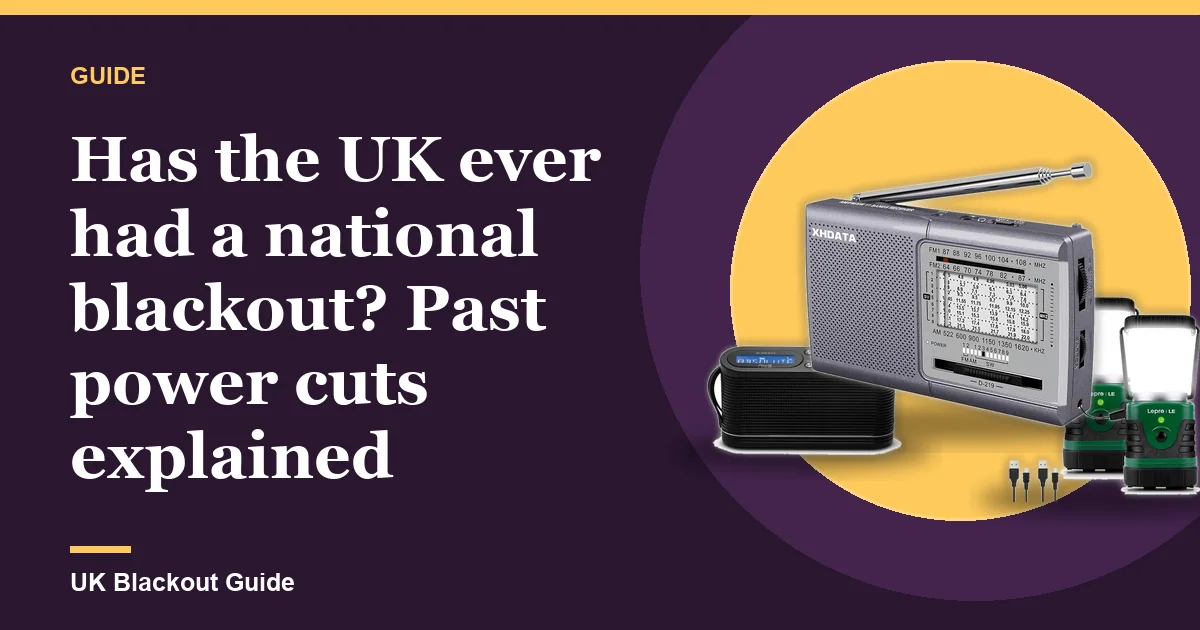
 Roberts PLAY10 FM/DAB/DAB+ Portable Radio★ 4.5 from 5,500 buyers · About £40Check price on Amazon
 XHDATA D219 Portable FM AM SW Radio★ 4.4 from 5,800 buyers · About £18.98Check price on Amazon
 LE Rechargeable Camping Light, 2-Pack★ 4.6 from 33,400 buyers · About £53Check price on Amazon
Chosen from Amazon UK listings on specification, price and buyer ratings. Not hands-on tested. We earn a commission if you buy.
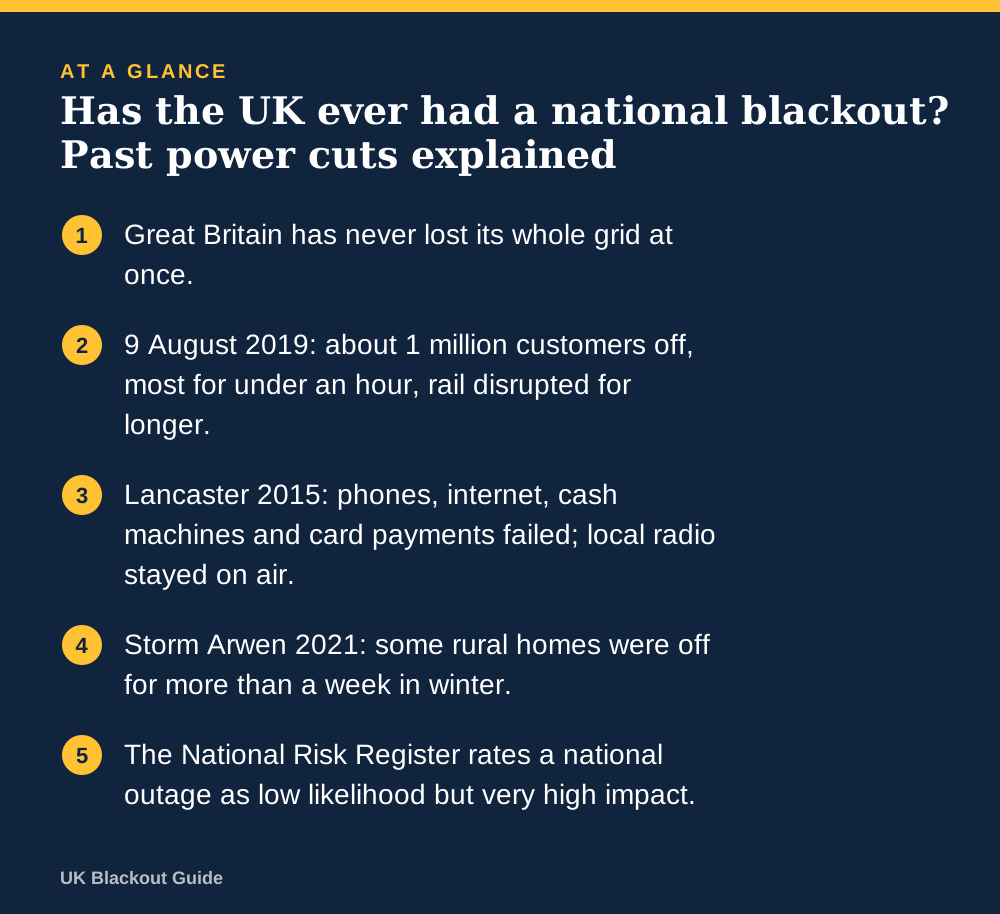
- Great Britain has never lost its whole grid at once.
- 9 August 2019: about 1 million customers off, most for under an hour, rail disrupted for longer.
- Lancaster 2015: phones, internet, cash machines and card payments failed; local radio stayed on air.
- Storm Arwen 2021: some rural homes were off for more than a week in winter.
- The National Risk Register rates a national outage as low likelihood but very high impact.
In pictures: the numbers that matter
Great Britain has never lost the whole grid
No. The modern electricity grid in Great Britain has never suffered a complete national shutdown. The country has had large regional power cuts, including about 1 million customers disconnected on 9 August 2019 and about 1 million who lost power in Storm Arwen in November 2021, but none of them blacked out the whole country at once.
| Event | Scale | How long | Cause |
|---|---|---|---|
| Lancaster, December 2015 | About 61,000 properties | A local outage, with phones and payments also down | Storm Desmond flooded a substation |
| 9 August 2019 | About 1 million customers | Under an hour for most | Lightning strike, then loss of two generators |
| Storm Arwen, November 2021 | About 1 million customers | More than a week for some rural homes | Wind damage to overhead lines |
Each of these was serious for the people involved, and each was regional. At every point most of the country still had power, and engineers and supplies could be brought in from unaffected areas.
Older readers will remember the rota power cuts of the 1970s, when electricity was rationed by area. Those were planned and scheduled; the system itself did not fail. The modern equivalent, in which planned cuts in a national energy shortage could last about three hours at a time by load block letter, is set out in how rota power cuts work.
Northern Ireland's grid is separate from Great Britain's. This page covers the British system, which has not had a total shutdown.
Power cut or blackout
In everyday speech any large cut is a blackout. In the technical sense, a blackout means the system itself has shut down and has to be restarted from nothing, which is what has never happened here. The difference, and why it matters when you read headlines, is explained in what a blackout is.
The 9 August 2019 power cut: what happened and how long it lasted
On 9 August 2019 a lightning strike on the network was followed by the loss of two generators. About 1 million customers were disconnected, most of them for under an hour. The grid did not shut down, but the knock-on disruption to the railway lasted far longer than the cut itself.
The sequence of events
Lightning strikes on power lines are routine, and the system is built to ride through them. On this occasion the strike was followed by the loss of two generators almost at once, which left the system short of power.
Why losing two generators switched off homes
Any electricity grid has to balance supply and demand second by second. The measure of that balance is frequency, held close to 50 Hz in Great Britain. If a large amount of generation disappears suddenly, demand outstrips supply and the frequency falls. That is dangerous for the whole system, because power stations protect themselves by disconnecting if it drops too far, which could turn a shortfall into a full shutdown.
To prevent that, the network has automatic protection that sheds a share of demand when frequency falls below a set level. That is what the 1 million disconnections were: part of the load was switched off automatically so the rest of the system could stay up. It worked. The grid stabilised, and most disconnected customers were back within the hour.
Why the railway took the hardest hit
There was major rail disruption. A railway does not recover the moment its supply returns: once services stop, trains and crews are out of position, and the timetable takes hours to rebuild. A short electrical event became a long evening for many travellers.
Two ways to read the day
One reading is reassuring: a rare combination of faults hit the national system, the automatic defences did their job, and nearly everyone was back within an hour. The other is more sober: an interruption of under an hour was enough to cause rail disruption that lasted much longer. Both describe one day. Neither tells you how likely a wider outage is.
Lancaster, December 2015: a city without power after Storm Desmond
In December 2015 flooding from Storm Desmond swamped a substation serving Lancaster and the surrounding area, and about 61,000 properties lost their electricity. The cause was simple and physical. Nothing went wrong with the national grid and there was no shortage of power in the country: a single piece of local equipment was under water, and everything downstream of it went dark.
Storms and floods are a familiar cause of longer cuts in the UK, alongside cable faults and equipment failures, as what causes power cuts explains.
Lancaster is remembered less for the darkness than for what else stopped. Mobile phone networks failed locally, home and business internet went down, cash machines stopped and shops could not take card payments. People could not ring relatives, look up news, withdraw money or pay by card, all at the same moment.
One service kept going. The Bay, the local commercial radio station, carried on broadcasting using a generator. Anyone with a battery radio or a car radio could follow what was happening; anyone relying on a smartphone, smart speaker or mains-only set could not.
The area was small compared with a national outage, and the rest of the country was working normally a short drive away. It is described here as what happened, not as a sign of what will happen elsewhere.
Storm Arwen, November 2021: rural homes off for more than a week
Storm Arwen arrived in November 2021 and about 1 million customers lost their electricity. Most were reconnected well before the last homes were. For a smaller group it was far longer: some rural homes in northern England and Scotland were without power for more than a week, in winter, with no heating controls, no lighting through long nights and in many cases no way to cook.
Nothing failed at national level. The grid kept running and most of the country noticed only bad weather. The damage was to local lines, repeated across a very large area.
Why remote homes waited longest
In the countryside, electricity mostly travels on overhead lines carried on poles. Wind and falling trees bring those lines down, and a big storm can do so in a great many separate places at once. Engineers generally restore the largest groups of customers first, because one repair to a main line can bring back thousands of homes. A farmhouse at the end of a long single line may need its own repair and comes later in the queue. Blocked roads slow everything further.
The government's Be Ready campaign asks households to be able to manage for three days. It has not asked anyone to prepare for a week and has not suggested a cut of that length is expected. Arwen is a record of one storm, not a forecast; if you live at the end of a lane and choose to keep more, that is your own choice beyond official guidance. The official figures for how long a wider restart could take are set out in how long a national blackout could last.
What failed each time: phones, cash machines, card payments and trains
Across these events the same pattern shows up. Light is the easy part to replace. The harder gaps are information, money and getting about, because the usual sources fail together.
| Service | What happened | Where |
|---|---|---|
| Mobile phones | Networks failed locally | Lancaster 2015 |
| Home internet | Went down with the power | Lancaster 2015 |
| Cash machines | Stopped working | Lancaster 2015 |
| Card payments | Shops could not take cards | Lancaster 2015 |
| Rail | Major disruption lasting far longer than the cut | 9 August 2019 |
| Heating, lighting and cooking | Off for days in cold weather | Storm Arwen 2021 |
Official Be Ready advice is that mobile networks may work only temporarily in some areas on backup power, and Lancaster showed what that gap feels like. A 999 call from a mobile can roam onto any available network, and a corded landline may work, though digital landlines need mains power; the detail is in whether mobile phones work in a power cut.
Almost every modern heating system needs electricity for its controls and pump, so in Arwen gas and oil boilers stopped along with electric heating. The full list of what goes off with the mains is in what stops working in a blackout.
What helped households each time: radio, cash, light and warmth
A battery radio
In Lancaster broadcast radio reached people when phones and internet could not, which is why a battery or wind-up FM radio is on the Be Ready kit list. Find your local stations before you need them and keep a written note of their frequencies with the set. Choose a simple set that runs on standard AA or AAA batteries and receives FM, with DAB as a bonus, and store spare batteries beside it rather than inside. The options are compared in the best radios for power cuts.
Cash in the house
With card terminals and cash machines both out, the money already in people's purses was all they could spend. The official kit list asks for cash in notes and coins. A modest amount in small denominations is enough, kept somewhere sensible at home; how much and where is covered in keeping cash for an emergency.
Light for long evenings
In late November it is dark by late afternoon, and several evenings of that need more than one torch. Be Ready's advice is that torches are safer than candles. An LED lantern lights a whole room; one for the main room and one for the bathroom covers most homes. If you do use candles, never leave one burning unattended and keep them away from curtains and children.
Warmth
Cold was the hardest part of Arwen for homes off for days. Official advice is to wear layers, use blankets and close doors and curtains. Over several days, the practical method is to pick one room, live and sleep in it, and heat people rather than the space, as set out in keeping warm in a power cut. The NHS advises keeping rooms you use at 18°C or above, and describes hypothermia as a body temperature below 35°C, with shivering, pale cold skin, slurred speech, confusion and tiredness as signs. Call 999 if you see them.
Hot food and drinks, safely
A hot drink makes a cold house far easier to bear. With an electric cooker out, a camping stove is the usual answer, and where you use it matters more than which one you buy.
Never use a camping stove, barbecue, patio heater or generator indoors, in a garage or in a tent. They give off carbon monoxide, which has no smell. Symptoms are headache, dizziness, nausea, breathlessness and collapse. Fit an audible alarm certified to EN 50291, and read carbon monoxide in power cuts before relying on any fuel-burning kit.
Neighbours
With no way to call, the only way to find out how someone is coping is to knock on the door. Be Ready's advice for any power cut includes checking on neighbours, and it costs nothing.
What these events do and do not tell us about a national outage
These events tell us how local and regional cuts play out: which services fail alongside the power, how long rural repairs can take after storms, and how the automatic defences on the national system behave. They do not tell us how likely a national outage is.
On that, the National Risk Register, from the Cabinet Office, describes a national power outage as low likelihood but very high impact, with knock-on effects on water, mobile, internet, fuel, payments and transport. No national blackout has been forecast or announced. Lancaster, August 2019 and Arwen are records of what happened, not signs of what will happen next.
Looking abroad
For a true whole-system failure you have to look abroad. On 28 April 2025 Spain and Portugal lost power across the entire Iberian peninsula. Most supply was restored by the early hours of the next day, and an expert panel later pointed to voltage-control problems and generators disconnecting in succession. Card payments, phones and transport were widely disrupted, and battery radios and cash proved useful, the same lessons as Lancaster. The full account is in what Spain and Portugal's blackout showed. It is a record of what happened there, not a forecast for the UK.
Never needed, but planned for
Because a total shutdown has never happened in Great Britain, the plan for restarting the whole grid from nothing, known as a black start, has never been used in full. How it would work, and the term Black Sky used for a prolonged, wide-area outage, are explained in Black Sky and black start explained.
What the government has said since
- Exercise Mighty Oak, 2023: the government ran a national power outage exercise to rehearse the response.
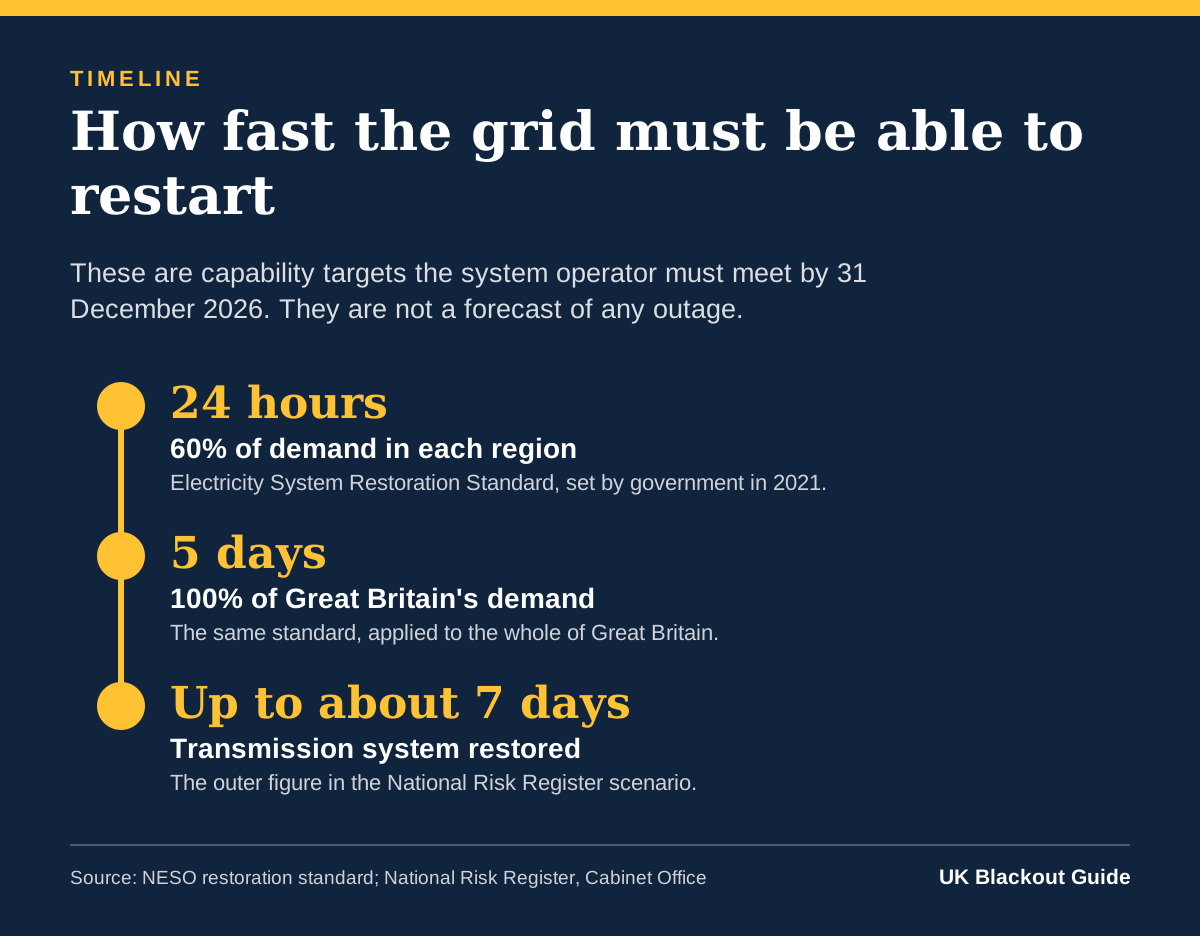
- Restoration standard: under the Electricity System Restoration Standard, set by government in 2021, NESO (the National Energy System Operator) must have the capability by 31 December 2026 to restore 60% of demand in each region within 24 hours and 100% of Great Britain's demand within five days.
- National Risk Register: rates a national outage as low likelihood but very high impact, and says restoring the transmission system could take up to about 7 days.
- Be Ready campaign, launched 22 October 2026: asks households to be able to manage for three days. It is presented as general preparedness, not a forecast, and its kit list includes a battery or wind-up radio, a torch, cash and a charged power bank, the very things that helped in Lancaster and Iberia. More on the campaign is in the Be Ready campaign explained.
Two things to sort before winter
The first is the Priority Services Register, which is free in England, Scotland and Wales (Northern Ireland uses Customer Care Registers). Many households qualify, including those with children under 5, older people and anyone who relies on powered medical equipment, and joining tells your network operator who may need extra help in a long cut; the Priority Services Register explained covers who qualifies.
The second is knowing that compensation for long unplanned cuts exists under Ofgem's Guaranteed Standards. Thresholds and amounts depend on the weather category and change over time, so check the current position with Ofgem or your network operator, or read power cut compensation.
What a short cut asks of a household
For a cut of under an hour, like most of those on 9 August 2019, you need very little: a torch you can find in the dark, a phone with some charge, and the habit of not opening the fridge or freezer.
- Report it by calling 105, free in England, Scotland and Wales, or 03457 643643 in Northern Ireland.
- Switch off anything hot, such as an iron, oven or electric fire, so it does not come back on unattended.
- Unplug the TV and computer in case of a surge when the supply returns.
- Keep fridge and freezer doors shut.
If you are travelling, the lesson of 2019 is different: keep a power bank and some cash in your bag, and expect a long wait.
What people who lived through them say to keep: budget, mid-range and high-end
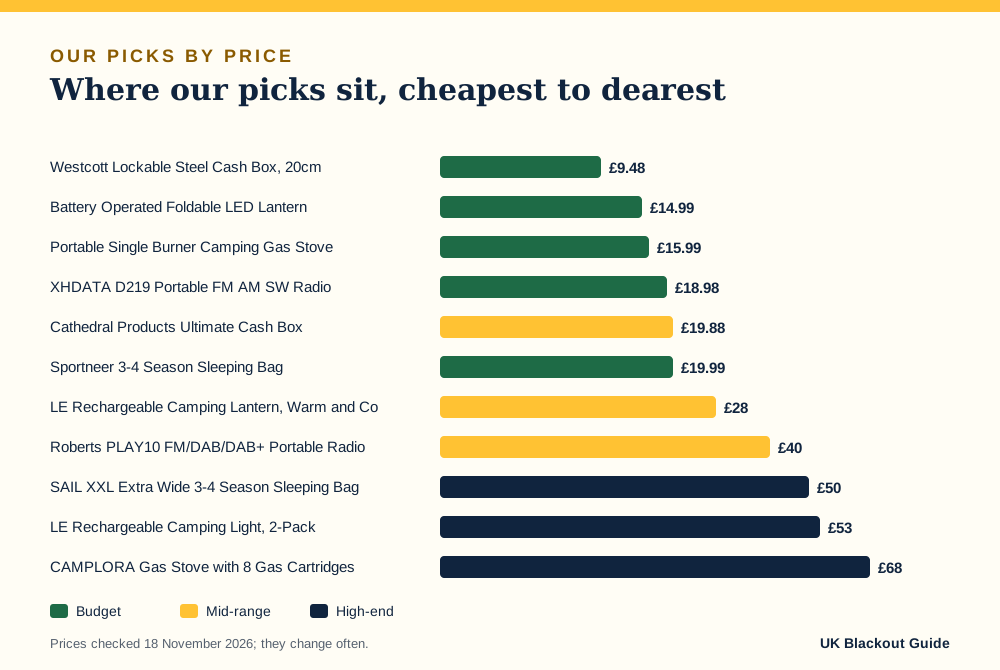
The picks below follow the lessons of Lancaster and Arwen: a battery radio for news, a cash box for a small float, a lantern for long evenings, a sleeping bag for an unheated bedroom and a camping stove for hot drinks, used outdoors. They were chosen from Amazon UK listings on 18 November 2026 on what each listing states, the price band and verified buyer ratings. We have not tested any of them, and prices change. Cash boxes are cheap throughout, so there is no high-end cash box.
High-end picks What the extra money buys in a power cut


LE Rechargeable Camping Light, 2-Pack
★ 4.6 from 33,400 buyers · About £53 when checked 18 November 2026Two of the same well-rated rechargeable lanterns, rated 4.6 from about 33,400 buyers. One for the main room and one for the bathroom covers most homes through several dark evenings.
- Covers two rooms
- Same highly rated lantern
- Both need charging before a cut
SAIL XXL Extra Wide 3-4 Season Sleeping Bag
★ 4.6 from 176 buyers · About £50 when checked 18 November 2026An extra-wide 3 to 4 season bag sold for warm and cold weather, rated 4.6 from about 180 buyers. The extra width suits anyone who finds standard bags cramped over several nights.
- Extra wide
- 3 to 4 season
- Fewer buyer ratings
- Bulkier to store
CAMPLORA Gas Stove with 8 Gas Cartridges
★ 4.6 from 247 buyers · About £68 when checked 18 November 2026A gas stove sold with eight gas cartridges, rated 4.6 from about 250 buyers. Buying the fuel with the stove means you have several days of boiling water ready to go.
- Comes with fuel
- Highly rated
- Use outdoors only
- Store cartridges cool, dry and upright
Mid-range picks The sensible middle for most homes


Roberts PLAY10 FM/DAB/DAB+ Portable Radio
★ 4.5 from 5,500 buyers · About £40 when checked 18 November 2026A portable FM, DAB and DAB+ radio from Roberts, rated 4.5 from about 5,500 buyers. FM and digital together means you can try both, as official advice suggests in a power cut.
- FM plus DAB
- Established radio brand
- Check the listing for battery type and runtime
Cathedral Products Ultimate Cash Box
★ 4.6 from 3,600 buyers · About £19.88 when checked 18 November 2026A cash box with foam lining and a cantilever coin tray, rated 4.6 from about 3,600 buyers. A larger box holds a float plus spare keys and a written contact list.
- Cantilever coin tray
- Foam lining
- Check the size against your cupboard
LE Rechargeable Camping Lantern, Warm and Cool Light
★ 4.6 from 33,400 buyers · About £28 when checked 18 November 2026A rechargeable lantern with warm and cool light, rated 4.6 from about 33,400 buyers, the most in this list. Warm light suits a living room through long winter evenings.
- Very large number of buyer ratings
- Warm light setting
- Rechargeable, so keep it topped up
- Ignore headline lumen figures and judge on ratings
Budget picks Cheapest ways to be covered


XHDATA D219 Portable FM AM SW Radio
★ 4.4 from 5,800 buyers · About £18.98 when checked 18 November 2026A small battery-operated FM, AM and shortwave radio sold for household and outdoor use, rated 4.4 from about 5,800 buyers. It is the kind of set that kept Lancaster listeners informed when phones and internet failed.
- Runs on batteries
- Large number of buyer ratings
- No DAB
- Keep spare batteries beside it
Westcott Lockable Steel Cash Box, 20cm
★ 4.7 from 1,700 buyers · About £9.48 when checked 18 November 2026A sheet steel cash box with two keys and a removable three-compartment coin tray, rated 4.7 from about 1,700 buyers. It keeps notes and coins together for the moment card machines and cash points go off.
- Steel with coin tray
- Highly rated
- A cash box deters casual access but is not a safe
Battery Operated Foldable LED Lantern
★ 4.5 from 1,600 buyers · About £14.99 when checked 18 November 2026A battery-operated LED lantern that folds and hangs, rated 4.5 from about 1,600 buyers. Running on replaceable batteries means it works through a long cut without needing a recharge.
- Battery powered
- Hangs from a hook
- Check which batteries it takes and stock spares
Sportneer 3-4 Season Sleeping Bag
★ 4.5 from 2,900 buyers · About £19.99 when checked 18 November 2026A 3 to 4 season sleeping bag listed at 220 by 80 cm and 1.5 kg, rated 4.5 from about 2,900 buyers. One per person is the aim for a cold night with the heating off.
- 3 to 4 season rating
- Strong rating for the price
- Check the comfort temperature on the listing
Portable Single Burner Camping Gas Stove
★ 4.6 from 204 buyers · About £15.99 when checked 18 November 2026A compact single-burner gas stove rated 4.6 from about 200 buyers. It boils water for a hot drink or a pouch meal, used outdoors only.
- Small and cheap
- Highly rated
- Outdoor use only because of carbon monoxide
- Check which gas canisters it takes
Most of this costs very little. A radio, a cash box and a lantern together come to well under £60 at the budget end. The middle tier buys a better-known radio with DAB, a brighter lantern or a warmer bag. The high end, such as a two-pack of lanterns, an extra-wide bag or a stove sold with a stock of gas, is worth it if you live somewhere rural that has lost power for days after storms before. For a three-day plan in a town, it is more than you need.
Checklist
Has the UK ever had a national blackout? Past power cuts explained
- Keep a battery or wind-up FM radio with spare batteries, and note local frequencies
- Keep a small float of cash in notes and coins at home
- Have a torch or lantern for each main room, not candles
- Keep a warm sleeping bag or blankets for each person
- Keep a camping stove for outdoor use only, with enough gas for a few days
- Fit an audible EN 50291 carbon monoxide alarm
- Agree a plan for finding family members if phones are down
- Join the Priority Services Register if you qualify
- Know to call 105 to report a cut
- Keep a power bank charged for phones
What the research found
These are published reports and statistics, summarised by us. They record what was measured or what happened; none is a forecast.
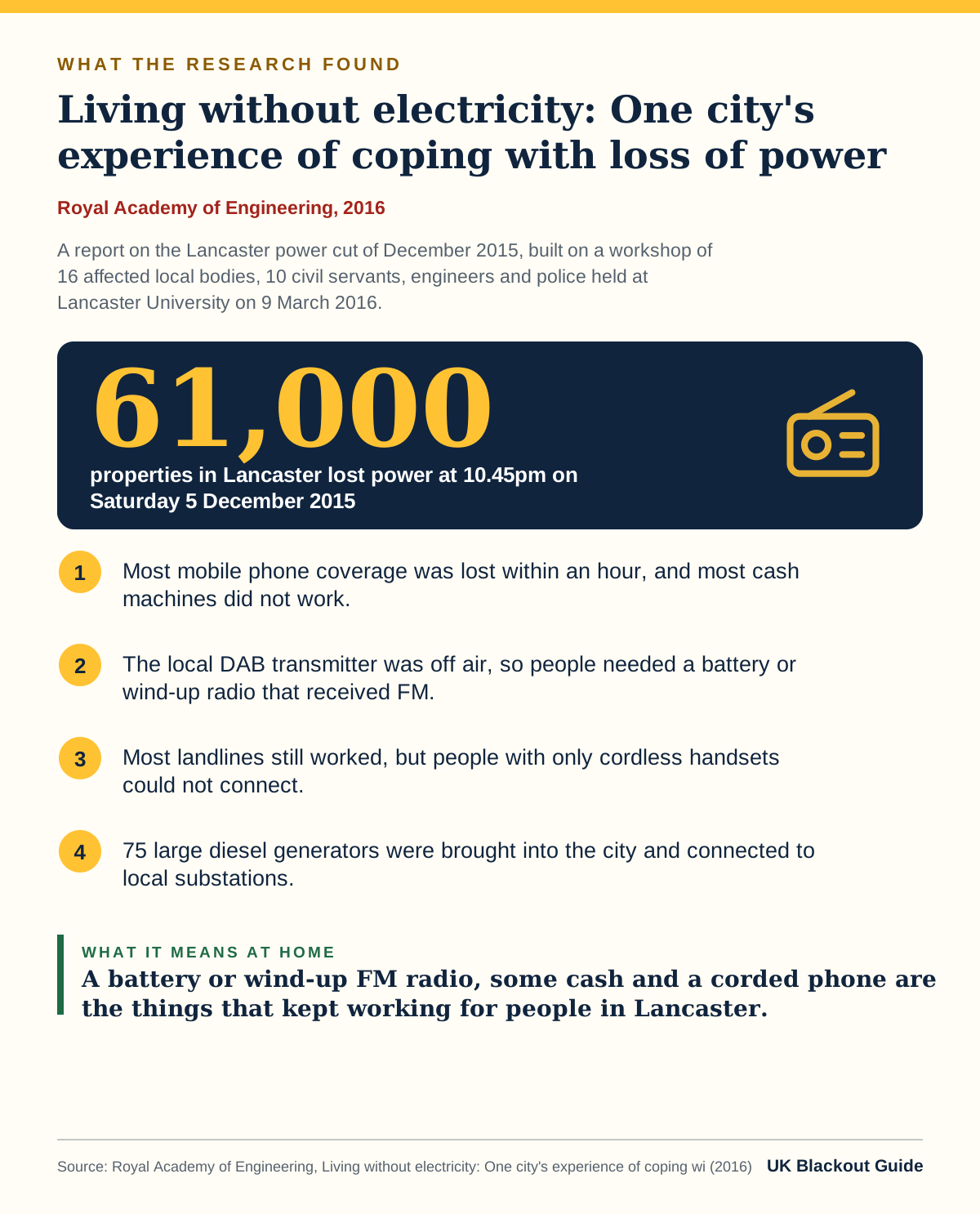
Royal Academy of Engineering (2016). A report on the Lancaster power cut of December 2015, built on a workshop of 16 affected local bodies, 10 civil servants, engineers and police held at Lancaster University on 9 March 2016. A battery or wind-up FM radio, some cash and a corded phone are the things that kept working for people in Lancaster.
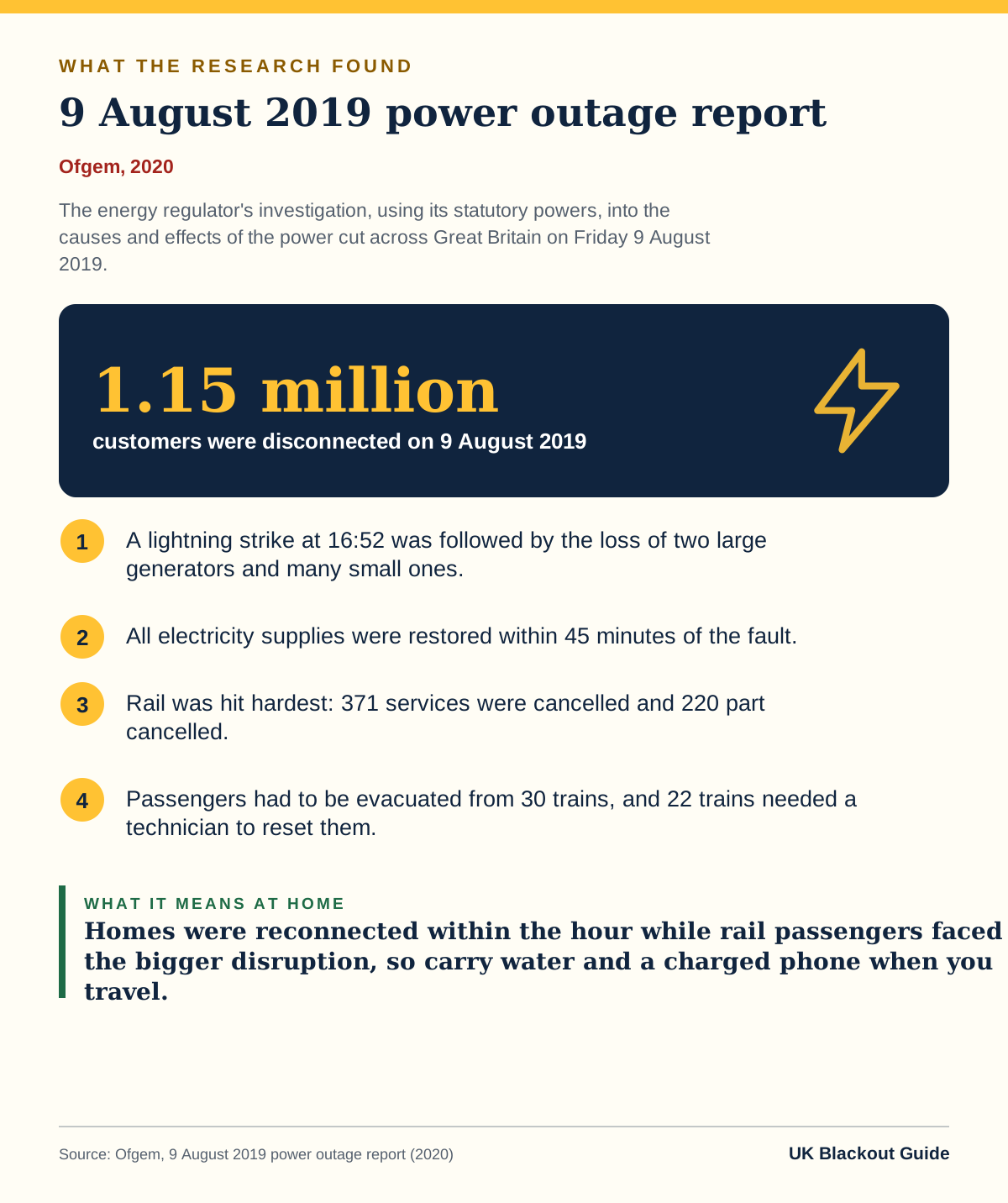
Ofgem (2020). The energy regulator's investigation, using its statutory powers, into the causes and effects of the power cut across Great Britain on Friday 9 August 2019. Homes were reconnected within the hour while rail passengers faced the bigger disruption, so carry water and a charged phone when you travel.
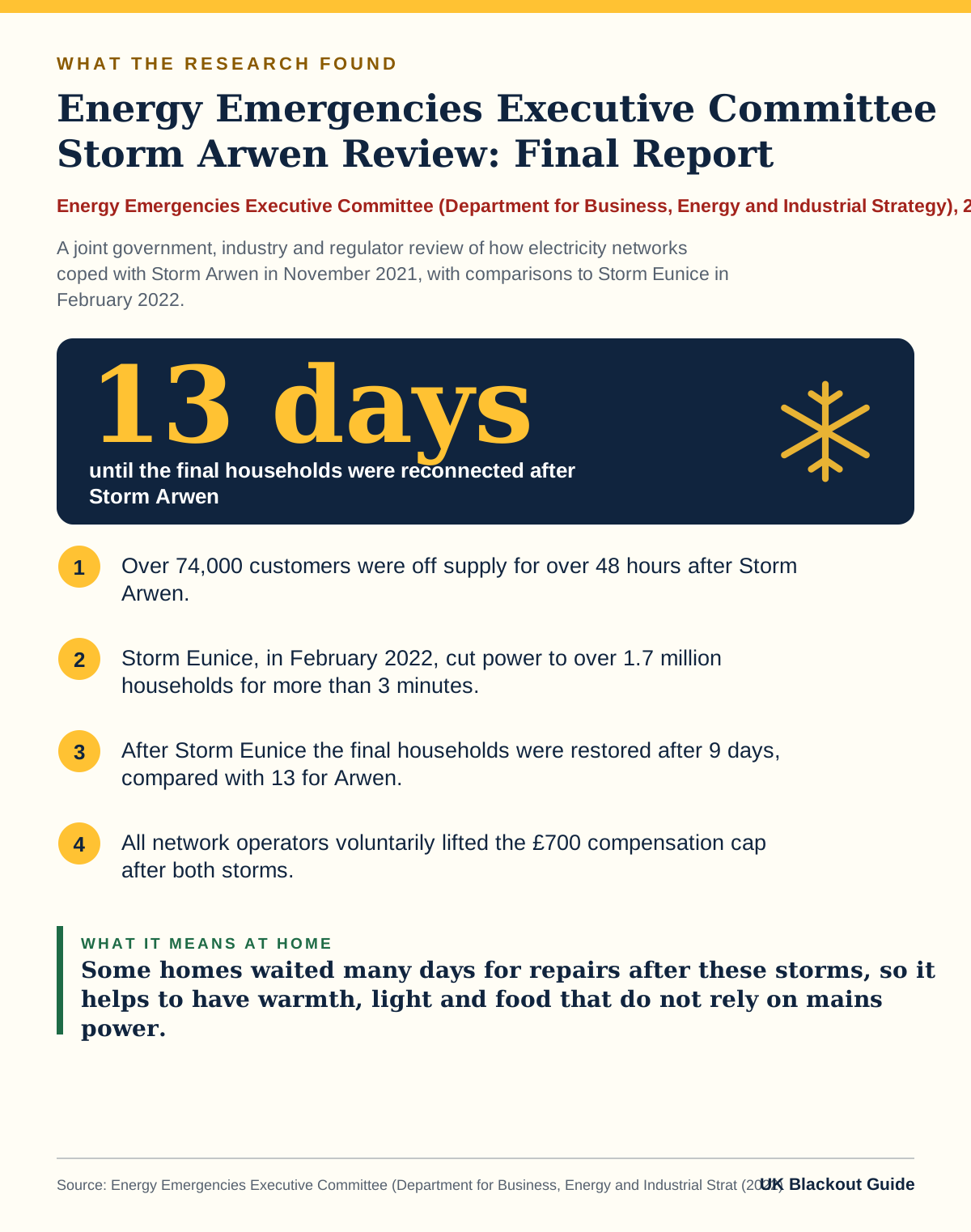
Energy Emergencies Executive Committee (Department for Business, Energy and Industrial Strategy) (2022). A joint government, industry and regulator review of how electricity networks coped with Storm Arwen in November 2021, with comparisons to Storm Eunice in February 2022. Some homes waited many days for repairs after these storms, so it helps to have warmth, light and food that do not rely on mains power.
Our data: what this costs
We recorded the price and buyer rating of every relevant listing we found on Amazon UK for this guide, 349 in all, and worked out the spread. These are our own figures, not a retailer's or a manufacturer's.
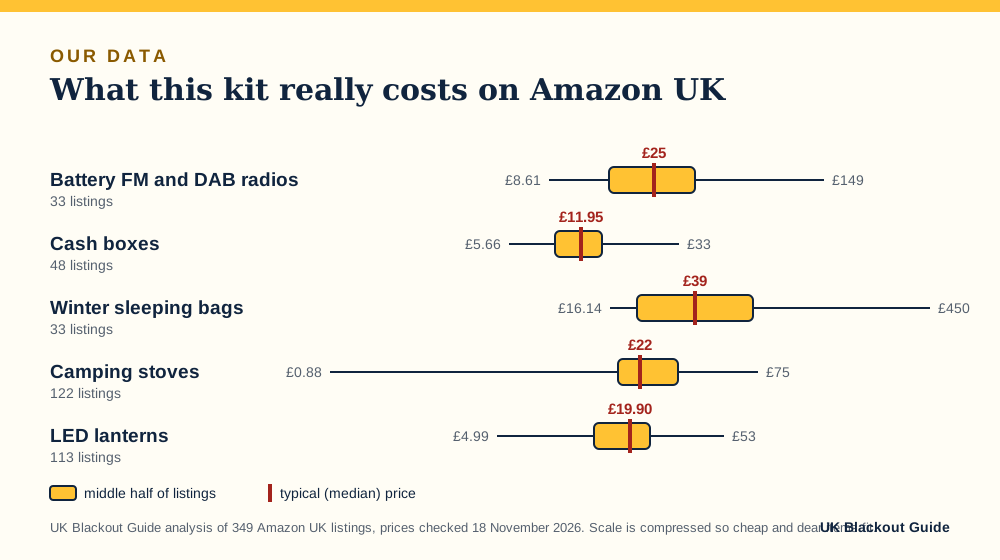
- The typical (median) price for battery FM and DAB radios is £25, and half of all listings fall between £15.99 and £39.
- The widest spread is in winter sleeping bags: the dearest listing costs about 12 times the typical one, so the top of the range is rarely needed for a power cut.
- 70% of LED lanterns listings are rated 4.5 stars or higher by buyers, the highest share in this group.
| Product type | Listings | Cheapest | Typical | Middle half | Dearest | Rated 4.5+ |
|---|---|---|---|---|---|---|
| Battery FM and DAB radios | 33 | £8.61 | £25 | £15.99 to £39 | £149 | 38% |
| Cash boxes | 48 | £5.66 | £11.95 | £9.11 to £14.88 | £33 | 60% |
| Winter sleeping bags | 33 | £16.14 | £39 | £21 to £72 | £450 | 55% |
| Camping stoves | 122 | £0.88 | £22 | £17.61 to £33 | £75 | 64% |
| LED lanterns | 113 | £4.99 | £19.90 | £13.72 to £24 | £53 | 70% |
Method: one search page per product type on Amazon UK, off-topic listings removed, prices and ratings as shown on 18 November 2026. It is a snapshot, not a full market survey, and prices move.
Common questions
What was the biggest power cut in UK history?
By number of customers, 9 August 2019 and Storm Arwen in 2021 each affected about 1 million. Arwen lasted far longer for those affected.
Were the 1970s power cuts a national blackout?
No. They were planned rota cuts that rationed electricity by area. The grid kept running throughout.
Has Northern Ireland had a national blackout?
Northern Ireland's grid is separate from Great Britain's. This page covers the British system, which has not had a total shutdown.
Did the whole country lose power in 2019?
No. The grid stayed live and most of the country was unaffected. A share of demand was disconnected automatically to keep the system stable.
Did mobile phones work in Lancaster during the cut?
No. Mobile and internet services failed locally, along with cash machines and card payments.
How did people in Lancaster get information?
The local radio station The Bay kept broadcasting on a generator, so people with battery or car radios could follow what was happening.
How long were people without power after Storm Arwen?
Most were reconnected much sooner, but some rural homes in northern England and Scotland were off for more than a week.
Can I get compensation for a storm power cut?
Payments are available for long unplanned cuts under Ofgem's Guaranteed Standards. Thresholds and amounts depend on the weather category, so check with Ofgem or your network operator.
- National Energy System Operator (NESO)
- National Risk Register, Cabinet Office
- Ofgem
- Be Ready, UK government
- NHS
- Priority Services Register
Reviewed against these sources on 18 November 2026. If official advice has changed since, follow the official advice.
General information only. This page is not professional, safety, medical, legal or financial advice, and it is not official guidance. No national blackout has been forecast or announced, and nothing here suggests one is expected. We are independent and have no connection to the government or any energy company. Always check the official sources linked on this page. Full disclaimer
Keep reading
 Guide
What causes power cuts in the UK? Storms, faults and cyber attacks
What causes power cuts in the UK: storms, cable and substation faults, rota cuts, and what officials have said about cyber attacks, AI and solar storms.
Read: What causes power cuts in the UK? Storms, Explainer
Spain and Portugal blackout 2025: what happened and UK lessons
On 28 April 2025 Spain and Portugal lost all power for most of a day. Phones, cards and trains failed. What happened and the practical lessons for UK homes.
Read: Spain and Portugal blackout 2025: what Guide
What are rota power cuts? UK load block letters explained
Rota power cuts UK explained: how three-hour cuts by load block letter would work, how to find your letter, who is protected and how to prepare for a planned cut.
Read: What are rota power cuts? UK load block Guide
Is the UK going to have a blackout? What the government has said
Is the UK going to have a blackout? No national blackout has been forecast or announced. What Be Ready, the Risk Register and NESO actually say, with dates.
Read: Is the UK going to have a blackout? What the