On this page
- In pictures
- What the Be Ready campaign is, in two sentences
- Why the government is asking households to prepare for three days
- The "three-day blackout" claim: what was said and what was not
- What Be Ready asks every household to do
- The official Be Ready kit list, item by item
- What the campaign says to do during a power cut
- Who gets extra help: the Priority Services Register
- What Be Ready does not cover, and where we go beyond it
- What to buy for the official list: budget, mid-range and high-end
- Be Ready checklist you can print
- Checklist
- What the research found
- Our data: what this costs
- Common questions
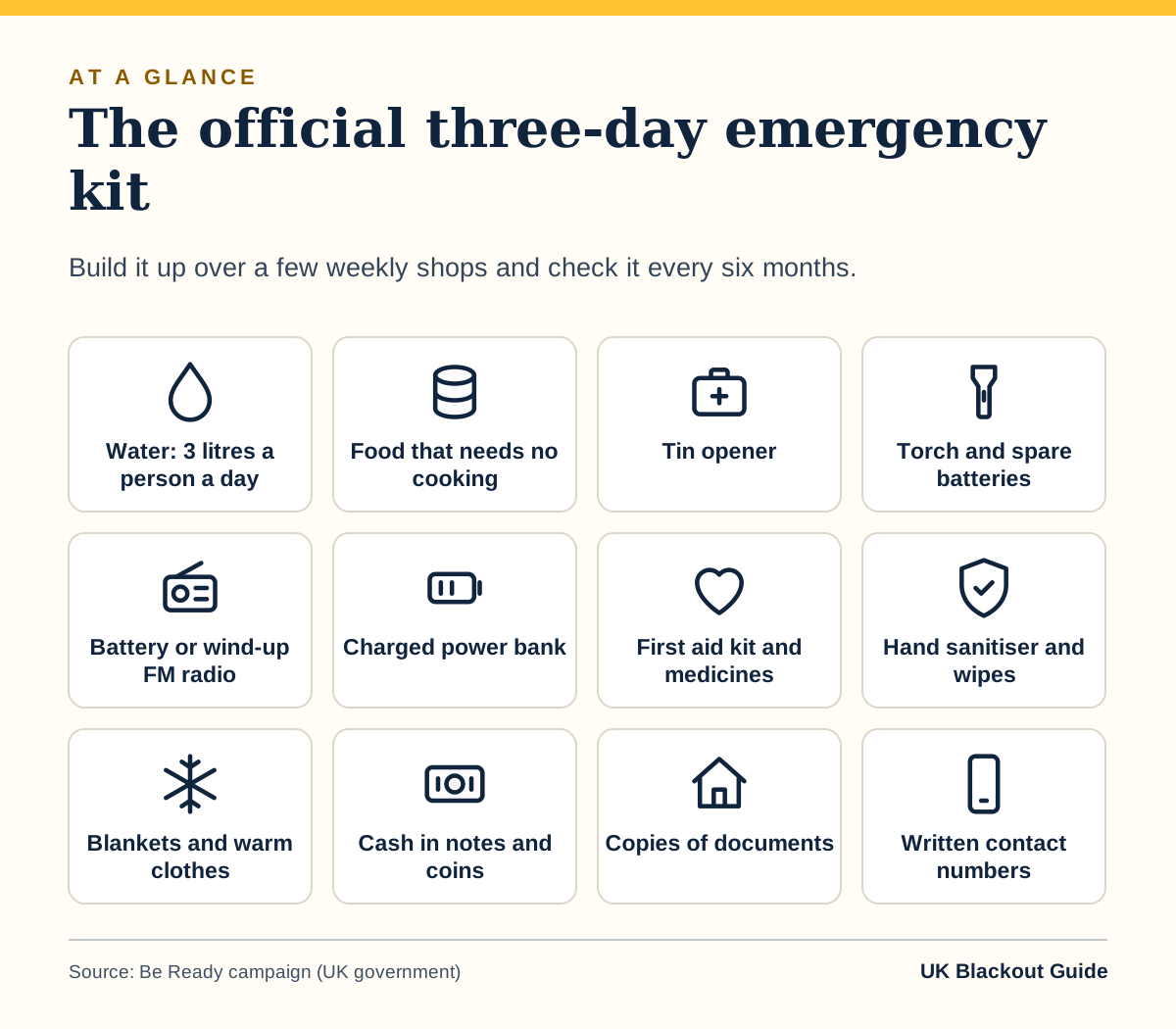
Be Ready is the UK government's household preparedness campaign, launched on 22 October 2026 and previously called Prepare. It asks every household to be able to manage for three days in an emergency, and publishes a short kit list: water at 3 litres per person per day, no-cook food, a torch, an FM radio, a charged power bank, a first aid kit, medication, warm bedding, cash and paper copies of documents. It is general preparedness, not a forecast of a blackout.
 iRonsnow Solar Hand Crank AM/FM Radio, 2000mAh★ 4.6 from 6,300 buyers · About £35Check price on Amazon
 Solarbaby Wind Up Solar AM/FM Radio with Torch★ 4.2 from 5,000 buyers · About £25Check price on Amazon
 Wind Up Solar Radio 20,000mAh Hand Crank AM/FM★ 4.5 from 167 buyers · About £54Check price on Amazon
Chosen from Amazon UK listings on specification, price and buyer ratings. Not hands-on tested. We earn a commission if you buy.
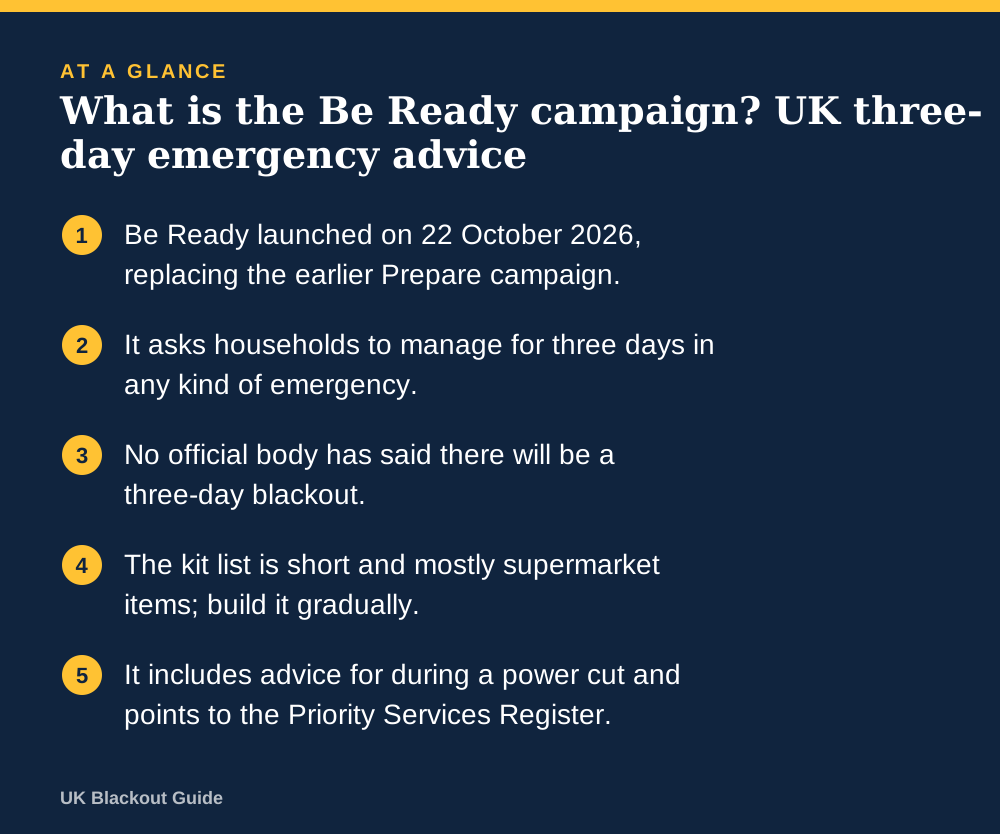
- Be Ready launched on 22 October 2026, replacing the earlier Prepare campaign.
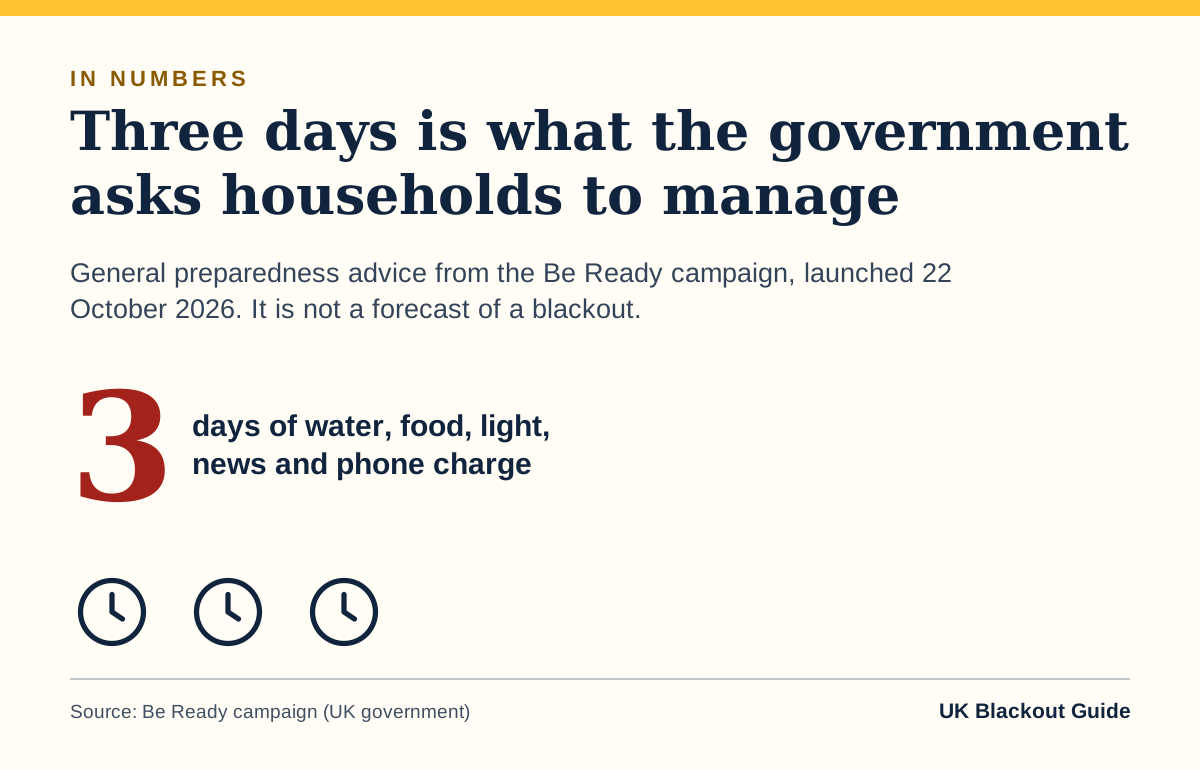
- It asks households to manage for three days in any kind of emergency.
- No official body has said there will be a three-day blackout.
- The kit list is short and mostly supermarket items; build it gradually.
- It includes advice for during a power cut and points to the Priority Services Register.
- Check your kit every six months, as the campaign advises.
In pictures: the numbers that matter
What the Be Ready campaign is, in two sentences
Be Ready is a UK government public campaign, with a website at beready.campaign.gov.uk, that asks every household to be able to manage for three days without outside help in an emergency such as a flood, storm or power cut. It was launched on 22 October 2026, replacing the earlier Prepare campaign, and it presents its advice as general preparedness, not a forecast of any particular event.
The campaign covers power cuts, flooding, severe weather and other disruption, and it does not say any of them is about to happen. No national blackout has been announced, planned or predicted.
This site is independent and has no connection to the government. What follows is a plain summary of the published advice, followed by the extra detail the campaign leaves out.
Why the government is asking households to prepare for three days
Three days is the period Be Ready asks households to be able to manage for. The campaign presents it as general preparedness for emergencies of any kind. It is not an estimate of how long a power cut would last, and the government has not suggested that an outage of any particular length is expected. We have not seen an official explanation that ties the figure to the electricity system.
It is also a practical amount. The water and food for three days fit in a cupboard, even for a family, and nothing on the list needs specialist equipment. It is closer to keeping a spare tyre than to building a bunker.
Why now
The campaign is new in name. It replaced Prepare, and the relaunch under a new name on 22 October 2026 brought it more attention. The government has not linked the launch to any expected event. What official sources have and have not said is collected in what the government has said about a UK blackout in 2026.
Much of the wider talk about blackouts mentions events that happened elsewhere or in the past: Storm Arwen in November 2021, when about a million customers lost power and some rural homes were off for more than a week; the Spain and Portugal blackout of 28 April 2025; and Exercise Mighty Oak, the government's national power outage exercise in 2023. Those are things that happened or were practised, not signs of what will happen here. Whether Britain has ever had a total outage is covered in the history of UK blackouts.
How the risk is officially described
The National Risk Register, published by the Cabinet Office, describes a national power outage as low likelihood but very high impact, with knock-on effects on water, mobile networks, internet, fuel, payments and transport. Planning for a low-likelihood, high-impact event is what governments do routinely; it does not mean the event is expected.
The "three-day blackout" claim: what was said and what was not
No official body has said there will be a three-day blackout in the UK. The three days comes from Be Ready's request that households be able to manage for that long in any emergency. It is a preparedness target for your home, not a prediction about the power supply.
How the figure became a headline
Two things happened close together. Be Ready launched with its three-day message on 22 October 2026. Then on 7 November 2026 the BBC reported on how it would keep broadcasting on FM radio during a prolonged outage, from an emergency studio with generator-backed transmitters and supplies for at least three days.
Put side by side, "manage for three days" and "supplies for at least three days" became "three-day blackout" in some headlines and posts, often alongside the term Black Sky, which describes a prolonged, wide-area outage that disrupts other essential services; what Black Sky means explains where the phrase comes from. Neither source predicts an outage. One is advice to households; the other is a broadcaster's contingency plan.
What official sources say about duration
| Source | What it says |
|---|---|
| Be Ready campaign | Households should be able to manage for three days. |
| Rota power cuts | In a national energy shortage, planned cuts could last about three hours at a time, by load block letter. |
| Electricity System Restoration Standard | By 31 December 2026, NESO must be able to restore 60% of demand in each region within 24 hours and 100% of Great Britain's demand within five days. |
| National Risk Register | A national outage is low likelihood but very high impact; restoring the transmission system could take up to about 7 days. |
None of these is a forecast. The restoration standard, set by government in 2021, is a capability NESO must have, and the Risk Register describes a planning scenario. The detail behind these figures is in how long a national blackout could last.
What the government has not said
It has not said a blackout will last three days. It has not given a date for one. It has not asked households to prepare for more than three days. If you see a post claiming the government has confirmed a three-day blackout, check it against the Be Ready website, where the wording is about being able to manage and sits alongside advice on flooding and severe weather.
A 72-hour kit, a phrase used by other countries and retailers, is the same thing as the three-day advice: three days of supplies.
What Be Ready asks every household to do
The campaign's requests fit into four short jobs.
- Gather a kit that lets you manage for three days: water, food, light, a radio, a power bank, first aid, medication, warmth, cash and paperwork.
- Build it gradually. The campaign is explicit that you should add items over time, not buy everything at once.
- Write things down. It asks for a written list of contacts and medication and printed copies of documents, because a phone may be flat or offline when you need it.
- Check it every six months. Replace water and food nearing their dates, test torches and the radio, and recharge the power bank.
It also asks people to think about others: check on neighbours during a power cut, and register for extra support if you or someone in your home may need it.
Nothing on the list requires bulk buying, and clearing shelves makes things harder for everyone. Adding a few tins and a pack of water to the weekly shop over a month or two does the job. A step-by-step version, with a written household plan and a six-week shopping order, is in our guide to preparing for a blackout.
The official Be Ready kit list, item by item
The list is short and mostly made of things you can buy in a supermarket. Here it is in full, with the practical detail that makes each line usable.
| Be Ready item | What it means in practice |
|---|---|
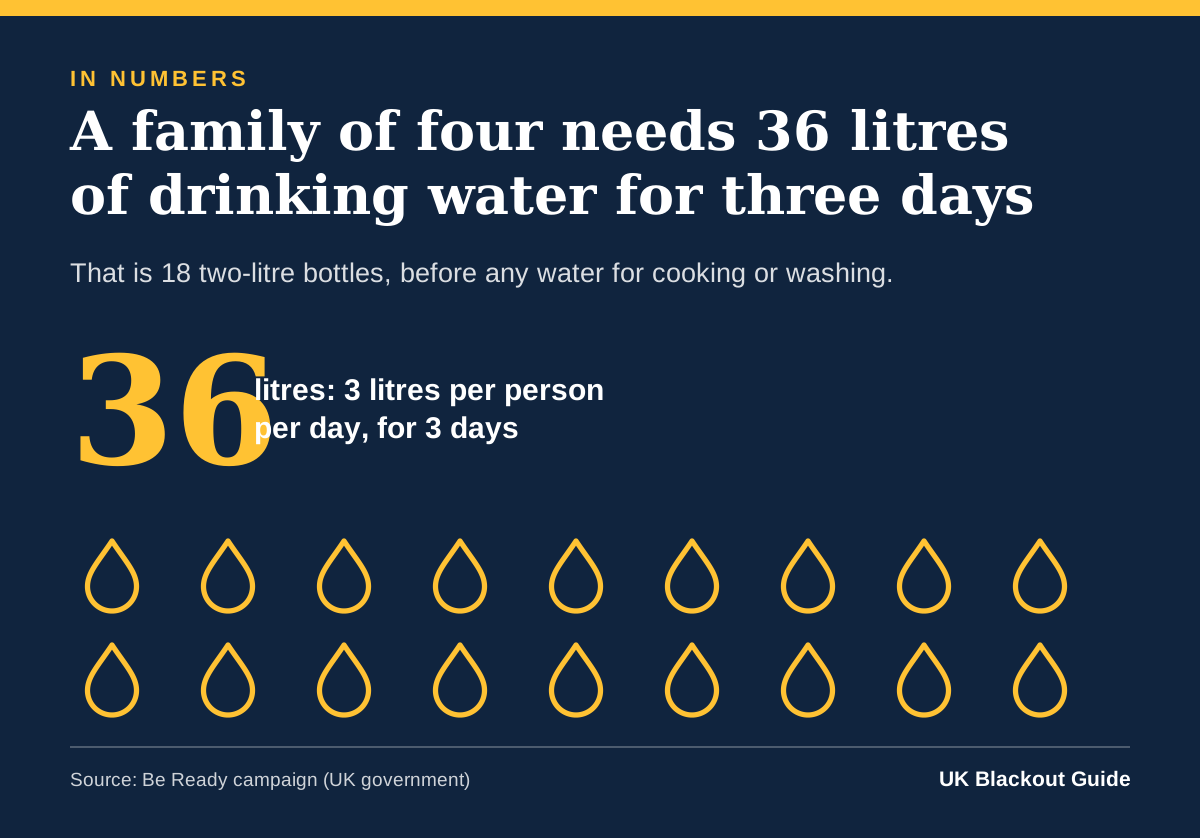
| Bottled water for 3 days | 3 litres per person per day for drinking, plus more for cooking and washing. A family of four needs 36 litres for drinking alone. |
| Non-perishable food for 3 days | Food that needs no cooking and no fridge: tinned fish, beans and fruit, crackers, cereal bars, long-life milk. |
| Tin opener | A manual one. An electric opener is useless in a power cut. |
| Battery or wind-up torch, spare batteries | The campaign notes that torches are safer than candles. One per adult is a good start. |
| Battery or wind-up FM radio | How official information would reach you if broadband and mobile data stopped. Try FM and digital. |
| Charged power bank | A 20,000 mAh bank gives a typical phone about three to four charges. |
| First aid kit | Dressings, bandages, burn care, gloves, scissors and a foil blanket. |
| Essential medication | Ask your pharmacist what reserve is sensible for you. |
| Hand sanitiser and wet wipes | Mains water can be disrupted during and after a power cut. |
| Blankets, sleeping bags, warm clothing | Most gas boilers stop in a power cut, so warmth comes from layers. |
| Cash in notes and coins | Card payments and cash machines can fail in a wide power cut. |
| Printed copies of documents | Identity, insurance and medical papers, kept together. |
| Written list of contacts and medication | On paper, so it works when your phone does not. |
| Baby supplies | Ready-to-feed formula is preferred, as it needs no clean water or heating; nappies. |
| Pet food | Three days for each animal, plus water. |
Water and food
Water is the heaviest item and the first practical question. Shop-bought bottled water is simplest for storage; if you fill your own, use food-grade containers made for drinking water and label them with the date. How much water to store works through the amounts by household size and how to keep it fresh.
For food, pick things your household already eats so nothing is wasted, and rotate them through normal meals. Menus that need no cooking are in our three-day food supply guide.
Light, radio and power
Most homes have tins, blankets and a torch somewhere. The usual gaps are the radio, the power bank, and a single place where everything is kept together. The radio is on the list because phones and broadband depend on networks that may fail, and the BBC has described plans to keep FM broadcasting going in a long outage.
For phones, usable charges are roughly the power bank's capacity in mAh multiplied by 0.65, divided by your phone's battery size. Top the bank up every few months so it is full when you need it.
What the campaign says to do during a power cut
Be Ready also gives advice for the cut itself. It is short and practical.
Report it
Call 105, which is free in England, Scotland and Wales, or 03457 643643 in Northern Ireland, or use your network operator's website. The network operator, not your energy supplier, fixes faults, and powercut105.com tells you which one covers your area. Reporting a power cut explains what they will ask and how to get updates.
Stay safe at home
- Keep away from fallen power lines.
- Turn off irons, ovens, electric fires and fryers so they do not come back on unattended.
- Unplug the TV and computer in case of a surge when the supply returns.
- Keep warm with layers and blankets, and close doors and curtains.
- Keep fridge and freezer doors shut. The Food Standards Agency says a fridge stays cold for around 4 hours if unopened, and a full freezer typically stays frozen for about 48 hours.
- Check on neighbours.
Staying in touch
A corded landline may work. Mobile networks may work temporarily in some areas on backup power. A 999 or 112 call from a mobile can roam onto any available network, so try even if your own provider shows no signal. Use a battery or wind-up radio for news, trying both FM and digital. Whether mobile phones work in a power cut explains why coverage can fade over a long outage.
Water
Mains water can be disrupted during and after a power cut, because pumping stations need electricity. That is why stored drinking water is on the list.
Never use a generator, barbecue, camping stove or patio heater indoors, in a garage or in a tent. Carbon monoxide has no smell and can kill. Use torches, not candles, for light.
Who gets extra help: the Priority Services Register
The Priority Services Register (PSR) is a free list kept by energy suppliers and network operators of customers who need extra help in a power cut. In England, Scotland and Wales you can join at thepsr.co.uk, or through your supplier or network operator. Northern Ireland uses Customer Care Registers instead.
Many households qualify, including those with children under 5, older people, and people who rely on powered medical equipment. Network operators use the register to give extra information and, in a long cut, sometimes practical support. Eligibility and how to sign up are set out in our guide to the Priority Services Register.
Two related points sit alongside it:
- Medical equipment. If anyone at home relies on powered equipment, ask their clinician or equipment supplier now what to do in a power cut, and follow that advice.
- Digital landlines. Landlines that run over broadband need mains power. Providers may give people who depend on a landline a free battery backup unit lasting at least one hour. Ask your provider.
Deaf people and those with hearing loss or a speech impairment can contact 999 by text through emergencySMS, but must register first by texting "register" to 999.
What Be Ready does not cover, and where we go beyond it
The campaign is deliberately short. That keeps it achievable, but it leaves practical gaps that this site fills. None of this changes the official ask of three days.
- Heating. Be Ready says keep warm with layers and blankets. It does not explain that most gas boilers stop in a power cut, or which heaters are safe indoors. Heating a room without electricity covers that, with the carbon monoxide rules.
- Cooking. The list asks for food that needs no cooking. Hot food and drinks help in winter, and a gas hob often lights with a match; camping stoves must stay outdoors.
- How much of each item. The list names items, not quantities beyond water. Our full emergency kit list adds sizes and numbers per person.
- A written household plan. The campaign asks for a contact list. A one-page plan with meeting points, jobs and the locations of your stopcock and gas valve goes further.
- Pets and children. It lists pet food and baby supplies; it does not cover keeping animals calm and warm or explaining a cut to a child.
- Cash. It says notes and coins, without an amount. Card payments, cash machines and banking apps all failed locally when Storm Desmond flooded a Lancaster substation in December 2015, cutting power to about 61,000 properties; keeping cash for an emergency suggests sensible amounts.
Some people choose to plan for longer than three days. The government has not asked households to do that and has not suggested an outage of that length is expected; anything beyond three days is a personal choice beyond official guidance.
What to buy for the official list: budget, mid-range and high-end
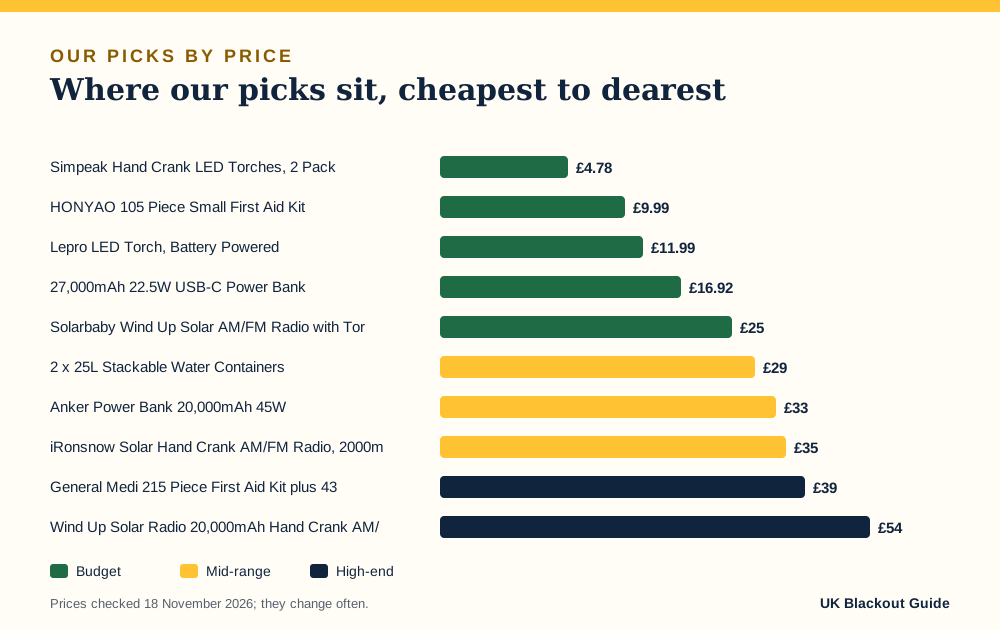
Most of the Be Ready list is ordinary shopping. The items below are the ones that usually need a separate purchase: a radio, a power bank, a torch, water containers and, for people who want to buy the basics in one go, ready-made first aid and emergency items. They come from Amazon UK listings on stated specification, price and verified buyer ratings. We have not hands-on tested any of them, and prices change.
High-end picks What the extra money buys in a power cut

Wind Up Solar Radio 20,000mAh Hand Crank AM/FM
★ 4.5 from 167 buyers · About £54 when checked 18 November 2026An AM/FM radio that charges by hand crank and solar, with a listed 20,000 mAh built-in battery. That combines the official radio and power bank lines in one unit that can be topped up without mains. Rated 4.5 from 167 buyers.
- FM plus crank and solar charging
- Large stated battery
- Fewer ratings
- Solar top-up is slow, so charge it from the wall first
General Medi 215 Piece First Aid Kit plus 43 Piece Mini Kit
★ 4.8 from 14,800 buyers · About £39 when checked 18 November 2026Two kits in one purchase, a 215-piece main kit and a 43-piece mini kit, with an emergency blanket, bandages and scissors named. It covers the first aid line of the Be Ready list for the house and a grab bag. Rated 4.8 from about 14,800 buyers.
- Two kits
- Very large number of ratings
- Just under £40
- Add your own medication
Mid-range picks The sensible middle for most homes


iRonsnow Solar Hand Crank AM/FM Radio, 2000mAh
★ 4.6 from 6,300 buyers · About £35 when checked 18 November 2026A hand crank and solar AM/FM radio with a 2,000 mAh battery, rated 4.6 from about 6,300 buyers. Crank charging means the radio keeps working with no batteries and no mains, which is what the official list asks for.
- Hand crank and solar
- Well rated by many buyers
- Weather band is a US feature and irrelevant here
- Small battery for phone top-ups
Anker Power Bank 20,000mAh 45W
★ 4.6 from 18,200 buyers · About £33 when checked 18 November 2026A 20,000 mAh bank with built-in USB-C cables, rated 4.6 from 18,200 buyers. At that size it gives a typical phone about three to four charges, enough for three days of light use.
- 20,000 mAh
- Built-in cables
- Around £33
- Recharge every few months
2 x 25L Stackable Water Containers
★ 4.8 from 446 buyers · About £29 when checked 18 November 2026Two stackable 25 litre cans, rated 4.8 from 446 buyers. Fifty litres covers a family of four's 36 litres of drinking water with some left for cooking and washing.
- 50 litres in total
- Stackable
- A full can is heavy
- Refresh tap water every six months
Budget picks Cheapest ways to be covered


Solarbaby Wind Up Solar AM/FM Radio with Torch
★ 4.2 from 5,000 buyers · About £25 when checked 18 November 2026A hand crank and solar AM/FM radio with a 2,000 mAh battery and torch, rated 4.2 from 5,000 buyers. It covers the radio line of the list and doubles as a backup light.
- Crank, solar and torch in one
- Under £25
- Lower rating than dearer sets
- Small battery for phone charging
27,000mAh 22.5W USB-C Power Bank
★ 4.3 from 12,600 buyers · About £16.92 when checked 18 November 2026A high-capacity unbranded bank rated 4.3 from 12,600 buyers, a low-cost way to tick the charged power bank line.
- Large stated capacity
- Under £20
- Unbranded
- Keep it charged
Lepro LED Torch, Battery Powered
★ 4.6 from 50,800 buyers · About £11.99 when checked 18 November 2026A battery-powered LED torch with adjustable focus, rated 4.6 from about 50,800 buyers. Be Ready asks for a battery or wind-up torch with spare batteries, and standard cells are easy to stockpile.
- Huge number of ratings
- Standard batteries
- Buy spare batteries with it
- Not rechargeable
Simpeak Hand Crank LED Torches, 2 Pack
★ 4.4 from 7,400 buyers · About £4.78 when checked 18 November 2026Two hand crank LED torches with carabiners, rated 4.4 from 7,400 buyers. Wind-up torches meet the official list without any batteries, which makes them good backups in a drawer.
- No batteries needed
- Two for a very low price
- Dimmer than battery torches
- Short runtime per wind
HONYAO 105 Piece Small First Aid Kit
★ 4.8 from 4,300 buyers · About £9.99 when checked 18 November 2026The title lists plasters, an emergency foil blanket, burn gel and eyewash in a small case. It ticks the first aid line of the Be Ready list at a low price. Rated 4.8 from about 4,300 buyers.
- Burn gel and foil blanket named
- About £10
- Small kit for a larger household
- Add your own medication
You can cover the official powered items for about £50 to £70: a torch on standard batteries, a wind-up or battery FM radio and a 20,000 mAh power bank. The mid-range buys a better-known power bank brand, a radio with a larger built-in battery, and stackable water containers. The high end in these categories is modest, around £40 to £55 for a crank radio with a big built-in power bank or a larger combined first aid kit. Ready-made kits vary widely; check the contents against the official list item by item, favour ones with a proper torch and radio over ones padded with low-value extras, and remember that none includes your water, food, medication or cash. Nothing on the Be Ready list needs a power station or generator.
Be Ready checklist you can print
Tick these off over a few weeks. The full tick-box version sits below the article, and the same list works for a flat, a family house or someone living alone.
- Water: 3 litres per person per day for three days, plus extra for cooking and washing.
- Food: three days that need no cooking or fridge, and a manual tin opener.
- Light: a torch per adult, with spare batteries.
- Radio: battery or wind-up, FM, with your local station's frequency written on it.
- Power: a charged power bank and cables.
- Health: first aid kit, essential medication, hand sanitiser, wet wipes.
- Warmth: blankets, sleeping bags, warm clothing.
- Paper: cash in notes and coins, document copies, a written contact and medication list.
- Dependants: baby supplies and pet food if they apply.
- Numbers: 105 (or 03457 643643 in Northern Ireland) and your network operator.
- Support: checked whether anyone at home qualifies for the Priority Services Register.
- Review: a reminder set for six months' time.
A ready-made first aid kit covers one line of this list; first aid kits for home emergencies compares sizes and contents.
Checklist
What is the Be Ready campaign? UK three-day emergency advice
- Water: 3 litres per person per day for three days
- Three days of no-cook food and a manual tin opener
- Torch per adult with spare batteries
- Battery or wind-up FM radio
- Charged power bank
- First aid kit and essential medication
- Hand sanitiser and wet wipes
- Blankets, sleeping bags and warm clothing
- Cash in notes and coins
- Printed documents and a written contact and medication list
- Baby supplies and pet food if needed
- 105 saved and network operator noted
- Checked Priority Services Register eligibility
- Six-monthly check booked
What the research found
These are published reports and statistics, summarised by us. They record what was measured or what happened; none is a forecast.
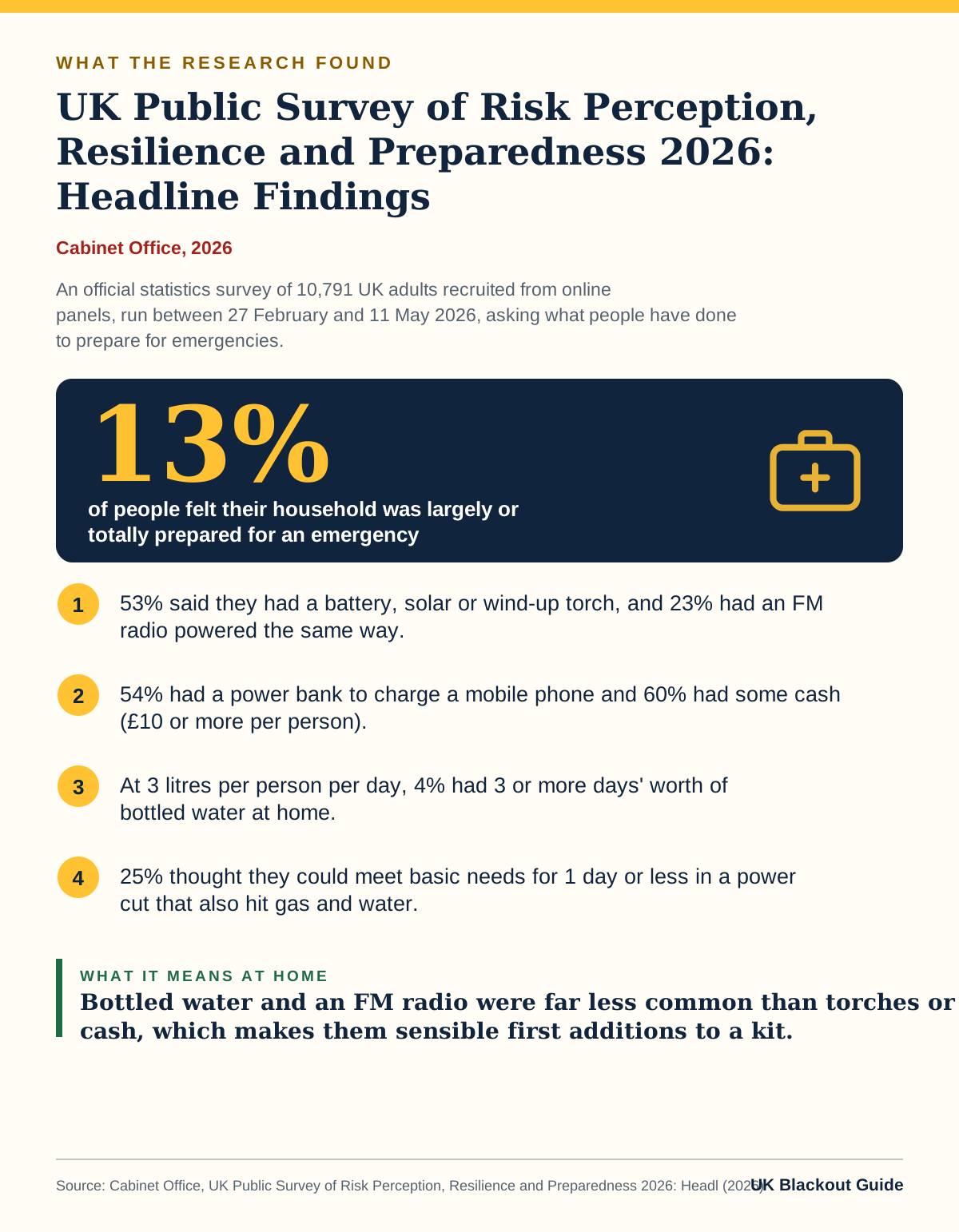
Cabinet Office (2026). An official statistics survey of 10,791 UK adults recruited from online panels, run between 27 February and 11 May 2026, asking what people have done to prepare for emergencies. Bottled water and an FM radio were far less common than torches or cash, which makes them sensible first additions to a kit.
Our data: what this costs
We recorded the price and buyer rating of every relevant listing we found on Amazon UK for this guide, 408 in all, and worked out the spread. These are our own figures, not a retailer's or a manufacturer's.
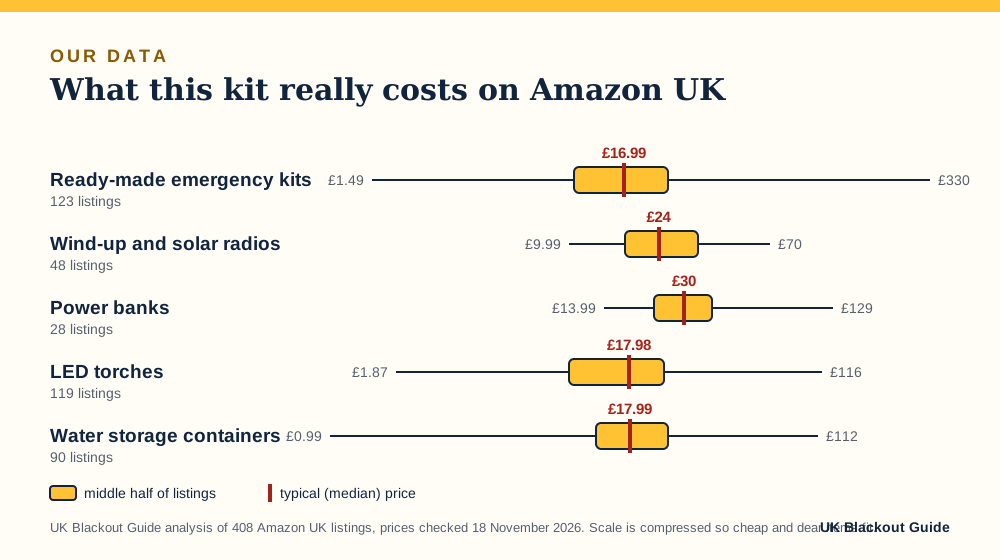
- The typical (median) price for ready-made emergency kits is £16.99, and half of all listings fall between £10.49 and £26.
- The widest spread is in ready-made emergency kits: the dearest listing costs about 19 times the typical one, so the top of the range is rarely needed for a power cut.
- 77% of ready-made emergency kits listings are rated 4.5 stars or higher by buyers, the highest share in this group.
| Product type | Listings | Cheapest | Typical | Middle half | Dearest | Rated 4.5+ |
|---|---|---|---|---|---|---|
| Ready-made emergency kits | 123 | £1.49 | £16.99 | £10.49 to £26 | £330 | 77% |
| Wind-up and solar radios | 48 | £9.99 | £24 | £17.18 to £35 | £70 | 66% |
| Power banks | 28 | £13.99 | £30 | £23 to £40 | £129 | 57% |
| LED torches | 119 | £1.87 | £17.98 | £9.99 to £25 | £116 | 70% |
| Water storage containers | 90 | £0.99 | £17.99 | £13.00 to £26 | £112 | 59% |
Method: one search page per product type on Amazon UK, off-topic listings removed, prices and ratings as shown on 18 November 2026. It is a snapshot, not a full market survey, and prices move.
Common questions
Is Be Ready a sign that a blackout is coming?
No. It is presented as general preparedness for many kinds of disruption, and no national blackout has been planned or predicted.
Is Be Ready a government website?
Yes. The campaign site is beready.campaign.gov.uk. This site is independent and not connected to government.
Is Be Ready the same as the old Prepare website?
It is the successor. The Prepare campaign was renamed and relaunched as Be Ready on 22 October 2026.
Did the BBC say there would be a three-day blackout?
No. Its report on 7 November 2026 described how it would keep broadcasting in a long outage, with supplies for at least three days. It did not forecast an outage.
Does the government know something it is not saying?
The campaign is presented as general preparedness. The National Risk Register rates a national outage as low likelihood but very high impact, and no blackout has been forecast or announced.
Is three days enough?
Three days is the official guidance, and the government has not asked households to prepare for longer. Going further is a personal choice beyond official advice.
Do I need a generator to follow Be Ready?
No. Generators are not on the list. The powered items it names are a torch, an FM radio and a charged power bank.
Does Be Ready say to stockpile?
No. It asks for three days of supplies and advises building them gradually, which avoids empty shelves.
How often should I check my kit?
Every six months, as the campaign advises: refresh water and food, test torches and the radio, and recharge the power bank.
- Be Ready campaign, UK government
- Power Cut 105
- NESO, National Energy System Operator
- National Risk Register, Cabinet Office
- Priority Services Register
- Food Standards Agency
Reviewed against these sources on 18 November 2026. If official advice has changed since, follow the official advice.
General information only. This page is not professional, safety, medical, legal or financial advice, and it is not official guidance. No national blackout has been forecast or announced, and nothing here suggests one is expected. We are independent and have no connection to the government or any energy company. Always check the official sources linked on this page. Full disclaimer
Keep reading
 Guide
What do you need in an emergency blackout kit? UK home checklist
Emergency blackout kit for home in the UK: the official Be Ready list, a 72-hour kit item by item, what to buy first, costs, storage and six-monthly checks.
Read: What do you need in an emergency blackout Guide
Is the UK going to have a blackout? What the government has said
Is the UK going to have a blackout? No national blackout has been forecast or announced. What Be Ready, the Risk Register and NESO actually say, with dates.
Read: Is the UK going to have a blackout? What the Guide
What stops working in a power cut? A UK guide to what still runs
What stops working in a power cut in the UK: heating, phones, internet, water, card payments, trains and smart meters, what still runs, and what runs out first.
Read: What stops working in a power cut? A UK guide Explainer
Spain and Portugal blackout 2025: what happened and UK lessons
On 28 April 2025 Spain and Portugal lost all power for most of a day. Phones, cards and trains failed. What happened and the practical lessons for UK homes.
Read: Spain and Portugal blackout 2025: what