On this page
- The direct answer: mobiles may work for a while, digital landlines need power
- How long mobile masts keep working
- Do landlines still work in a power cut
- Digital landlines: what changed and what your provider must offer
- Getting a free backup battery for your landline
- Calling 999 in a power cut
- Texting 999: how to register
- Corded phones: when one still helps
- Walkie-talkies: range, licence-free use and limits
- What to buy: budget, mid-range and high-end
- What the official advice says about phones
- Making a phone battery last
- Checklist
- What the research found
- Our data: what this costs
- Common questions
Your mobile works for as long as its battery lasts, and the network may keep working temporarily on mast backup power, though signal can fade in a long cut. A digital landline stops with the router unless it has battery backup; a corded phone on a traditional line may still work. Cordless phones stop. From a mobile, 999 or 112 can roam onto any available network, so always try.
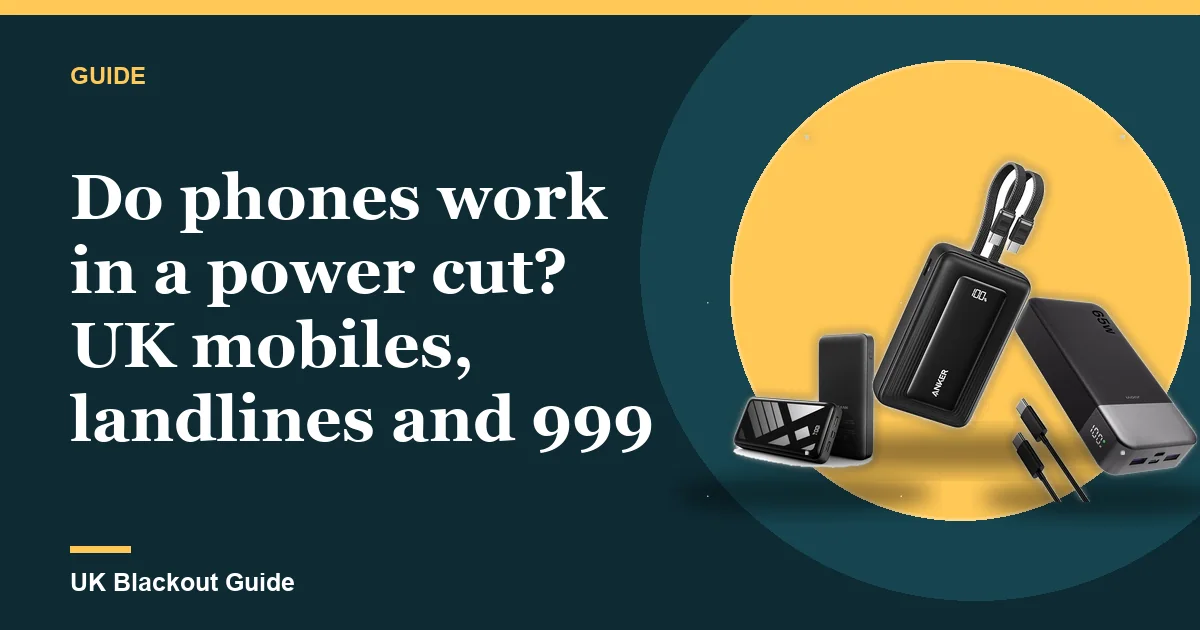
 Anker Power Bank 20,000mAh 45W★ 4.6 from 18,200 buyers · About £33Check price on Amazon
 27,000mAh 22.5W USB-C Power Bank★ 4.3 from 12,600 buyers · About £16.92Check price on Amazon
Chosen from Amazon UK listings on specification, price and buyer ratings. Not hands-on tested. We earn a commission if you buy.
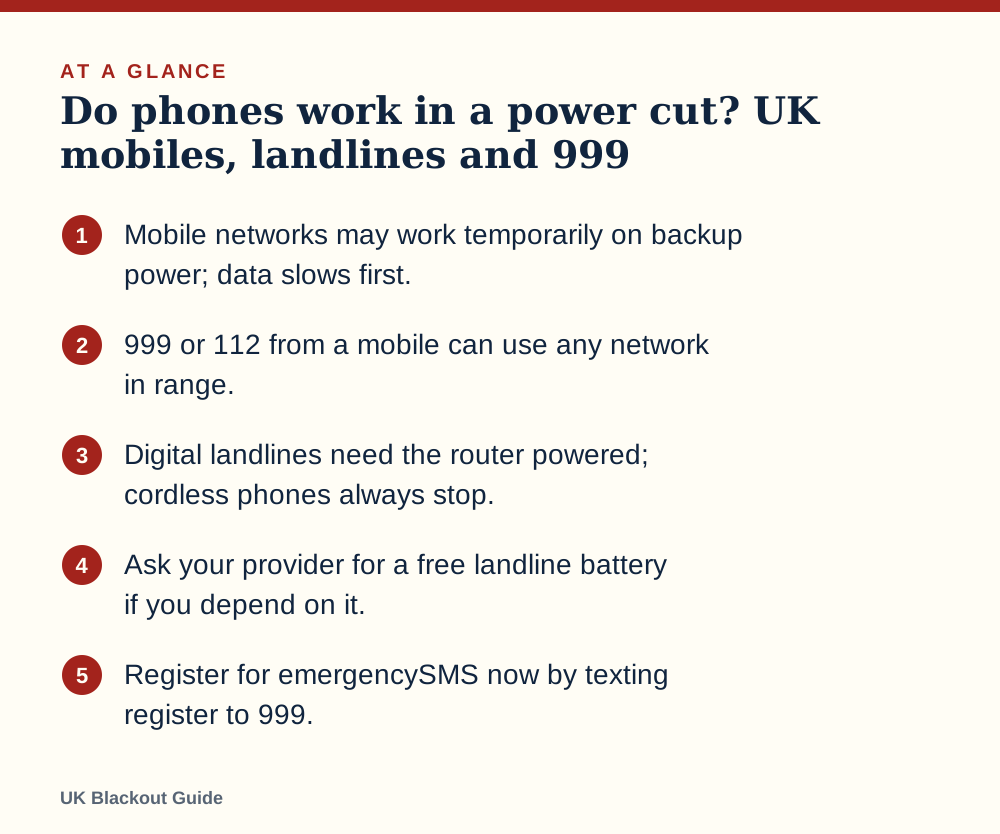
- Mobile networks may work temporarily on backup power; data slows first.
- 999 or 112 from a mobile can use any network in range.
- Digital landlines need the router powered; cordless phones always stop.
- Ask your provider for a free landline battery if you depend on it.
- Register for emergencySMS now by texting register to 999.
- A power bank and a wind-up radio cover most households.
The direct answer: mobiles may work for a while, digital landlines need power
Your mobile itself works for as long as its battery lasts; the network is the weak point. The government's Be Ready campaign says mobile networks may keep working temporarily in some areas on backup power, so signal can fade as a cut goes on. Landlines depend on the type: a digital landline runs through your router and stops with the mains unless it has battery backup, while a corded phone on a traditional copper line may still work.
Emergency calls have the best chance of all. From a mobile, a 999 or 112 call can roam onto any available network, not only your own, so dial even if the screen shows no service.
| Phone | In a power cut |
|---|---|
| Mobile phone | Works on its battery; network may work temporarily on mast backup |
| 999 or 112 from a mobile | Can roam onto any network still in range |
| Corded phone, traditional copper line | May keep working on power from the line |
| Digital landline (plugs into the router) | Stops unless the router has battery backup |
| Any cordless phone | Stops: the base station needs mains power |
| Wi-Fi calling | Stops when the router loses power |
| Walkie-talkies | Work handset to handset over short range, no network needed |
Home Wi-Fi stops as soon as the router loses power, so your phone falls back to mobile data. That adds traffic to the masts still running, and data can slow to a crawl. Texts often get through when calls struggle, because they need far less network capacity.
How long mobile masts keep working
There is no single figure. A mobile network is made up of many thousands of sites, and they are not built alike. Some have batteries, a smaller number of important sites have generators, and small sites on rooftops and lamp posts may have very little backup at all. How long each lasts also depends on the age of its batteries and how busy it is. Treat any confident number of hours you see quoted as a guess.
Where the cut is matters as much as how long it lasts. If only your street is off, the mast serving you may be on a different part of the electricity network and carry on as normal.
What you are likely to notice
Service rarely stops all at once. Data tends to slow first, because everyone nearby has lost home Wi-Fi and is using the same mast. Calls may take several attempts, and texts often keep getting through after apps have stopped loading. As sites run down, coverage becomes patchy: signal upstairs and none in the kitchen, or a short walk that brings it back. Each operator has its own sites and backup, so one network can keep working locally after another has dropped. Your phone works harder to hold a weak signal, so its battery drops faster.
When the power returns, signal usually comes back soon after, though sites may take a little time to restart and the network can be busy at first.
What has happened elsewhere
Past events show what has happened, not what will happen here. In Lancaster in December 2015, a flooded substation cut power to about 61,000 properties and mobile and internet services failed locally. Across Spain and Portugal on 28 April 2025, phones were widely disrupted during a blackout from which most supply was back by the early hours of the next day; the account of the Spain and Portugal blackout covers what people found useful. The National Risk Register describes a national outage as low likelihood but very high impact, with knock-on effects on mobile and internet services.
Plan as if the signal will go
Use the early part of a cut, while the network is up, to send the messages that matter and check your network operator's update. Then treat the phone as something that may become a clock with a torch. News after that point comes by radio: broadcast transmitters cover wide areas, and the BBC has described generator-backed FM transmitters as part of its emergency plans. The government's Emergency Alerts, loud messages sent to 4G and 5G phones in a life-threatening emergency, also need mobile signal to reach you, as how Emergency Alerts work explains.
Do landlines still work in a power cut
It depends which kind you have. Look at where your phone plugs in.
- If it goes into the back of your broadband router, or into an adaptor connected to the router, you have a digital landline. Calls are carried over the internet connection, so they need the router, and the router needs the mains.
- If it plugs into a wall socket with no router involved, you are probably still on a traditional line. That line carries a small amount of power from the exchange, which is why an old corded phone can ring and dial with the house in darkness.
You can test it. Unplug the router for a minute and lift the handset. No dial tone means the line is digital. If you are unsure, ring your provider and ask one question: does my landline work if my router is unplugged.
The word "corded" matters. The Be Ready campaign says a corded landline may work in a power cut. A cordless handset talks to a base station that plugs into the mains, so it dies with everything else, whatever line it is on. If you have a traditional line and a cordless phone, plug a corded phone into the socket instead.
Digital landlines: what changed and what your provider must offer
For decades the standard advice was that a plain corded phone would keep working in a power cut, because the copper phone network carried its own small supply from the exchange. That is still true for homes on a traditional line. But providers are moving customers to digital landlines, where calls travel over broadband. The handset and the number stay the same; the phone now plugs into the router, and when the router loses power, the landline goes with it.
You keep your number when you go digital and can usually keep your handset. The change is being made across providers' networks, so you generally cannot stay on the old system indefinitely, but you can ask for extra support if you depend on the line. Your provider should write to you before switching.
Full fibre needs two boxes powered
Full fibre homes often have a second small box on the wall where the fibre enters, called an ONT. It needs power too, so any backup has to feed both boxes or the line will still drop.
Backup at home has a limit
A battery at your end keeps your equipment alive. If the provider's own street equipment loses power in a wide or long outage, the line can still fail. A backed-up landline suits local faults and rota cuts of about three hours, and is helpful but not certain beyond that. The guide to keeping Wi-Fi on in a power cut explains what sits between you and the exchange.
Alarms and devices on the phone line
Telecare and personal alarm pendants, some burglar alarms and some older medical monitoring devices dial out over the landline. After a digital switch they depend on the router like everything else. Tell your telecare provider and your phone provider about each other before any change, and ask how long the alarm works without mains. The page on looking after older relatives in a power cut covers pendant alarms and regular check-ins.
Getting a free backup battery for your landline
Possibly. Providers may give customers who depend on their landline a free battery backup unit that keeps it working for at least one hour in a power cut. You have to ask; the offer is not always made automatically.
Who is likely to qualify
Each provider sets its own criteria, but the scheme is aimed at people who depend on a landline to call for help. You are in the group they have in mind if any of these apply:
- You have no mobile phone, or cannot use one.
- There is no reliable mobile signal inside your home.
- You have a telecare or pendant alarm connected to the line.
- You have a disability, health condition or other circumstance that means you would struggle to get help another way.
You do not have to be elderly. If you are on the Priority Services Register for your electricity, say so, but it is a separate scheme and your phone company does not automatically know about it.
How to ask
Ring your provider, or its accessibility or vulnerable customer team if it has one, and say plainly: "I depend on my landline to call for help in a power cut. Can you provide a battery backup unit?" Then ask three follow-up questions: how long will the unit keep the phone working, does it power everything needed (router and any fibre box), and will you replace the battery when it wears out. If you have a telecare alarm, tell the alarm company too.
One hour is a minimum, so plan beyond it
An hour covers a short fault and gives you time to make calls at the start of a longer one. It will not see you through an evening or a three hour rota cut. Often the unit keeps your broadband on as well, for as long as it lasts. To extend cover, add a mini UPS of your own, keep a charged mobile and power bank, and keep a corded phone if your line is still copper.
A router draws only about 10 to 15 watts, so a small battery unit can run one for hours. Runtime is roughly the capacity in watt-hours multiplied by 0.85, divided by the watts.
Some power banks can run a router with the right cable if the voltage matches, but a purpose-made mini UPS is simpler because it switches over automatically, with no break in the call.
Calling 999 in a power cut
You can still call 999. When you dial 999 or 112 from a mobile, the phone is allowed to use any network it can find, so a call can connect through another operator's mast when your own has no coverage or has lost power. 999 and 112 reach the same operators in the UK.
The screen can mislead you. "No service" means no service from your network. Some phones show "emergency calls only" or "SOS" when another network is in range. Either way, the test is to dial. If the call does not connect, move: go outside, go upstairs, or walk to higher or more open ground and try again. Masts lose backup power at different times, so a few hundred metres can make the difference.
Emergency calls are free and need no credit. Do not rely on a phone with no SIM, as behaviour varies. Mobiles can often send your location automatically during an emergency call, but always be ready to give your address or describe where you are.
From a landline
A corded phone on a traditional line may carry on working. A digital landline only works if the router and phone have backup power and the network is still running; otherwise use a mobile. Wi-Fi calling is in the same position as a digital landline.
Which number for which problem
| Situation | Number |
|---|---|
| Danger to life, fire, serious injury or illness, crime in progress | 999 or 112 |
| Power lines down or damaged equipment | 105, and 999 if anyone is in danger |
| Reporting a cut (England, Scotland, Wales) | 105 |
| Reporting a cut in Northern Ireland | 03457 643643 |
| Smell of gas or suspected carbon monoxide | 0800 111 999 |
| Medical advice that is not an emergency | 111 |
The power cut on its own is not a 999 matter; reporting a power cut on 105 is the route for that. Treat fallen cables as live and stay well back.
Carbon monoxide has no smell. If people in a home using a generator, barbecue or camping stove develop headache, dizziness, nausea or breathlessness, get everyone into fresh air and call 999.
Keep charge in reserve, and a plan if nothing works
The most common reason for being unable to call in a long outage is a flat phone. Set a floor, for example 20%, below which the phone is used for nothing except emergencies, and keep one phone in the household switched on and audible if anyone is unwell. If no phone works at all, try a neighbour, whose phone may be on a different network or line. Failing that, send someone to fetch help or reach a working phone while someone else stays with the casualty. Homes that rely on powered medical equipment should plan with their clinician well ahead, as medical equipment in a power cut describes; follow your own clinician's advice over anything general.
Texting 999: how to register
You can text 999 through the emergencySMS service, but only once your phone is registered. Register now, because doing it during an emergency costs minutes you may not have. It is free.
- Open a new text message and enter 999 as the number.
- Type the single word register and send it.
- Read the reply explaining the service.
- Reply with the word yes.
- Wait for a final message confirming your phone is registered.
Registration belongs to that phone number, so register again if you change number. It is worth doing on every mobile in the household, including older children's, and on the phone of anyone you care for.
Who it is for
emergencySMS was set up for people who are deaf, have hearing loss or have a speech impairment. Anyone may register, and it can help when speaking is not possible. It is not faster than a call: texts are relayed through an operator and each question and answer takes time. If you can talk, ring. There is also a British Sign Language video relay service, 999 BSL, for BSL users with a data connection.
What to write
Give three things in the first message: which service (police, ambulance, fire or coastguard), what has happened in a few words, and where, with the full address and postcode, or the road, town and a nearby landmark. For example: "Ambulance. Man collapsed, not breathing. 14 High Street, outside the post office, postcode if known." Then stay with your phone. If nothing comes back within about three minutes, send again or find another way to call. You cannot send photos, and messaging apps are not connected to 999.
Texting 999 in a power cut
A text needs the mobile network just as a call does, and unlike a voice call it may not roam onto another network, so try a call as well if you can make yourself understood. Texts do need very little capacity, so a message may get through on a congested network when calls fail.
Corded phones: when one still helps
On a traditional copper line, a basic corded phone that takes its power from the phone socket is the simplest emergency phone you can own. It has no battery to go flat and nothing to charge, and a handset kept in a drawer covers you even if your everyday phone is a feature model.
On a digital line, a corded phone is still the right handset to plug into a backed-up router, because it adds no power demand of its own; a cordless base would need backup power too.
Line-powered means no plug and no batteries
The simplest corded phones have one cable, to the phone socket, and nothing else. Once a phone adds a backlit display, an answerphone or call blocking, it usually needs a mains adaptor or batteries for those extras, and some lose more than the extras when the power fails. Look for wording such as "no AC power required". If the listing is silent, assume the phone needs mains and ask the seller.
For older and vulnerable users
Large, high-contrast buttons, a loud adjustable ringer, a flashing ring light and hearing aid compatibility all help in poor light. Speed dial can hold a family number and a neighbour. A phone fixed to the hall wall is easy to find in the dark.
To test one, plug it in and make a call, then switch off any mains adaptor and try again. On a digital line, also try it with the router unplugged. Whether it is worth keeping a landline just for power cuts depends on your mobile signal and who lives with you: for someone who relies on a landline or has poor mobile coverage, it can be.
Walkie-talkies: range, licence-free use and limits
Walkie-talkies keep working when mobile networks and broadband are down, as long as their batteries are charged. A mobile is a radio that talks to a mast, and the mast needs electricity; a walkie-talkie talks straight to another walkie-talkie, with nothing in between.
Licence-free PMR446
The sets sold for general use in the UK are PMR446 radios. They are licence-free, low powered by law with a fixed aerial, and any brand will talk to any other on the standard channels, provided both are on the same channel and any privacy code is matched or switched off. More powerful business or amateur radios need a licence, and some radios sold online are programmable sets meant for licensed users, so look for PMR446 or licence-free on the listing.
Range in practice
Packaging often quotes several kilometres. That assumes a clear line of sight, hilltop to hilltop. Walls, houses, trees and hills absorb the signal. In an ordinary housing estate, a few hundred metres is a fair expectation; between floors of one building or from house to garden to the end of the road they are usually reliable; in open country with a clear view you may get a kilometre or more. Output power is capped, so a dearer set does not buy more range: price mostly buys build, battery life and water resistance. Test them between the actual places you have in mind and note where contact drops.
Where they earn their place
Think short distances and simple messages: a parent indoors and children playing outside, two households checking on each other at set times, a carer a few doors from an older relative whose landline has stopped. Children can use them with simple rules: stay within the tested range, agree check-in times and never share personal details on air. One handset per person who may be away from the house, plus one that stays home, suits most families.
Limits to be clear about
Walkie-talkies cannot call 999, and nobody is listening on your behalf. Anyone nearby on the same channel can hear you, and privacy codes only filter what you hear, so do not read out addresses or say a house is empty. Sets that only charge from a mains dock are no help after a day or two: prefer USB charging, so a power bank or car can top them up, and keep spare cells if they take AA or AAA. The guide to batteries for emergencies covers rechargeables you can refill from a power bank. Agree a channel in advance, write it down, and switch on at agreed times rather than all day.
What to buy: budget, mid-range and high-end
Staying in touch in a cut comes down to a charged mobile, a radio for news, and, depending on your home, a corded phone, a router battery or a set of walkie-talkies. These picks come from Amazon UK listings, compared on what each listing states, price and buyer ratings. We have not tested them, and prices change.
High-end picks What the extra money buys in a power cut


JUOVI 65W 20,000mAh Power Bank
★ 4.5 from 1,100 buyers · About £40 when checked 18 November 2026The listing gives 20,000 mAh with 65W output, enough for many laptops as well as phones and walkie-talkies. It is rated 4.5 by more than 1,000 buyers.
- 65W covers many laptops
- Large capacity
- Good rating
- Fewer ratings than the big brands
- More than phones alone need
Motorola TALKABOUT T82 Extreme
★ 4.4 from 5,100 buyers · About £72 when checked 18 November 2026From one of the best known names in two-way radio, rated 4.4 by about 5,100 buyers. The title gives little specification, so check the pack contents, battery type and water resistance before paying the premium.
- Established brand
- Large ratings history
- No extra range over cheaper PMR446 sets
- Check battery type on the listing
Wind Up Solar Radio 20,000mAh
★ 4.5 from 167 buyers · About £54 when checked 18 November 2026The listing gives a 20,000 mAh battery with hand crank and solar charging and AM/FM reception, so it can top up phones several times as well as bring news. It is rated 4.5 by about 170 buyers.
- Large battery for phone top-ups
- Hand crank and solar
- FM
- Fewer ratings
- Heavier than a small radio
Mid-range picks The sensible middle for most homes


Anker Power Bank 20,000mAh 45W
★ 4.6 from 18,200 buyers · About £33 when checked 18 November 2026The listing gives 20,000 mAh and 45W output with two built-in USB-C cables, so there is no cable to lose. That works out at about three to four charges of a typical phone. It is rated 4.6 by more than 18,000 buyers.
- Built-in cables
- Huge ratings history
- Several days of phone use
- USB-C cables only
- Top it up every few months
APC Back-UPS Connect CP12036LI 12V Mini UPS
★ 4.2 from 571 buyers · About £47 when checked 18 November 2026The listing describes a 12V DC lithium-ion mini UPS designed for routers and VoIP devices, from a long-standing UPS brand. It switches over instantly, so a call does not drop when the mains fails. It is rated 4.2 by about 570 buyers.
- Built for routers and VoIP
- Instant switchover
- Known brand
- Check voltage and plug match
- Fibre boxes may need a second output
eSynic Rechargeable Walkie-Talkies, 4 Pack
★ 4.4 from 3,500 buyers · About £46 when checked 18 November 2026Four rechargeable handsets described as licence-free, at a little over £10 each, so every household on a short street can have one. It is rated 4.4 by about 3,500 buyers.
- Four handsets
- Licence-free
- Low cost per handset
- Rating may be shared with the brand's two-pack
- Check how they charge
iRonsnow Solar Hand Crank Emergency Radio
★ 4.6 from 6,300 buyers · About £35 when checked 18 November 2026The listing describes a solar and hand crank AM/FM radio with a 2,000 mAh battery. It is rated 4.6 by about 6,300 buyers, the most in its category here. The weather band in the title is a US service and is no use in the UK; buy it for FM.
- Hand crank and solar
- Strong rating from many buyers
- FM
- US weather band is irrelevant here
- Small battery for phone charging
Budget picks Cheapest ways to be covered


27,000mAh 22.5W USB-C Power Bank
★ 4.3 from 12,600 buyers · About £16.92 when checked 18 November 2026The listing gives 27,000 mAh with 22.5W fast charging, a large store for the price, rated 4.3 by more than 12,000 buyers.
- High stated capacity
- Low price
- Many ratings
- Unbranded listing
- Slower output than 45W models
VTech CD1100 Trimstyle Corded Phone
★ 4.3 from 547 buyers · About £7.99 when checked 18 November 2026The title states plainly that no AC power is required, the property you are buying for. It lists last number redial, ringer control, receiver volume and hearing aid compatibility. It is rated 4.3 by about 550 buyers.
- Listing says no mains needed
- Very cheap standby
- Hearing aid compatible
- Only works on a copper line in a cut
- Basic features
VTech SA3100 Corded Senior Phone
★ 4.4 from 47 buyers · About £18.21 when checked 18 November 2026The listing combines high-contrast large buttons, talking digits, a visual ringer, speed dial and a speakerphone with an older user in mind. It is rated 4.4, though from fewer than 50 buyers.
- Large high-contrast buttons
- Visual ringer
- Speed dial
- Few ratings so far
- Check which features need power
Retevis RT24 PMR446 Walkie-Talkies, 2 Pack
★ 4.6 from 4,800 buyers · About £29 when checked 18 November 2026The RT24 is listed as a PMR446 radio, the licence-free band in the UK, and comes as a pair with earpieces. It is rated 4.6 by about 4,800 buyers, a sound start for a couple or two neighbouring homes.
- Licence-free PMR446
- Earpieces included
- Strong rating
- Real range is a few hundred metres in town
- Charge both before a cut
2000mAh Wind Up Solar Emergency Radio
★ 4.5 from 61 buyers · About £16.99 when checked 18 November 2026The listing describes an AM/FM radio with hand crank and solar charging, a 2,000 mAh battery, an LED torch and USB phone charging. It is rated 4.5, though from only about 60 buyers.
- Hand crank and solar
- FM reception
- Torch and phone top-up
- Few ratings
- A 2,000 mAh battery gives only a partial phone charge
Start with a 20,000 mAh power bank, about three to four phone charges, and a wind-up radio; together they cost around £50 to £70 and cover most households. Add a line-powered corded phone, under £20, only if your landline is still copper. A router battery at £45 to £60 is worth it if you rely on a digital landline or broadband alarm. Walkie-talkies are optional, and a dearer pair buys no extra range, so spend on enough handsets rather than a premium brand. The high-end radios add a bigger battery to charge a phone; that helps in a long cut but is not needed for a short one.
What the official advice says about phones
The government's Be Ready campaign, launched on 22 October 2026, asks households to be able to manage for three days. It presents this as general preparedness, not a forecast, and no national blackout has been forecast or announced. Its points on phones and contact are:
- Keep a charged power bank in your kit.
- A corded landline may work in a power cut.
- Mobile networks may work temporarily in some areas on backup power.
- Emergency calls from a mobile can roam onto any available network (999 or 112).
- Keep a battery or wind-up radio, and try both FM and digital stations.
- Keep a written list of contacts and medication.
- Check on neighbours.
On landlines, providers may give people who depend on one a free battery backup unit lasting at least an hour. On texting, emergencySMS needs registration first. The full official kit list and how to build it slowly is in preparing for a power cut in the UK.
A battery or wind-up radio is the official answer to news when phones fail. Look for FM reception, a hand crank and USB charging, and the comparison of emergency radios sets out the options.
Making a phone battery last
Treat the charge you have as a fixed budget. Turn the screen brightness down, switch on low power mode, and use texts instead of calls and video. Use a torch for light and save the phone for communication. In a longer cut, switching off between agreed check-in times saves the most.
A charged power bank is on the official kit list. Usable phone charges are roughly the capacity in mAh multiplied by 0.65, divided by your phone's battery size, so a 20,000 mAh bank gives about three to four charges of a typical phone. Recharge it every few months, because a flat power bank is no use, and see power banks for power cuts for sizes from one person to a family.
Write key numbers on paper: 105, your network operator, family, neighbours, GP and pharmacy. A contacts list stored in a dead handset is no help. Agree with family where you would meet and when you would check in if phones fail, and know which neighbour has a different network or line from yours.
Checklist
Do phones work in a power cut? UK mobiles, landlines and 999
- Check whether your landline is copper or digital
- Keep a line-powered corded phone if you are still on copper
- Ask your provider for a battery backup if you depend on the landline
- Register every mobile for emergencySMS
- Keep a power bank charged and top it up every few months
- Keep a wind-up or battery radio with FM
- Write key numbers on paper, including 105
- Agree a check-in time and meeting place with family
- Tell your telecare provider about any digital switch
- Agree a walkie-talkie channel with neighbours if you use them
What the research found
These are published reports and statistics, summarised by us. They record what was measured or what happened; none is a forecast.
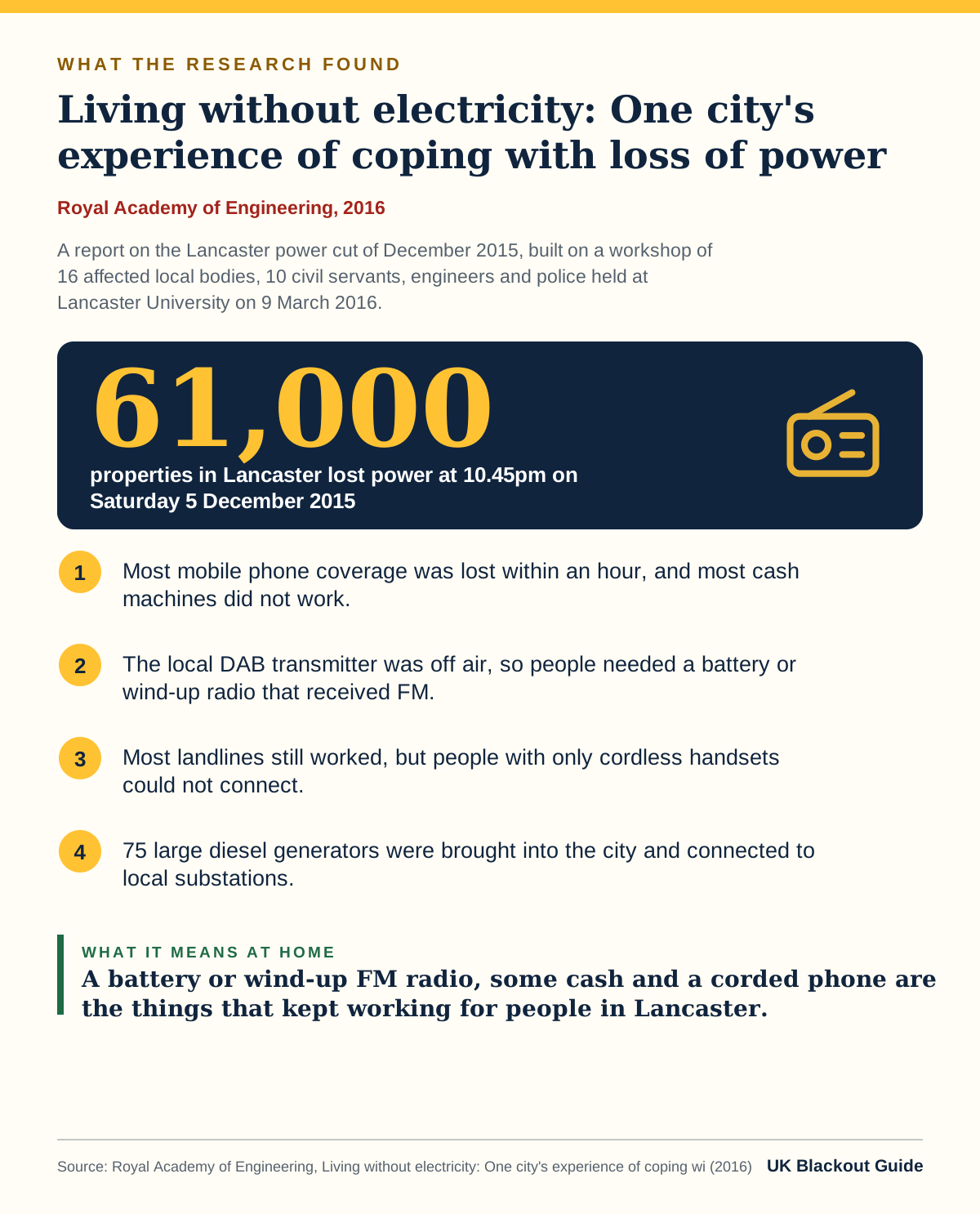
Royal Academy of Engineering (2016). A report on the Lancaster power cut of December 2015, built on a workshop of 16 affected local bodies, 10 civil servants, engineers and police held at Lancaster University on 9 March 2016. A battery or wind-up FM radio, some cash and a corded phone are the things that kept working for people in Lancaster.
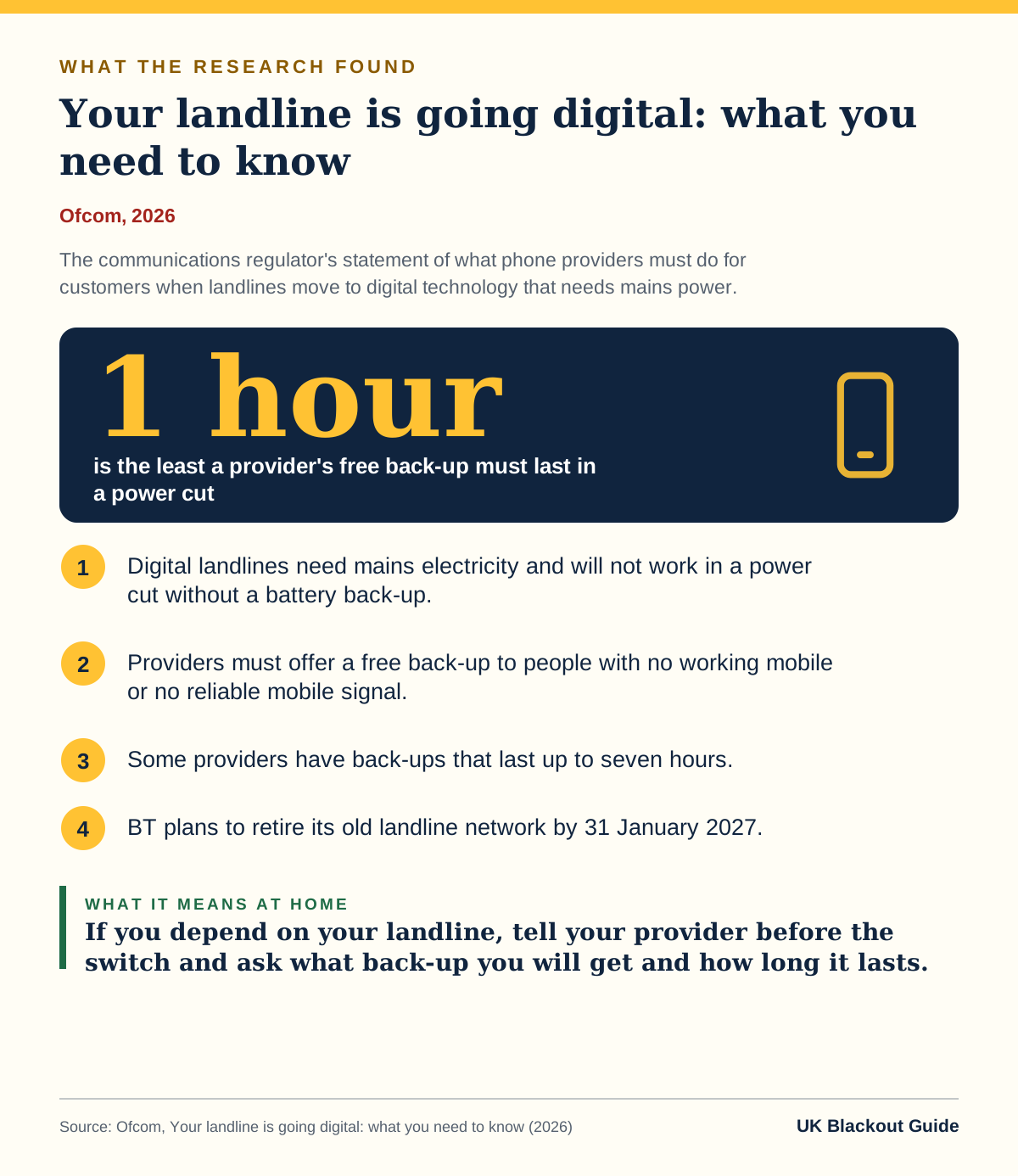
Ofcom (2026). The communications regulator's statement of what phone providers must do for customers when landlines move to digital technology that needs mains power. If you depend on your landline, tell your provider before the switch and ask what back-up you will get and how long it lasts.
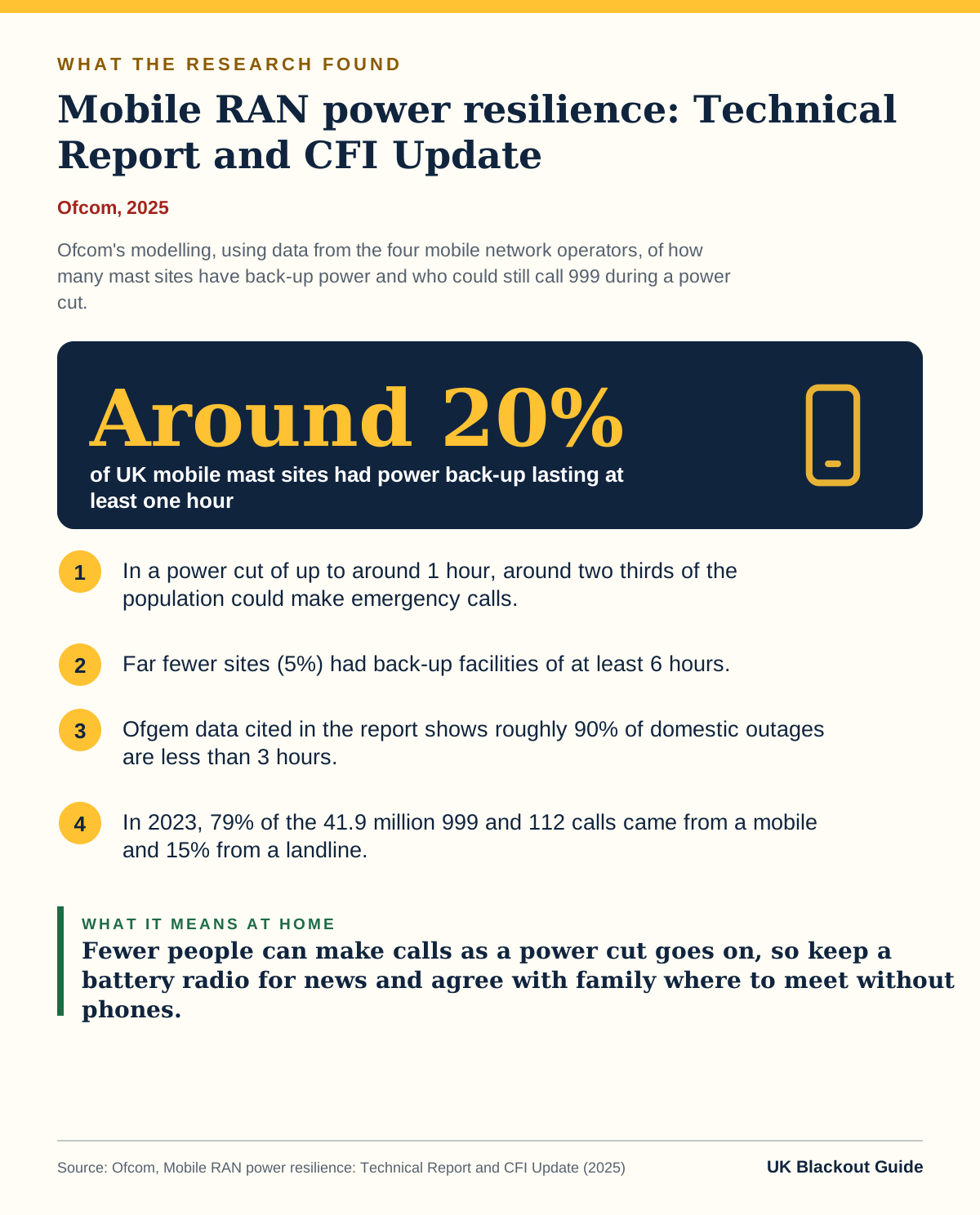
Ofcom (2025). Ofcom's modelling, using data from the four mobile network operators, of how many mast sites have back-up power and who could still call 999 during a power cut. Fewer people can make calls as a power cut goes on, so keep a battery radio for news and agree with family where to meet without phones.
Our data: what this costs
We recorded the price and buyer rating of every relevant listing we found on Amazon UK for this guide, 126 in all, and worked out the spread. These are our own figures, not a retailer's or a manufacturer's.
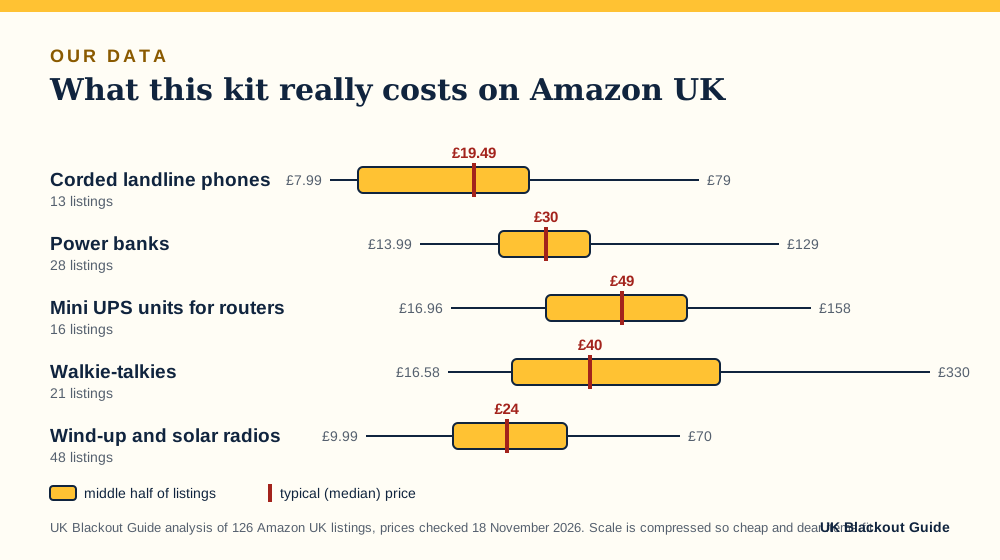
- The typical (median) price for corded landline phones is £19.49, and half of all listings fall between £9.50 and £27.
- The widest spread is in walkie-talkies: the dearest listing costs about 8 times the typical one, so the top of the range is rarely needed for a power cut.
- 66% of wind-up and solar radios listings are rated 4.5 stars or higher by buyers, the highest share in this group.
| Product type | Listings | Cheapest | Typical | Middle half | Dearest | Rated 4.5+ |
|---|---|---|---|---|---|---|
| Corded landline phones | 13 | £7.99 | £19.49 | £9.50 to £27 | £79 | 8% |
| Power banks | 28 | £13.99 | £30 | £23 to £40 | £129 | 57% |
| Mini UPS units for routers | 16 | £16.96 | £49 | £30 to £73 | £158 | 21% |
| Walkie-talkies | 21 | £16.58 | £40 | £25 to £90 | £330 | 38% |
| Wind-up and solar radios | 48 | £9.99 | £24 | £17.18 to £35 | £70 | 66% |
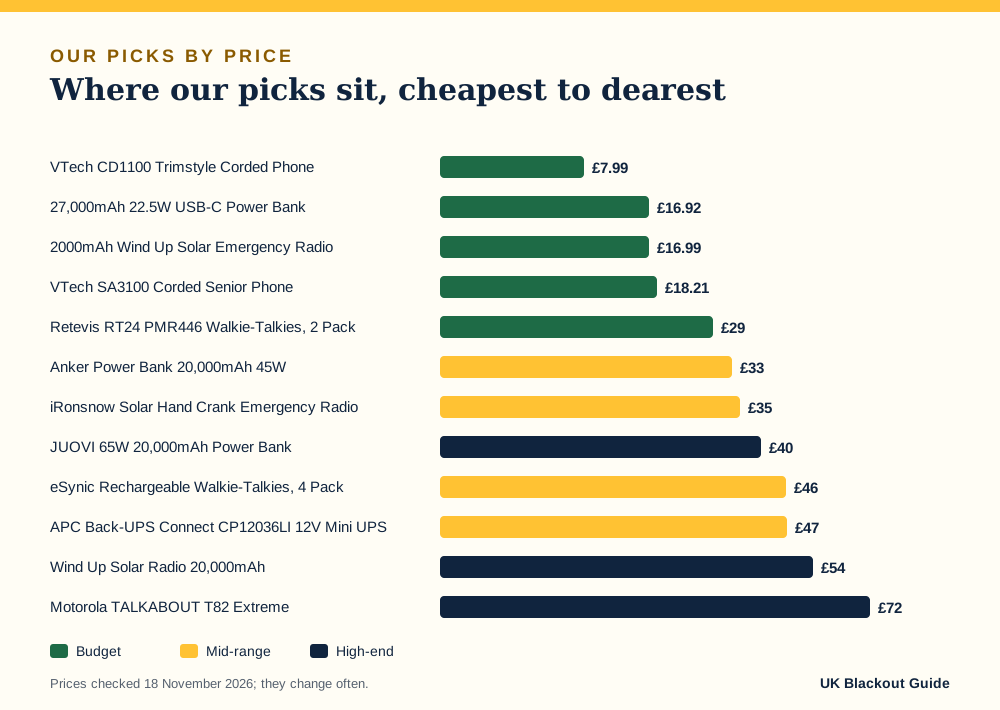
Method: one search page per product type on Amazon UK, off-topic listings removed, prices and ratings as shown on 18 November 2026. It is a snapshot, not a full market survey, and prices move.
Common questions
Will texts get through when calls do not?
Often, yes. A text needs far less network capacity than a call, so it can get through on a weak or busy network, sometimes after a delay.
Does Wi-Fi calling work in a power cut?
Only if your router and the broadband line still have power. Without a backup battery on the router, Wi-Fi calling stops with the mains.
Do all mobile networks fail at the same time?
No. Each operator has its own sites and backup, so one network can keep working locally after another has dropped.
Will my cordless phone work on a traditional line?
No. The base station needs mains power, so the handsets stop. Plug a corded phone into the socket instead.
How long does a provider's landline backup battery last?
At least one hour. Ask your provider what the unit it supplies offers and whether it will replace the battery when it wears out.
Is 112 different from 999?
No. Both connect to the same emergency operators in the UK, from mobiles and landlines.
Should I call 999 to report a power cut?
No. Call 105, or 03457 643643 in Northern Ireland. Use 999 only if there is danger to life.
Does it cost anything to text 999?
No. Registering and sending emergency texts are free.
Do I need a licence for walkie-talkies in the UK?
Not for PMR446 sets, which are licence-free. More powerful or programmable radios can need a licence.
Should I keep my phone switched off to save battery?
Low power mode with the screen dimmed is usually enough. In a longer cut, switching off between agreed check-in times saves the most.
- Be Ready campaign, UK government
- Emergency Alerts, GOV.UK
- Power Cut 105
- The Priority Services Register
- Age UK
- National Risk Register, Cabinet Office
Reviewed against these sources on 18 November 2026. If official advice has changed since, follow the official advice.
General information only. This page is not professional, safety, medical, legal or financial advice, and it is not official guidance. No national blackout has been forecast or announced, and nothing here suggests one is expected. We are independent and have no connection to the government or any energy company. Always check the official sources linked on this page. Full disclaimer
Keep reading
 Buying guide
What is the best emergency radio for a UK blackout?
Best emergency radios for a UK blackout: battery FM and DAB sets, wind-up and solar radios, which station to tune to and the frequencies to write down now.
Read: What is the best emergency radio for a UK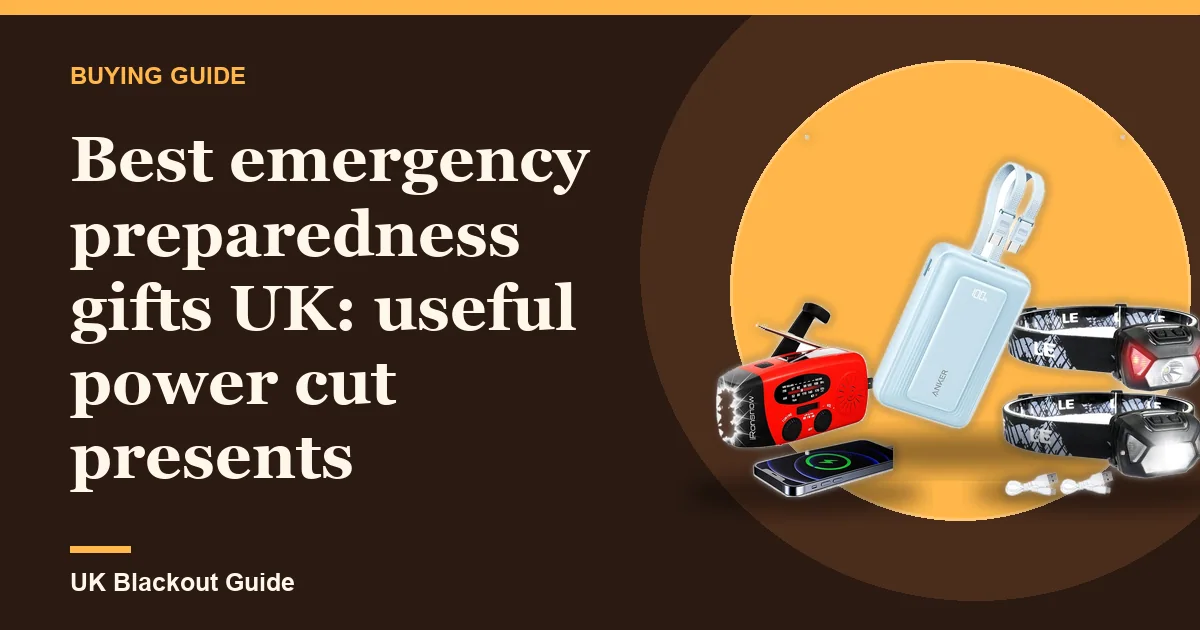 Buying guide
Best emergency preparedness gifts UK: useful power cut presents
Ten emergency preparedness gifts that work in a power cut: radios, power banks, head torches, hand warmers and flasks picked from Amazon UK listings.
Read: Best emergency preparedness gifts UK: useful Explainer
Spain and Portugal blackout 2025: what happened and UK lessons
On 28 April 2025 Spain and Portugal lost all power for most of a day. Phones, cards and trains failed. What happened and the practical lessons for UK homes.
Read: Spain and Portugal blackout 2025: what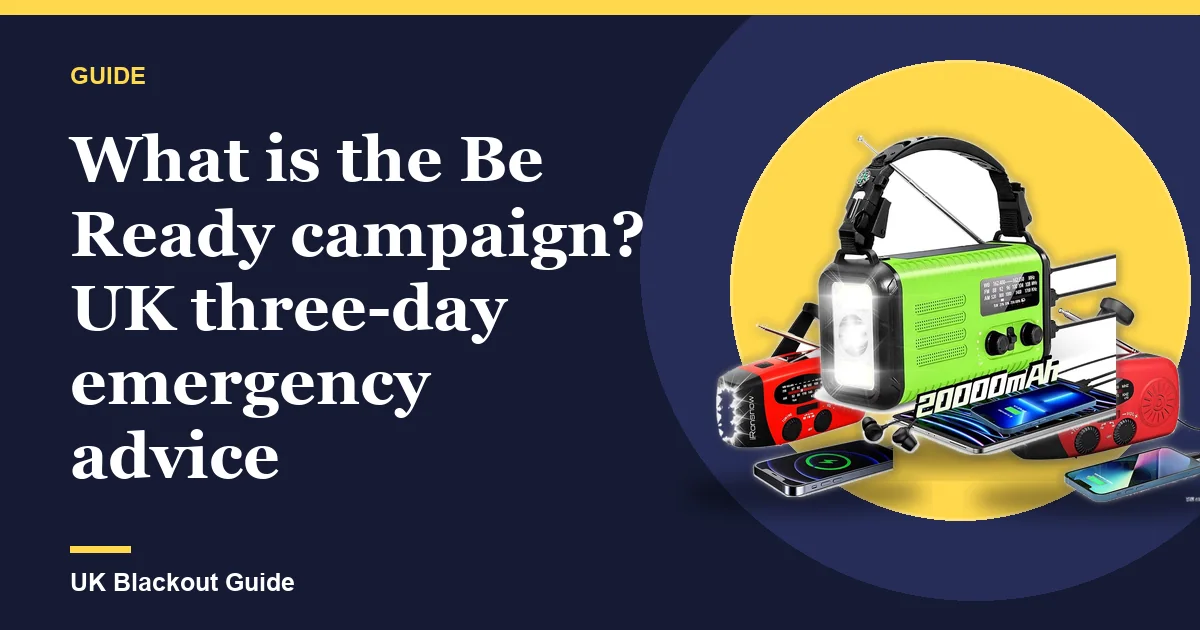 Guide
What is the Be Ready campaign? UK three-day emergency advice
Be Ready campaign explained: what the UK government's three-day advice asks households to do, the official kit list, and what the three-day claim really means.
Read: What is the Be Ready campaign? UK three-day