On this page
- In pictures
- The short answer: no national blackout has been forecast or announced
- What the government has said, and what it has not said
- Is there a date for a UK blackout? Where the "when" rumours come from
- Is the blackout warning real? Be Ready is general preparedness, not a forecast
- How likely is a national blackout: what the National Risk Register says
- Will there be power cuts this winter? What official bodies have published
- Why everyone is talking about blackouts in 2026: a dated timeline
- Local power cut, rota cut or national outage: three different things
- Should you be worried? Putting the risk in proportion
- Is preparing sensible or paranoid? What a calm three-day plan looks like
- Coping with worry about blackouts, for adults and children
- What to buy if you want to be ready: budget, mid-range and high-end
- Sources and how we check official statements
- Checklist
- What the research found
- Our data: what this costs
- Common questions
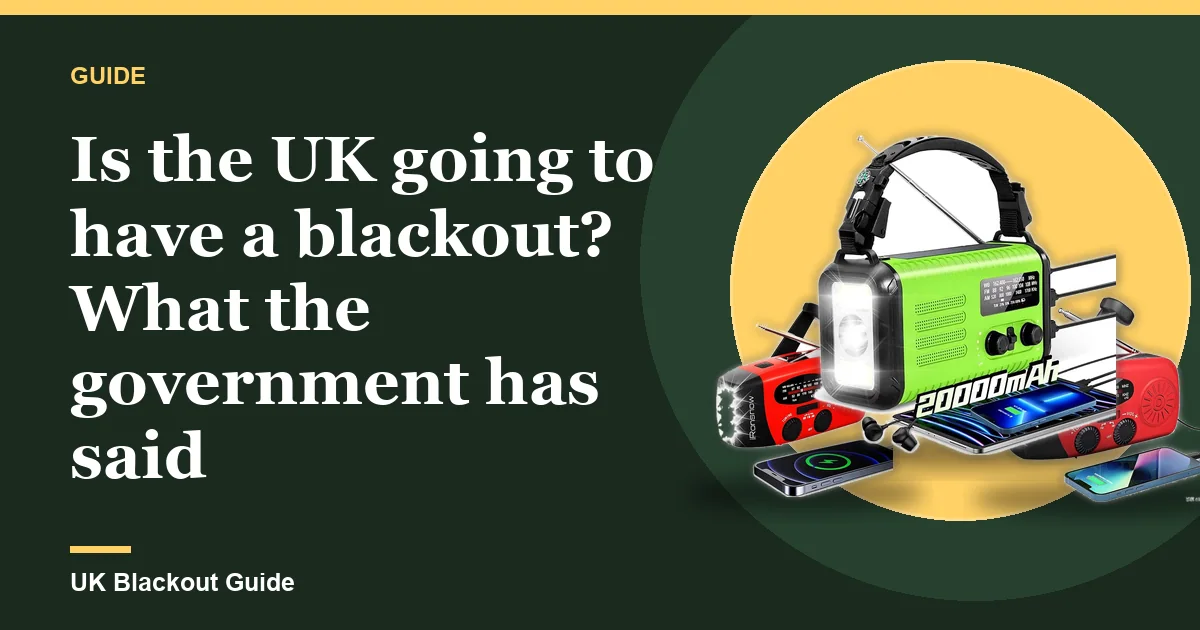
No national blackout has been planned, announced or forecast for the UK, and no official body has given a date. The government's Be Ready campaign, launched on 22 October 2026, asks households to be able to manage for three days as general preparedness, not as a forecast. The National Risk Register describes a national power outage as low likelihood but very high impact.
 iRonsnow Solar Hand Crank Emergency Radio, 2000mAh★ 4.6 from 6,300 buyers · About £35Check price on Amazon
 Solarbaby Wind Up Solar Radio, AM/FM★ 4.2 from 5,000 buyers · About £25Check price on Amazon
 Wind Up Solar Radio 20000mAh, Hand Crank AM/FM★ 4.5 from 167 buyers · About £54Check price on Amazon
Chosen from Amazon UK listings on specification, price and buyer ratings. Not hands-on tested. We earn a commission if you buy.
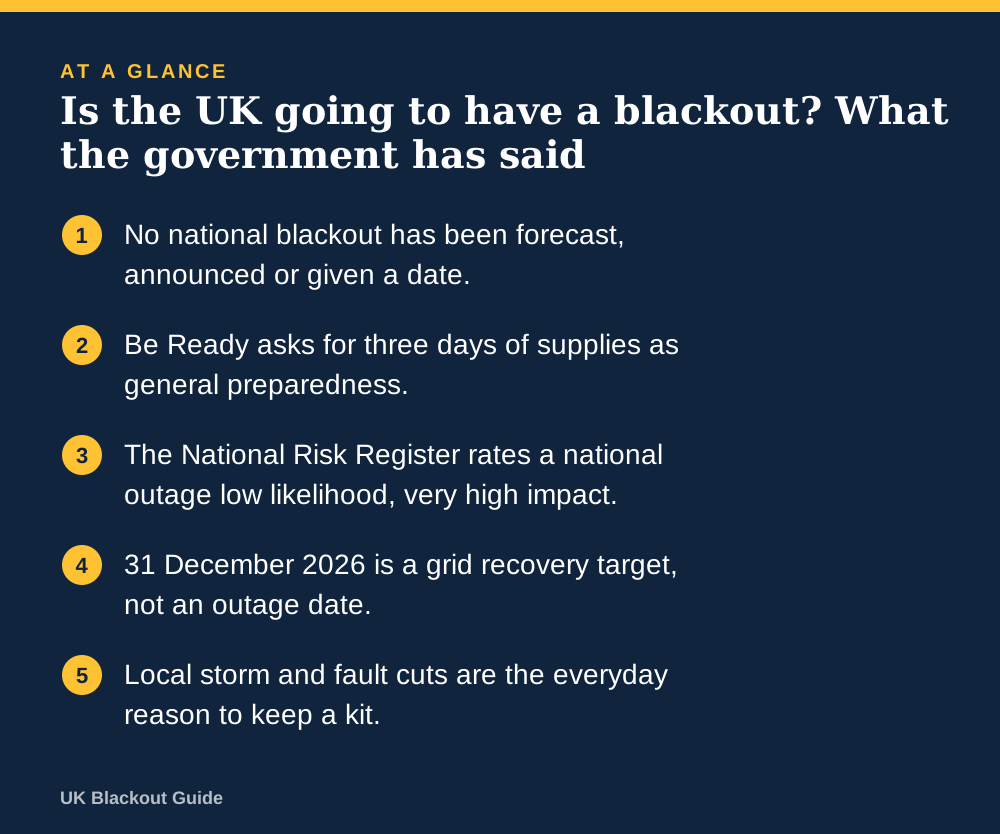
- No national blackout has been forecast, announced or given a date.
- Be Ready asks for three days of supplies as general preparedness.
- The National Risk Register rates a national outage low likelihood, very high impact.
- 31 December 2026 is a grid recovery target, not an outage date.
- Local storm and fault cuts are the everyday reason to keep a kit.
In pictures: the numbers that matter
The short answer: no national blackout has been forecast or announced
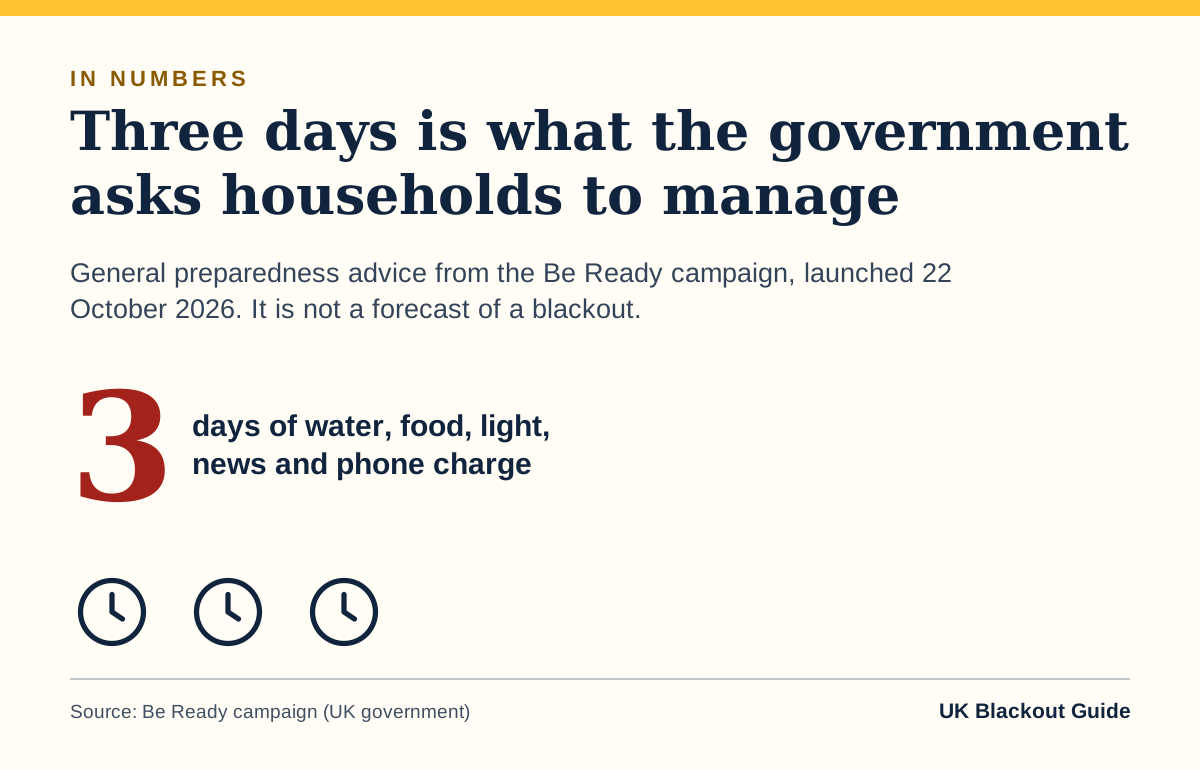
No. No national blackout has been planned, announced or forecast for the UK, and nobody in authority has given a date. What the government has said, through its Be Ready campaign launched on 22 October 2026, is that every household should be able to manage for three days. It presents that as general preparedness for emergencies of all kinds, not as a forecast of a blackout.
The government's National Risk Register describes a national power outage as low likelihood but very high impact. Those two halves belong together. The impact is why government, grid and broadcasters plan for it. The likelihood is why the household ask is a modest three days of supplies, not anything more dramatic.
Ordinary local power cuts are a separate, everyday matter. They happen somewhere in the UK every day, mostly from storms and equipment faults, and most are fixed within hours. The same small kit helps in both.
This page sets out exactly what official bodies have said and not said, where the recent headlines came from, and what a calm, proportionate response looks like. Every statement about risk below names its source. We last checked them on 18 November 2026.
What the government has said, and what it has not said
What has been said
| Source | What it said |
|---|---|
| Be Ready campaign (UK government, 22 Oct 2026) | Households should be able to manage for three days. General preparedness, not a forecast. |
| National Risk Register (Cabinet Office) | A national power outage is low likelihood but very high impact. Restoring the transmission system could take up to about 7 days. |
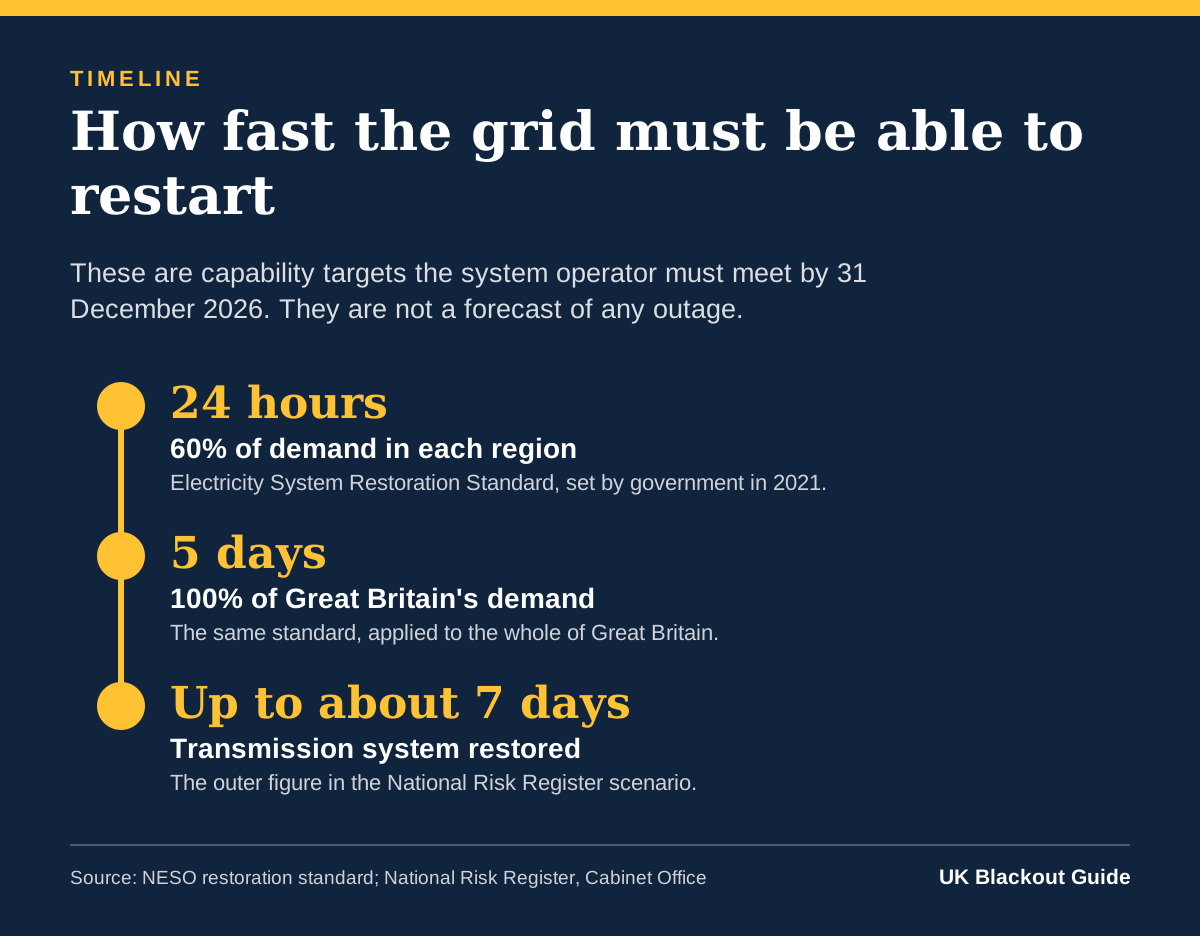
| Electricity System Restoration Standard (set by government, 2021) | By 31 Dec 2026, NESO must be able to restore 60% of demand in each region within 24 hours and 100% of Great Britain's demand within five days. |
| Exercise Mighty Oak (government, 2023) | A national power outage exercise rehearsing the response. |
| BBC report (7 Nov 2026) | How the BBC would keep broadcasting on FM from an emergency studio, with generator-backed transmitters and supplies for at least three days. |
What has not been said
It helps to be exact about what is missing from the official record. As of 18 November 2026:
- No official body has given a date, month or season for a blackout.
- No official body has said a national blackout is expected or likely.
- No official body has named a cause it expects to bring one about.
- The government has not asked households to prepare for longer than three days.
- The government has not told people to buy generators or to stockpile.
Posts and videos that give a date, a cause or a longer timescale are adding something the official sources do not contain. That is the single most useful test to apply to anything you read.
Is there a date for a UK blackout? Where the "when" rumours come from
There is no date for a UK blackout, because no blackout has been announced, planned or forecast by the government, by NESO (the National Energy System Operator, which runs Great Britain's electricity system) or by any network operator. Claims of a leaked date do not match anything any of them has published, and since no date has been set, there is nothing to leak.
Three real dates appear in genuine official or news sources, and each is easy to misread:
- 22 October 2026: the government launched Be Ready, its household preparedness campaign.
- 7 November 2026: the BBC reported on how it would keep broadcasting on FM radio during a long outage.
- 31 December 2026: the deadline for NESO to have the capability to restore 60% of demand in each region within 24 hours and 100% of Great Britain's demand within five days.
The last one causes the most confusion. It is a target for recovering faster after a failure, set by government back in 2021. It is a date on a regulator's calendar, not a date on which anything is expected to happen. The engineering job it describes, restarting the grid from nothing in stages, is explained in our guide to how long a national blackout could last.
Power cuts that do come with a date
Some power cuts are planned. Network operators switch off small areas for maintenance and give notice beforehand. Separately, in a national energy shortage, rota power cuts could be used: planned cuts of about three hours at a time, organised by load block letter, which you can find at powercut105.com or on some bills. These would be announced in advance. None has been announced. Faults and storm damage cannot be scheduled, which is why a basic kit is kept ready rather than bought when a date appears.
Is the blackout warning real? Be Ready is general preparedness, not a forecast
The campaign is real. The forecast that many posts describe is not. No official body has issued a warning that a blackout is coming.
Be Ready is the UK government's household preparedness campaign, at beready.campaign.gov.uk. It was previously called Prepare. It asks households to be able to manage for three days without outside help, and it covers emergencies in general, including flooding and severe weather as well as power cuts. The government presents it as general preparedness. Nothing in it says a blackout is expected. Our page explaining the Be Ready campaign goes through it in full.
The official kit list
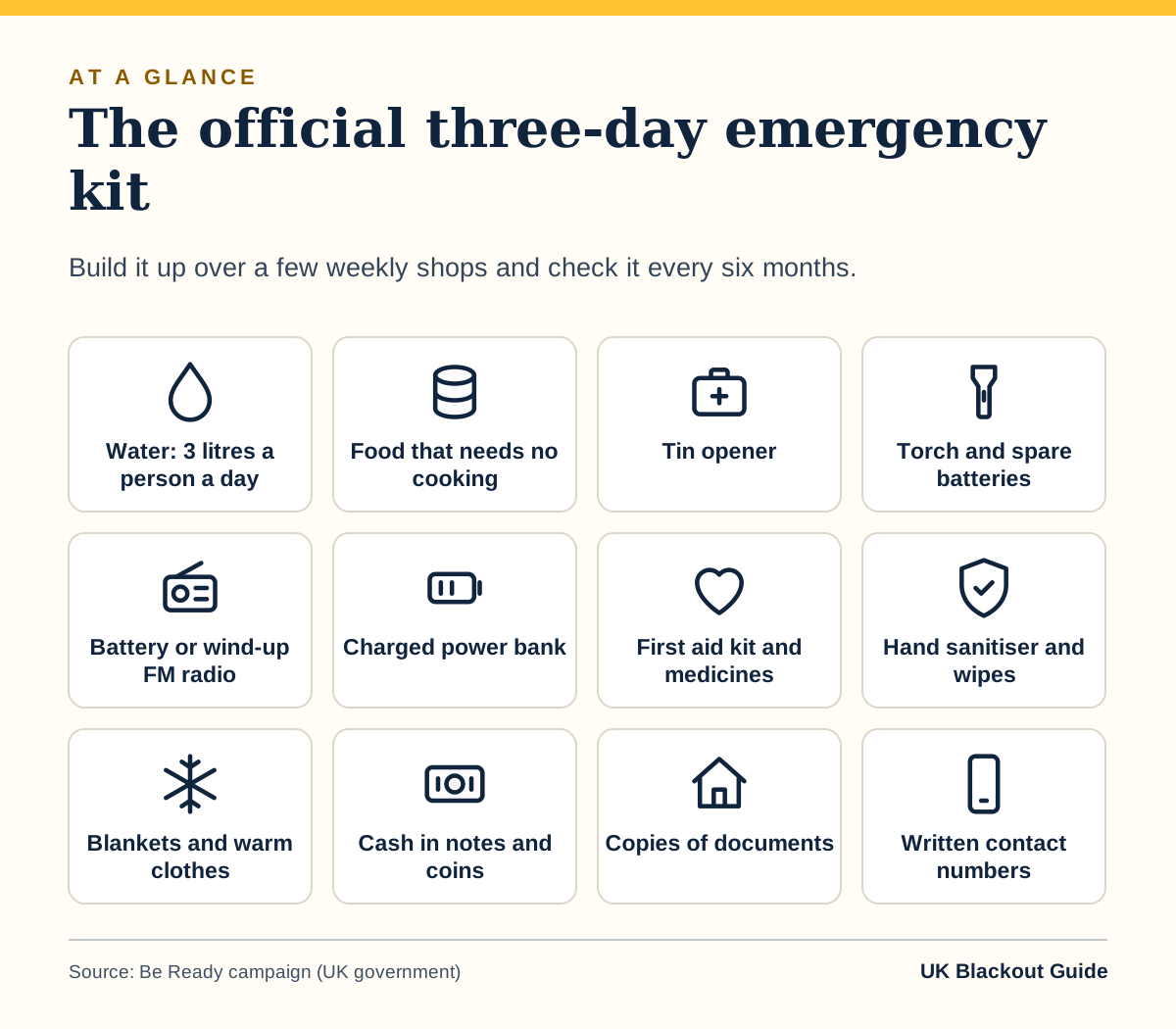
Be Ready lists bottled water for three days (3 litres per person per day for drinking, more for cooking and washing), non-perishable food that needs no cooking or fridge, a tin opener, a battery or wind-up torch with spare batteries, a battery or wind-up FM radio, a charged power bank, a first aid kit, essential medication, hand sanitiser and wet wipes, blankets and warm clothing, cash in notes and coins, printed copies of documents, a written list of contacts and medication, baby supplies and pet food. It advises building the kit gradually and checking it every six months.
How to check a claim you have seen
- Does it name a date or a cause? No official source does. A post that does has added it.
- Does it name a source you can open? Go to the Be Ready site, neso.energy or your network operator's site and look for the same words.
- Does it ask you for anything? Official advice never asks for payment, bank details or a click on a link to "register". Look-alike sites that sell products or ask for details are a known trick, set out in our guide to scams during power cuts.
Genuine Emergency Alerts are sent by the government to 4G and 5G phones only in a life-threatening emergency, and they need mobile signal. We know of no Emergency Alert about a blackout. Be Ready is a public information campaign, not an alert, and real alerts never ask you to reply or pay; our explainer on how Emergency Alerts work shows what one looks like.
How likely is a national blackout: what the National Risk Register says
The National Risk Register, published by the Cabinet Office, sets out the most serious risks that could affect the UK, from severe weather to pandemics, and rates each for how likely it is and how much harm it would do. It describes a national power outage as low likelihood but very high impact.
Low likelihood is the register's rating for the chance of it happening. It does not mean impossible, and the register puts no date or season on it. Very high impact is its rating for the harm one would do, because of the knock-on effects it describes on other essential services.
The register is a planning document. Its main readers are councils, emergency services, utilities and businesses, and an entry means a risk has been judged serious enough to prepare for. It does not mean the event is expected. People insure their homes against fire and wear seatbelts on every journey without expecting a fire or a crash.
The knock-on effects it names
| Service affected | What it means at home | The simple precaution |
|---|---|---|
| Water | Supply may be disrupted | Stored water, 3 litres per person per day |
| Mobile | Masts rely on backup power that may only hold temporarily | A written list of contacts and a family plan |
| Internet | Routers and networks go down | A battery or wind-up FM radio |
| Fuel | Forecourt pumps are electric | Do not let the car run near empty |
| Payments | Card terminals and cash machines fail | Cash in notes and coins |
| Transport | Trains and traffic signals are affected | A plan for getting home, and for staying put |
The full picture of what stops working in a blackout, from boilers to cash machines, is on its own page.
The seven-day figure
The register says restoration of the transmission system, the high-voltage backbone that carries power across the country, could take up to about 7 days. Read that as the outer edge of a planning description. It does not say every home would be dark for a week, and it is not a prediction. The restoration standard sets a faster target: 60% of regional demand within 24 hours and all of Great Britain's demand within five days. The government has not asked households to prepare for longer than three days.
How the grid is protected
NESO keeps spare generation in reserve so that the sudden loss of a large power station or cable does not bring the system down, and the grid is built so a single failure can be isolated. On 9 August 2019 a lightning strike was followed by the loss of two generators. Automatic systems disconnected about 1 million customers to protect everyone else, and most were back on in under an hour. The modern grid in Great Britain has not had a full national blackout; the history is covered in whether the UK has ever had a national blackout.
Causes
The register rates the outcome, a national power outage, not any particular cause. The official statements we rely on do not name hacking, space weather or anything else as an expected or probable cause of a UK blackout. Our guide to what causes power cuts explains in general terms how ordinary faults and storms cut supply; it is not a forecast.
Will there be power cuts this winter? What official bodies have published
Ordinary local power cuts happen every winter, so cuts somewhere in the UK this winter would be nothing unusual. Storms bring down overhead lines, equipment develops faults, and network operators repair them. Most are local and short. A few are not: Storm Arwen in November 2021 cut power to about 1 million customers, and some rural homes in northern England and Scotland were off for more than a week. That is what happened then, not a prediction for this winter.
No official body has announced or forecast a national blackout this winter, and no rota cuts have been announced. No official body has tied the risk of a national outage to a season either. We hold no official winter forecast to quote, so we will not guess at one. Storms that bring down overhead lines are more frequent in autumn and winter, and any cut is harder to cope with in the cold.
Where to check for yourself
- NESO (neso.energy) runs Great Britain's electricity system and publishes its own assessments of supply.
- Your network operator fixes faults in your area and shows live power cuts on its website. Enter your postcode at powercut105.com to find out which operator is yours.
- 105 is the free number for reporting a power cut and getting updates in England, Scotland and Wales; in Northern Ireland, call 03457 643643. Our guide to reporting a power cut covers what to say.
- The Met Office issues weather warnings, the best early sign of storm-related cuts.
Your energy supplier does not fix power cuts, so there is no need to ring them. Northern Ireland's grid is run separately from Great Britain's, though the National Risk Register is UK-wide.
Why everyone is talking about blackouts in 2026: a dated timeline
The current wave of coverage did not come from a single announcement. It built up from planning steps taken years apart, and then three things landed within a few weeks in autumn 2026.
| Date | What happened |
|---|---|
| December 2015 | Storm Desmond floods a Lancaster substation; about 61,000 properties lose power, and local radio station The Bay keeps broadcasting on a generator |
| 9 August 2019 | Lightning strike and loss of two generators; about 1 million customers disconnected, most for under an hour |
| 2021 | Government sets the Electricity System Restoration Standard, with a deadline of 31 December 2026 |
| November 2021 | Storm Arwen leaves some rural homes without power for more than a week |
| 2023 | Exercise Mighty Oak, a government national power outage exercise |
| 28 April 2025 | Total blackout across Spain and Portugal; most supply restored by the early hours of the next day |
| 22 October 2026 | Be Ready campaign launches, asking households to manage for three days |
| 7 November 2026 | BBC report describes its emergency broadcasting plan |
| 31 December 2026 | NESO restoration capability deadline |
Read in order, the official items are planning steps, not a single announcement. The storms and the Iberian blackout are things that happened, not signs of what will happen here.
The BBC report gave it a name
The BBC's report on 7 November 2026 brought the planning term "Black Sky" to a wide audience. It is jargon for a prolonged, wide-area outage that disrupts other essential services, and it sounds ominous, which helped it spread. The report describes a contingency plan of the kind broadcasters, hospitals and utilities keep as routine. Our explainer on what Black Sky means covers the term. The practical lesson is a modest one: if the national broadcaster's fallback is FM radio, a household needs something that can receive FM without mains power.
Spain and Portugal
On 28 April 2025 the whole Iberian peninsula lost power. An expert panel later pointed to voltage-control problems and generators disconnecting in succession. Card payments, phones and transport were widely disrupted, and people with battery radios and cash found them useful. It is often mentioned in UK coverage, but no official UK body has presented it as a sign of what will happen here. The practical lessons from the Iberian blackout are about households, not forecasts.
Attention is not risk
A burst of stories on one subject makes a risk feel as if it has grown, when what has grown is the attention. The National Risk Register's description is the same as before the headlines, and no official body has said the risk has changed. Social media rewards the most alarming reading of any story, so expect claims of secret dates and imminent shutdowns. None has a source.
Local power cut, rota cut or national outage: three different things
Much of the confusion in the headlines comes from mixing up different kinds of event. The official rating of low likelihood but very high impact applies to only one of them.
| Local or regional cut | Rota cut | National outage | |
|---|---|---|---|
| Cause | Faults, storms, damage | A national energy shortage | A wide failure of the whole system |
| How often | Every day somewhere in the UK | None announced | Not seen on Great Britain's modern grid |
| Warning | Usually none; storms may be forecast | Planned and announced, by load block letter | None |
| Length | Mostly minutes or hours; storms can be longer | About three hours at a time | Restoration standard: 60% of regional demand within 24 hours, all within five days |
| Official view | Report on 105; compensation may apply | A planned tool for a shortage | Low likelihood, very high impact (National Risk Register) |
If you live in a city, cables are mostly underground and less exposed to storm damage, so long local cuts are less common. Rural homes served by overhead lines are the ones that waited longest after Storm Arwen. A national outage would affect cities and countryside alike.
The practical point is that a three-day kit serves all three. It is far more likely to be used in an ordinary storm cut than anything national, and long unplanned cuts can also bring power cut compensation from your network operator under Ofgem's rules.
Should you be worried? Putting the risk in proportion
Nothing official says you should be worried. No blackout has been announced, planned or forecast, and the National Risk Register describes a national outage as low likelihood. The government's ask is small: be able to manage for three days.
The reason to prepare anyway is the same reason you fit a smoke alarm. House fires are rare, but the alarm is cheap and the harm it prevents is serious. The same supplies also help in ordinary disruptions: a local power cut, a burst water main, heavy snow or a week of illness.
If someone in your home depends on electricity
Some households have a practical reason to plan with more care: powered medical equipment, a baby, or an older relative living alone. The Priority Services Register is free and gives extra support in a power cut. In England, Scotland and Wales you can join at thepsr.co.uk or through your supplier or network operator; Northern Ireland uses Customer Care Registers. Many households qualify, including those with children under 5, older people and people who rely on powered medical equipment. For medical equipment, ask your own clinician or equipment supplier what to do in a power cut and follow their advice.
Would we be warned?
Planned rota cuts would be announced in advance. A sudden fault gives no warning, which is the whole reason a basic kit is kept ready rather than bought on the day. In a life-threatening emergency, the government can send an Emergency Alert to 4G and 5G phones that have signal.
Is preparing sensible or paranoid? What a calm three-day plan looks like
Preparing for three days is sensible, and it is exactly what the government asks every household to do. It is the same kind of precaution as a smoke alarm or a spare tyre. It tips into unhelpful territory when it causes debt, family conflict or constant worry, or relies on unsafe kit.
A simple test: does it earn its keep in normal life?
Sensible preparation is mostly made of things you would use anyway. A power bank goes on holiday. A torch finds the fuse box. Tinned food gets eaten. A first aid kit deals with cut fingers. If you never need them in a power cut, you have lost nothing. If an item only makes sense in an extreme scenario, costs a lot and needs maintenance, think hard before buying it.
The calm three-day plan
- Find a torch, check it works, and put spare batteries with it.
- Put bottled water (3 litres per person per day) and three days of food you already eat, needing no cooking, in one cupboard with a tin opener.
- Get a battery or wind-up FM radio.
- Charge a power bank and leave it in a drawer. A 20,000 mAh bank gives a typical phone about 3 to 4 charges.
- Write key phone numbers on paper, including 105 for power cuts.
- Add blankets, a first aid kit, a week of medication if you can, and a little cash in notes and coins.
Build it over a few weeks of ordinary shopping, not in one trip. Buying slowly is cheaper and fairer to everyone else, and there is no need to clear a supermarket shelf. Then check it every six months. The full official list, item by item, is in our emergency kit list. Our guide on how to prepare for a blackout turns it into a step-by-step plan for your home.
Signs it has stopped helping
- You are spending money you do not have, or hiding purchases.
- You check the news or your supplies compulsively and still feel unsafe.
- It is causing arguments at home or frightening children.
- You are storing things that create real danger, such as large amounts of petrol, or planning to run a generator in a garage. The Health and Safety Executive allows up to 30 litres of petrol at home in suitable containers, and generators must never run indoors because of carbon monoxide.
How far past three days is reasonable?
A week or two of food and water is a personal choice. The government has not asked for it and has not suggested an outage of that length is expected; it is optional planning beyond official guidance. Plans for a month or more are harmless if affordable and safe, and unnecessary for most people. Not preparing at all is the less sensible position.
Coping with worry about blackouts, for adults and children
Worry feeds on vagueness, so start with the facts in plain words: no blackout is planned or forecast, the official ask is three days, and the official assessment is low likelihood. Then give the worry a small job to do. Telling yourself to stop worrying rarely works; finishing a short task often does.
Turn the worry into one finished task
The three-day plan above is deliberately short. Work through it over a fortnight, then stop. You are now better prepared than most households, and you can say so to yourself when the next headline appears. If the list keeps growing every time you read something new, that is the anxiety talking, not the evidence.
Put a fence round the news
- Choose one or two reliable sources, such as the Be Ready site and your network operator, and ignore the rest.
- Check at a set time, once a day at most, and not in bed.
- Mute or unfollow accounts that post alarming predictions without sources.
- Notice the difference between "officials are planning for" and "officials expect". Most stories are the first kind.
Calming your body
Anxiety is physical as well as mental: a tight chest, a racing heart, restless sleep. Slow your breathing, in through the nose and out for longer through the mouth, for a few minutes. Go for a walk. Keep to regular meals and bedtimes, and go easy on caffeine and alcohol. Talk to someone you trust; saying a fear aloud often shrinks it. The NHS website has free guidance on anxiety, including breathing exercises and self-help.
If a child has picked up on it
Children hear more than adults assume, from school, television and you. Ask what they have heard, correct what is wrong in simple words, and tell them what the family would do: nobody has said a blackout is coming, and we have a torch, a radio and a plan. Showing them the kit, and giving them a torch of their own, often helps. Our guide to a power cut with children has games and ways to explain it.
When to ask for help
Speak to your GP if worry about this, or anything else, is there most days, is affecting your sleep, work or relationships, or is causing panic attacks. Anxiety is common and treatable. In England you can refer yourself to NHS talking therapies without seeing a GP first; elsewhere in the UK, your GP is the route. For urgent mental health help, call NHS 111. Samaritans answer on 116 123, free, at any hour. If you or someone else is in immediate danger, call 999. This is general information, and your own doctor's guidance comes first.
What to buy if you want to be ready: budget, mid-range and high-end
You do not need to buy much, and most homes already own part of the official list. The gaps are usually a radio that works without mains, a charged power bank, a good light and a first aid kit. These picks come from Amazon UK listings, chosen on what each listing states, price and verified buyer ratings. We have not tested them, and prices change.
High-end picks What the extra money buys in a power cut


Wind Up Solar Radio 20000mAh, Hand Crank AM/FM
★ 4.5 from 167 buyers · About £54 when checked 18 November 2026The listing describes an AM/FM emergency radio with hand crank and solar charging and a 20,000 mAh battery. FM is what the BBC plans to use in a long outage, and the large battery can top up a phone too. Rated 4.5 from 167 buyers, at about £54.
- FM plus crank and solar
- Large stated battery
- Can charge a phone
- Fewer ratings
- Bulkier than a basic radio
LE Rechargeable Camping Lantern, 1000 Lumen, 2-Pack
★ 4.6 from 33,400 buyers · About £53 when checked 18 November 2026Two rechargeable lanterns with warm and cool light, rated 4.6 from more than 33,000 buyers. One for the living room and one for the kitchen covers an evening without power, and torches and lanterns are safer than candles.
- Two lanterns
- Warm and cool light
- Very large pool of ratings
- Recharge every few months
- More than one person needs
General Medi First Aid Kit 215 Piece plus Mini Kit
★ 4.8 from 14,800 buyers · About £39 when checked 18 November 2026A 215-piece kit plus a 43-piece mini kit, including an emergency blanket, per the listing. A first aid kit is on the Be Ready list, and the mini kit suits a car or grab bag. Rated 4.8 from about 14,800 buyers.
- Two kits
- Emergency blanket included
- 4.8 stars
- No torch, radio, water or food
Mid-range picks The sensible middle for most homes


iRonsnow Solar Hand Crank Emergency Radio, 2000mAh
★ 4.6 from 6,300 buyers · About £35 when checked 18 November 2026An AM/FM radio with solar and hand crank power and a 2,000 mAh battery, rated 4.6 from about 6,300 buyers. Two ways to power it without mains match the Be Ready advice for a battery or wind-up radio.
- Crank and solar
- FM
- 4.6 from about 6,300 buyers
- Small battery for phone charging
- US weather band is no use here
Anker Power Bank 20,000mAh 45W
★ 4.6 from 18,200 buyers · About £33 when checked 18 November 2026A 20,000 mAh, 45 W power bank with built-in USB-C cables, rated 4.6 from about 18,200 buyers. At that capacity it gives a typical phone about 3 to 4 charges, the official kit's charged power bank.
- 20,000 mAh
- Built-in cables
- Large pool of ratings
- Top it up every few months
UGREEN Nexode 20,000mAh Power Bank
★ 4.5 from 4,400 buyers · About £24 when checked 18 November 2026A 20,000 mAh power bank with a built-in cable, rated 4.5 from about 4,400 buyers. A cable that cannot go missing is one less thing to find in the dark.
- 20,000 mAh
- Built-in cable
- 4.5 stars
- 20 W output is slower for laptops
Blukar Rechargeable Camping Lantern
★ 4.7 from 15,400 buyers · About £23 when checked 18 November 2026A rechargeable lantern rated 4.7 from about 15,400 buyers. One lantern lights a room and leaves your hands free, which a torch does not. Ignore the headline lumen figure and judge it on the ratings.
- 4.7 stars
- Rechargeable
- Hands-free room light
- Lumen claim in the title is a maker figure
Budget picks Cheapest ways to be covered



Solarbaby Wind Up Solar Radio, AM/FM
★ 4.2 from 5,000 buyers · About £25 when checked 18 November 2026A hand crank and solar AM/FM radio with a 2,000 mAh rechargeable battery, rated 4.2 from about 5,000 buyers. Covers the official FM radio item at a low price.
- Crank and solar
- FM
- Low price
- 4.2 rating
- Basic build
20000mAh Power Bank with LCD Display
★ 4.3 from 3,900 buyers · About £13.99 when checked 18 November 2026A 20,000 mAh power bank with an LCD display, rated 4.3 from about 3,900 buyers. The display shows how much charge is left, which helps you ration it in a long cut.
- Under £15
- LCD charge display
- 20,000 mAh
- Lesser-known brand
- 4.3 rating
General Medi 150 Piece First Aid Kit
★ 4.8 from 14,800 buyers · About £14.88 when checked 18 November 2026A 150-piece compact kit with an emergency foil blanket and scissors, rated 4.8 from about 14,800 buyers. Covers the Be Ready first aid item cheaply.
- 4.8 stars
- Foil blanket included
- Compact
- Smaller than the full kit
Battery Operated Foldable LED Lantern
★ 4.5 from 1,600 buyers · About £14.99 when checked 18 November 2026A battery-operated foldable LED lantern, rated 4.5 from about 1,600 buyers. Standard batteries can be stockpiled, so it does not depend on a charge from before the cut.
- Runs on standard batteries
- Foldable
- Under £15
- Keep spare batteries with it
Under about £60 in total covers the gaps for most homes: a budget wind-up radio, a 20,000 mAh power bank and a basic first aid kit. The middle of the range adds better-rated radios, known-brand power banks and brighter lanterns. The high end buys a radio with a large built-in battery, a twin pack of lanterns or a bigger first aid kit. That is worth it for a large household or someone who lives rurally, where storm cuts can run longer. For most people it is more than the three-day ask needs, and spending more does not make you safer than a complete basic kit. Whatever you buy, a ready-made kit still leaves water, food, medication and cash for you to add; our guide to the best emergency radios compares more models if the radio is your main gap.
Sources and how we check official statements
We are an independent site, not a government one. Every statement on this page about risk, likelihood or official plans comes from a named official source, and we do not add dates, causes or durations that those sources do not contain. Where something is a historic or foreign event, such as Storm Arwen or the Iberian blackout, we describe what happened and do not present it as a sign of what will happen here.
The sources we rely on are the Be Ready campaign site (beready.campaign.gov.uk), the National Risk Register published by the Cabinet Office, NESO for the Electricity System Restoration Standard, Power Cut 105 for reporting and network operators, and the government's Emergency Alerts page. We last checked them on 18 November 2026, and we update this page when any of them changes.
If you see a claim elsewhere that is not on this list, go to the source it names and look for the same words. If it names no source, treat it as unverified.
Checklist
Is the UK going to have a blackout? What the government has said
- Check a torch works and has spare batteries
- Store 3 litres of water per person per day for three days
- Keep three days of food that needs no cooking, and a tin opener
- Get a battery or wind-up FM radio
- Keep a power bank charged
- Write key numbers on paper, including 105
- Keep a little cash in notes and coins
- Join the Priority Services Register if you qualify
- Pick one or two trusted sources for news
- Check the kit every six months
What the research found
These are published reports and statistics, summarised by us. They record what was measured or what happened; none is a forecast.
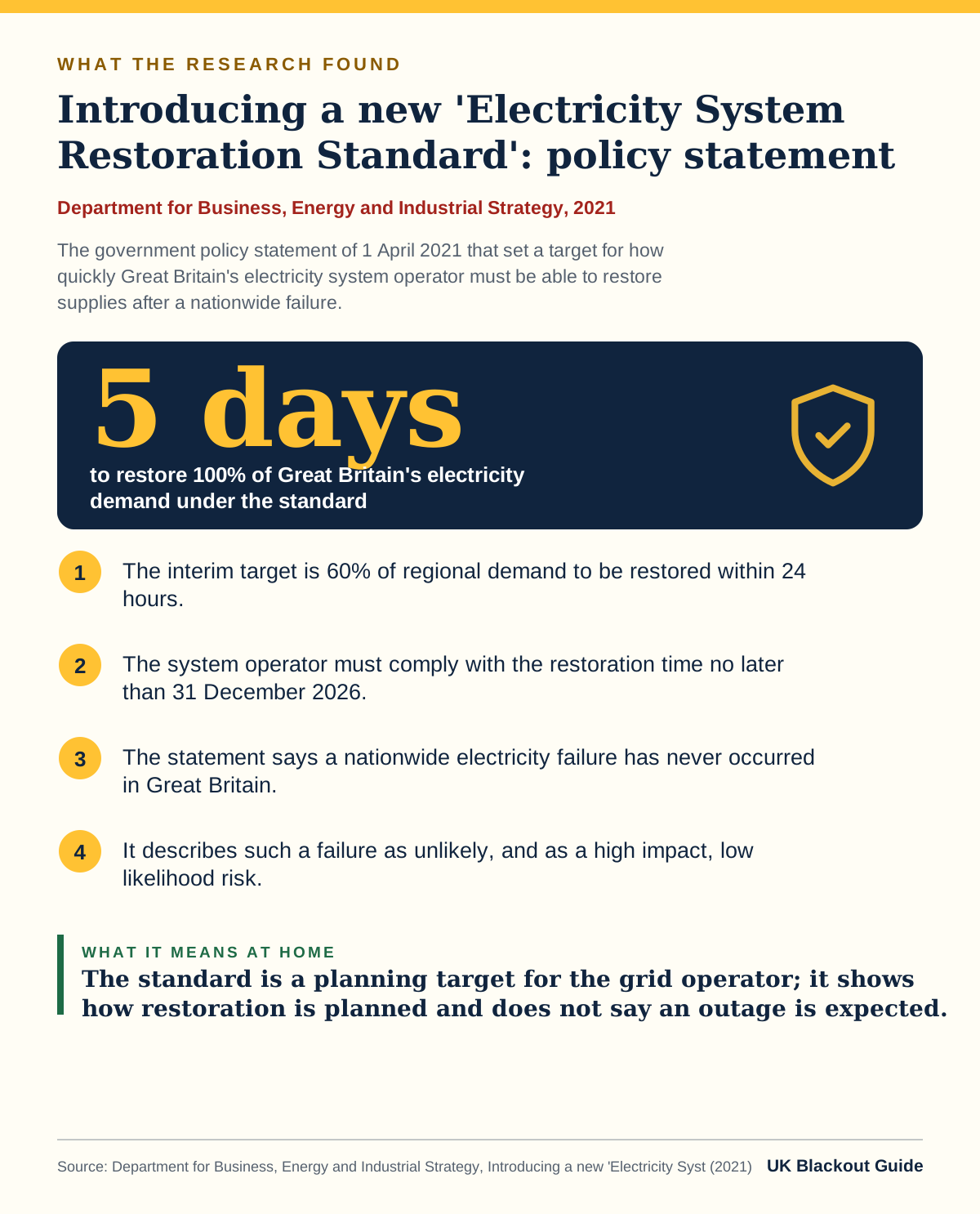
Department for Business, Energy and Industrial Strategy (2021). The government policy statement of 1 April 2021 that set a target for how quickly Great Britain's electricity system operator must be able to restore supplies after a nationwide failure. The standard is a planning target for the grid operator; it shows how restoration is planned and does not say an outage is expected.
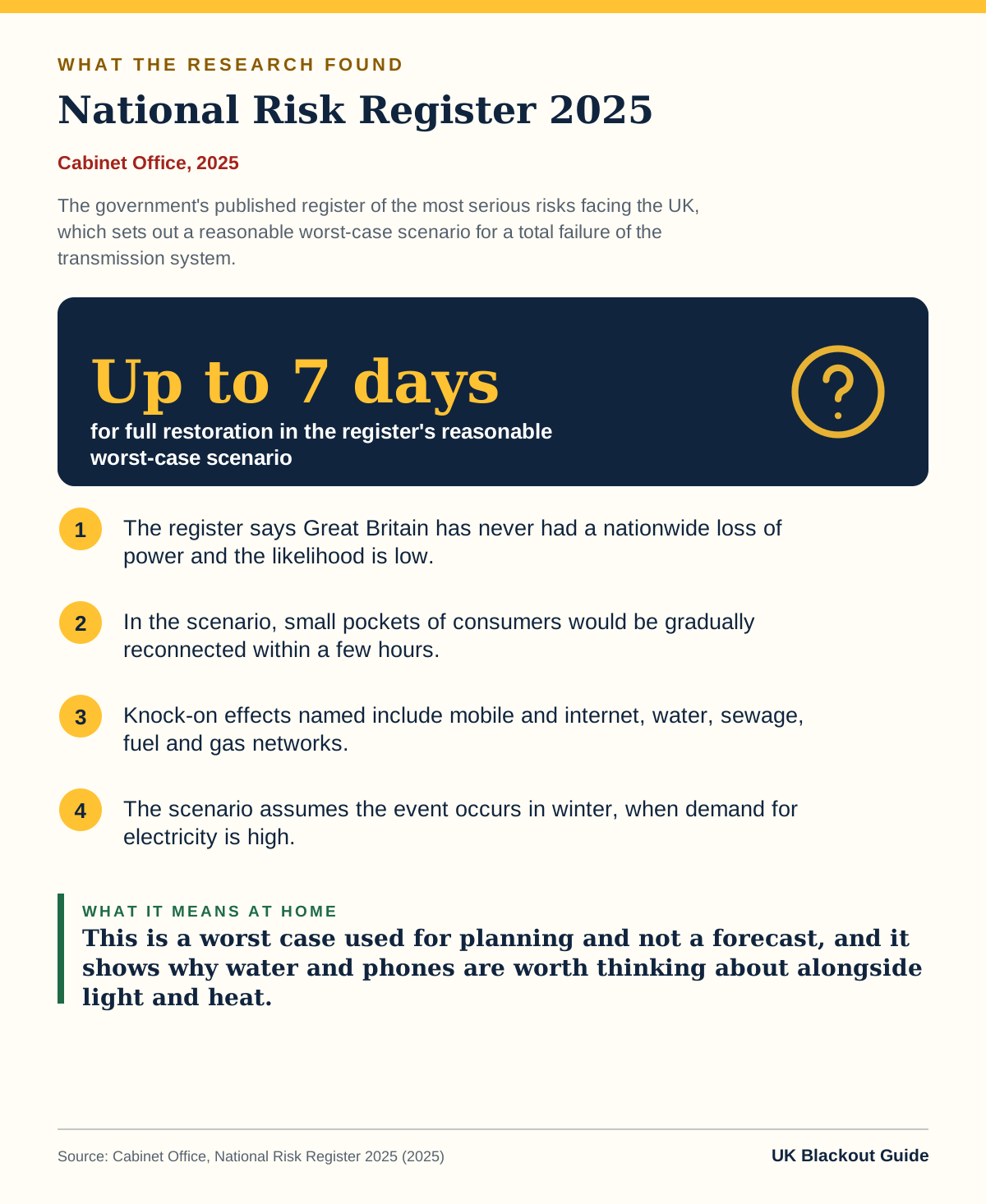
Cabinet Office (2025). The government's published register of the most serious risks facing the UK, which sets out a reasonable worst-case scenario for a total failure of the transmission system. This is a worst case used for planning and not a forecast, and it shows why water and phones are worth thinking about alongside light and heat.
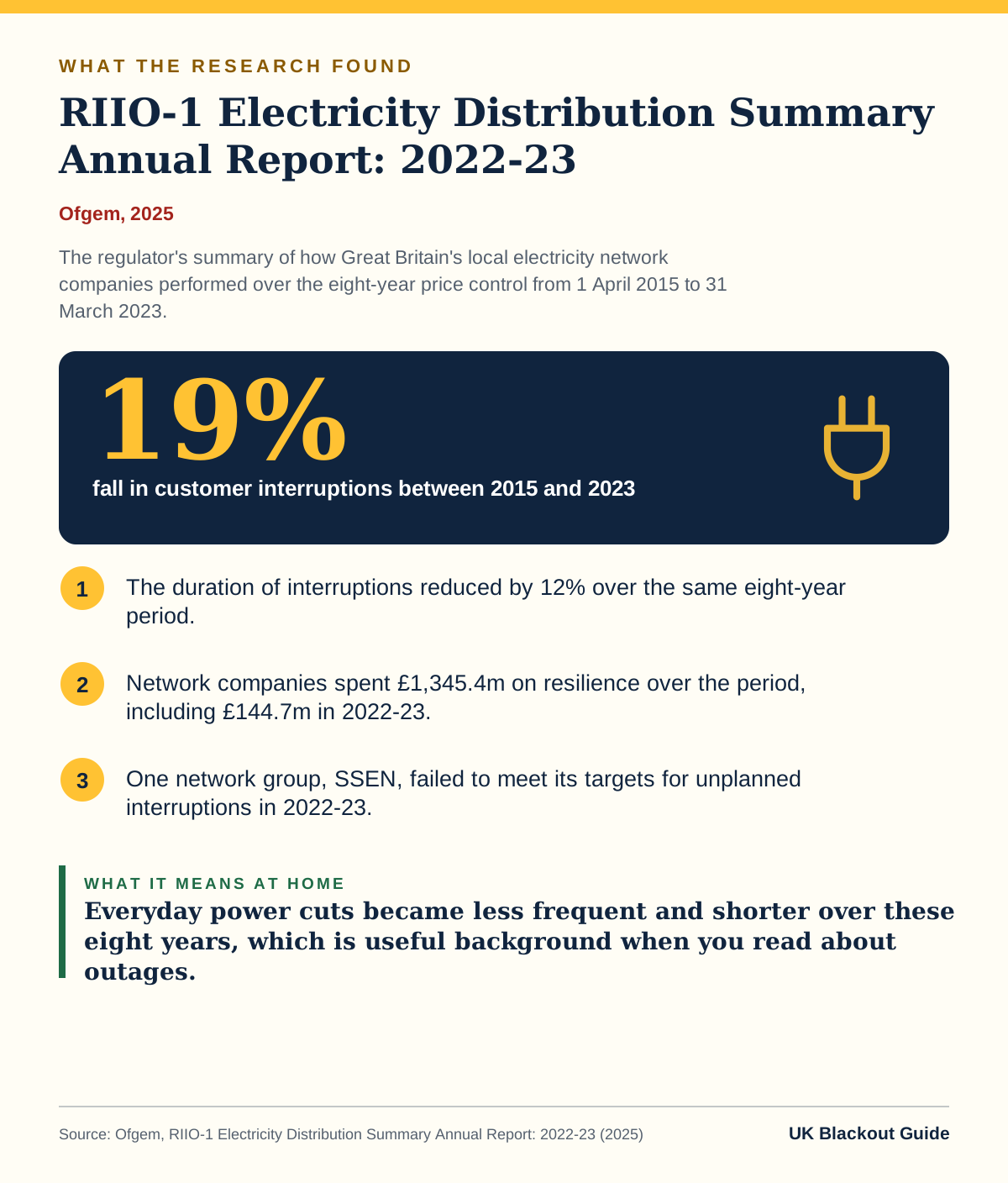
Ofgem (2025). The regulator's summary of how Great Britain's local electricity network companies performed over the eight-year price control from 1 April 2015 to 31 March 2023. Everyday power cuts became less frequent and shorter over these eight years, which is useful background when you read about outages.
Our data: what this costs
We recorded the price and buyer rating of every relevant listing we found on Amazon UK for this guide, 312 in all, and worked out the spread. These are our own figures, not a retailer's or a manufacturer's.
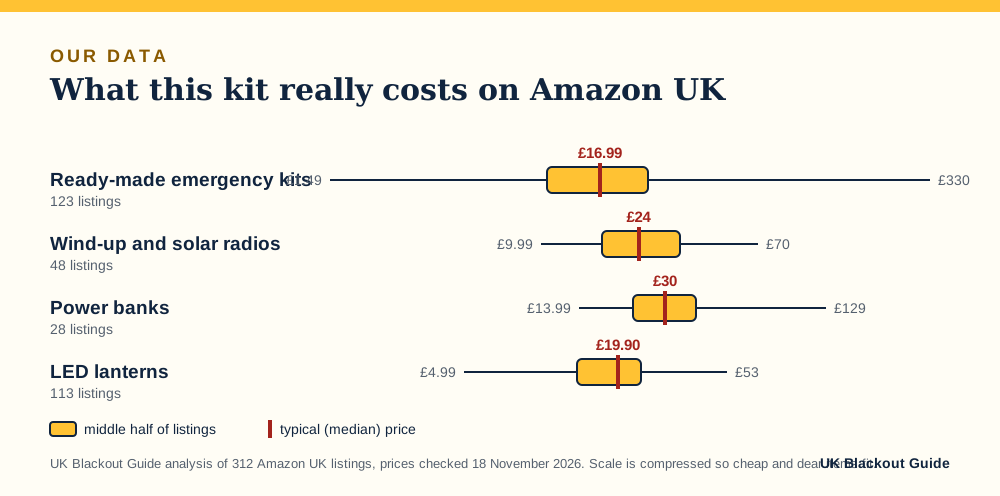
- The typical (median) price for ready-made emergency kits is £16.99, and half of all listings fall between £10.49 and £26.
- The widest spread is in ready-made emergency kits: the dearest listing costs about 19 times the typical one, so the top of the range is rarely needed for a power cut.
- 77% of ready-made emergency kits listings are rated 4.5 stars or higher by buyers, the highest share in this group.
| Product type | Listings | Cheapest | Typical | Middle half | Dearest | Rated 4.5+ |
|---|---|---|---|---|---|---|
| Ready-made emergency kits | 123 | £1.49 | £16.99 | £10.49 to £26 | £330 | 77% |
| Wind-up and solar radios | 48 | £9.99 | £24 | £17.18 to £35 | £70 | 66% |
| Power banks | 28 | £13.99 | £30 | £23 to £40 | £129 | 57% |
| LED lanterns | 113 | £4.99 | £19.90 | £13.72 to £24 | £53 | 70% |
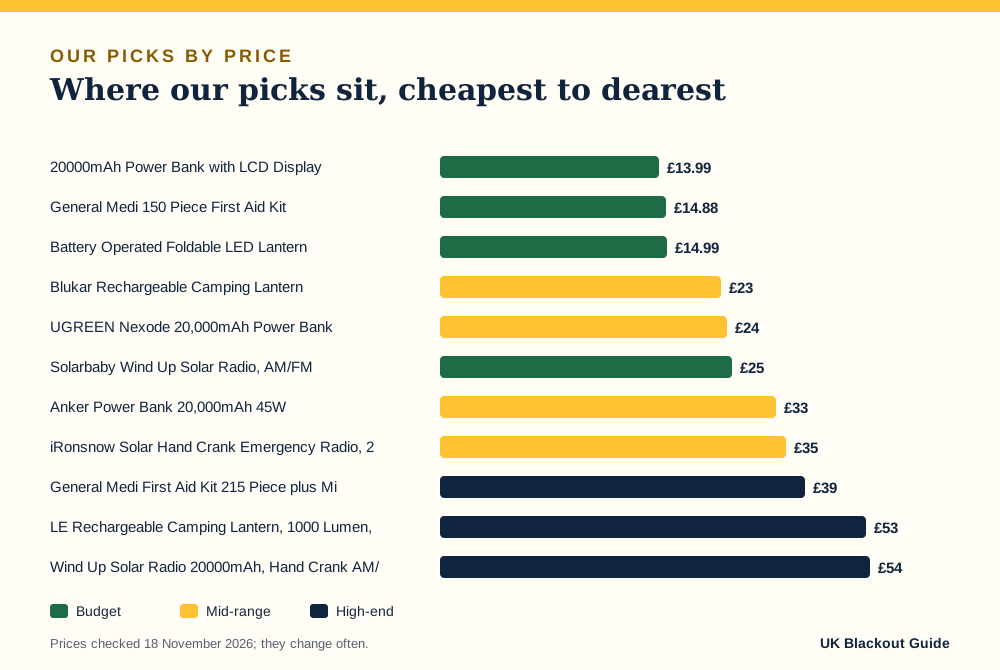
Method: one search page per product type on Amazon UK, off-topic listings removed, prices and ratings as shown on 18 November 2026. It is a snapshot, not a full market survey, and prices move.
Common questions
Has the government said there will be a blackout in 2026?
No. The Be Ready campaign asks households to be able to manage for three days as general preparedness, and it is not presented as a forecast of a blackout.
What happens on 31 December 2026?
It is the deadline for NESO to have the capability to restore 60% of regional demand within 24 hours and all of Great Britain's demand within five days. It is a recovery target, not an outage date.
Is Be Ready only about power cuts?
No. It is a general household preparedness campaign covering several kinds of emergency, including flooding and severe weather. The kit list suits all of them.
Is Be Ready a scam?
No. It is the UK government's preparedness campaign, formerly called Prepare, at beready.campaign.gov.uk. Be wary of look-alike sites that sell products or ask for details.
Did the government send a blackout alert to phones?
We know of no such alert. Emergency Alerts are used only for life-threatening emergencies, and Be Ready is a public information campaign.
Is the risk of a blackout higher in winter?
No official body has tied the risk of a national blackout to a season. Storms that cause local cuts are more frequent in autumn and winter.
Should I be stockpiling?
No. Be Ready advises building a three-day kit gradually. It does not ask anyone to stockpile.
How long would a national blackout last?
No official body has said. The National Risk Register says restoring the transmission system could take up to about 7 days, and NESO must be able to restore all demand within five days.
Why did the government hold Exercise Mighty Oak?
It was a 2023 government exercise rehearsing the response to a national power outage. The government has not linked it to any expected event.
Is a three-day kit enough?
It is what the government asks for. Anything longer is a personal choice beyond official guidance.
Who can I talk to if the news is making me anxious?
Your GP, or NHS talking therapies in England. Samaritans answer on 116 123 at any time, free, and NHS 111 helps with urgent mental health concerns.
- Be Ready campaign, UK government
- National Risk Register, Cabinet Office
- National Energy System Operator (NESO)
- Power Cut 105
- Emergency Alerts, GOV.UK
- NHS
- Met Office
Reviewed against these sources on 18 November 2026. If official advice has changed since, follow the official advice.
General information only. This page is not professional, safety, medical, legal or financial advice, and it is not official guidance. No national blackout has been forecast or announced, and nothing here suggests one is expected. We are independent and have no connection to the government or any energy company. Always check the official sources linked on this page. Full disclaimer
Keep reading
 Guide
What is the Be Ready campaign? UK three-day emergency advice
Be Ready campaign explained: what the UK government's three-day advice asks households to do, the official kit list, and what the three-day claim really means.
Read: What is the Be Ready campaign? UK three-day Guide
What do you need in an emergency blackout kit? UK home checklist
Emergency blackout kit for home in the UK: the official Be Ready list, a 72-hour kit item by item, what to buy first, costs, storage and six-monthly checks.
Read: What do you need in an emergency blackout Explainer
Spain and Portugal blackout 2025: what happened and UK lessons
On 28 April 2025 Spain and Portugal lost all power for most of a day. Phones, cards and trains failed. What happened and the practical lessons for UK homes.
Read: Spain and Portugal blackout 2025: what Guide
What are rota power cuts? UK load block letters explained
Rota power cuts UK explained: how three-hour cuts by load block letter would work, how to find your letter, who is protected and how to prepare for a planned cut.
Read: What are rota power cuts? UK load block