On this page
- In pictures
- The direct answer: what official bodies have said about duration
- What the government has asked for: three days, and nothing longer
- The restoration figures: 24 hours, five days and about seven days
- Three days without power: the plan the government asks for
- A week without power: what changes after day three
- 30 days: optional planning beyond official guidance
- 90 days: stock, rotation and routine for those who want it
- What each length of plan costs, roughly
- What to buy for three days: budget, mid-range and high-end
- What to add for a week or longer
- Common questions about long outages, answered in full
- Checklist
- What the research found
- Our data: what this costs
- Common questions
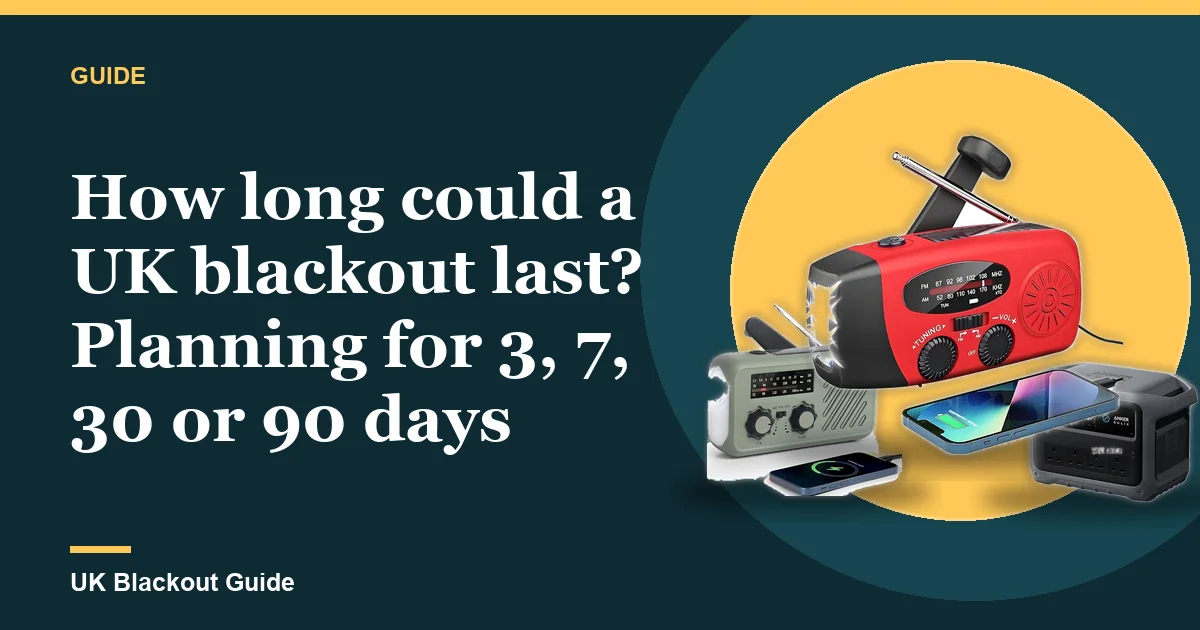
No national blackout has been forecast. The Be Ready campaign asks households to manage for three days. NESO must be able to restore 60% of each region's demand within 24 hours and all of Great Britain's within five days, by 31 December 2026. The National Risk Register says the transmission system could take up to about seven days. Plans for a week, 30 or 90 days are optional, beyond official guidance.
 Hand Crank Emergency Radio with Solar Power Bank, 2000mAh★ 4.5 from 1,100 buyers · About £40Check price on Amazon
 Solarbaby Wind Up Solar Radio, AM/FM, 2000mAh★ 4.2 from 5,000 buyers · About £25Check price on Amazon
 Anker SOLIX C1000 Gen 2, 1024Wh Power Station★ 4.7 from 1,700 buyers · About £599Check price on Amazon
Chosen from Amazon UK listings on specification, price and buyer ratings. Not hands-on tested. We earn a commission if you buy.
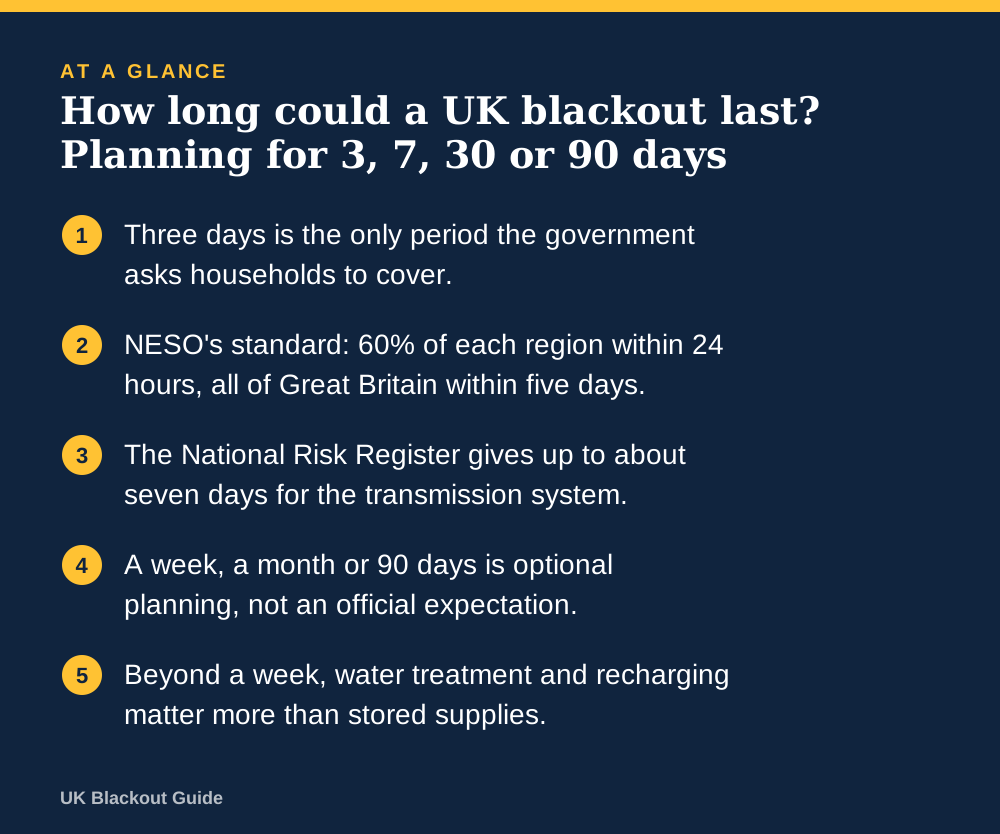
- Three days is the only period the government asks households to cover.
- NESO's standard: 60% of each region within 24 hours, all of Great Britain within five days.
- The National Risk Register gives up to about seven days for the transmission system.
- A week, a month or 90 days is optional planning, not an official expectation.
- Beyond a week, water treatment and recharging matter more than stored supplies.
- Rotate stored food through normal meals so a longer plan costs little.
In pictures: the numbers that matter
The direct answer: what official bodies have said about duration
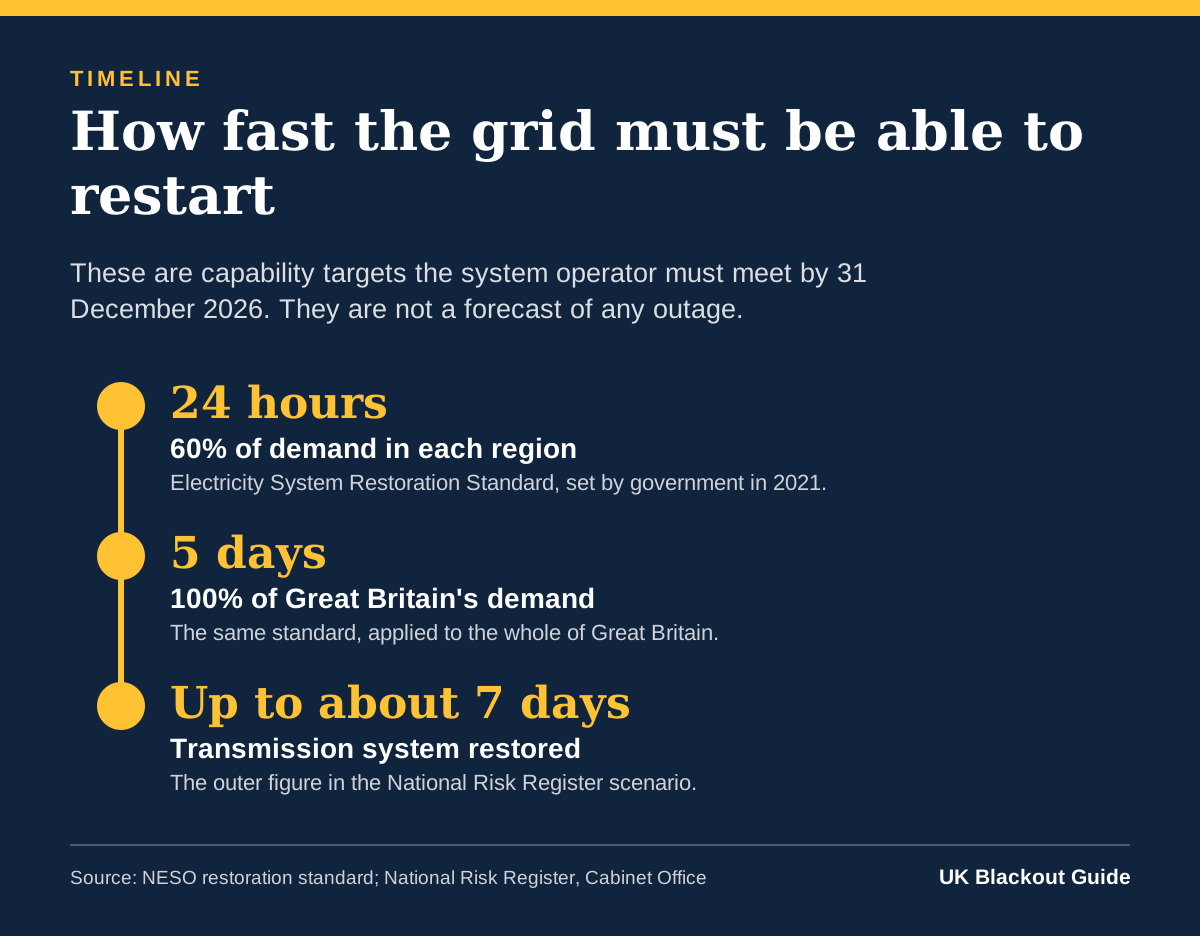
Official bodies have given three figures, and none of them is a forecast. The government's Be Ready campaign asks households to be able to manage for three days. NESO, which runs Great Britain's electricity system, must by 31 December 2026 be able to restore 60% of demand in each region within 24 hours and all of Great Britain's demand within five days. The National Risk Register says restoring the transmission system could take up to about seven days.
The same Risk Register describes a national outage as low likelihood but very high impact. No national blackout has been forecast or announced, and Great Britain has never had a complete loss of its national grid. The figures above describe what the system is built to do if one happened, not an expectation that it will.
That gives a simple way to read the rest of this page. Three days is what the government asks for, and most households can stop there. A week, 30 days and 90 days are optional planning beyond official guidance, for people who want a wider margin. The government has not asked households to prepare for that long and has not suggested an outage of that length is expected.
| Figure | Who says it | What it describes |
|---|---|---|
| 3 days | Be Ready campaign | How long households are asked to manage for, as general preparedness |
| 24 hours | Electricity System Restoration Standard | 60% of demand restored in each region, capability due by 31 Dec 2026 |
| 5 days | Electricity System Restoration Standard | 100% of Great Britain's demand restored |
| About 7 days | National Risk Register | Possible time to restore the transmission system |
What the government has asked for: three days, and nothing longer
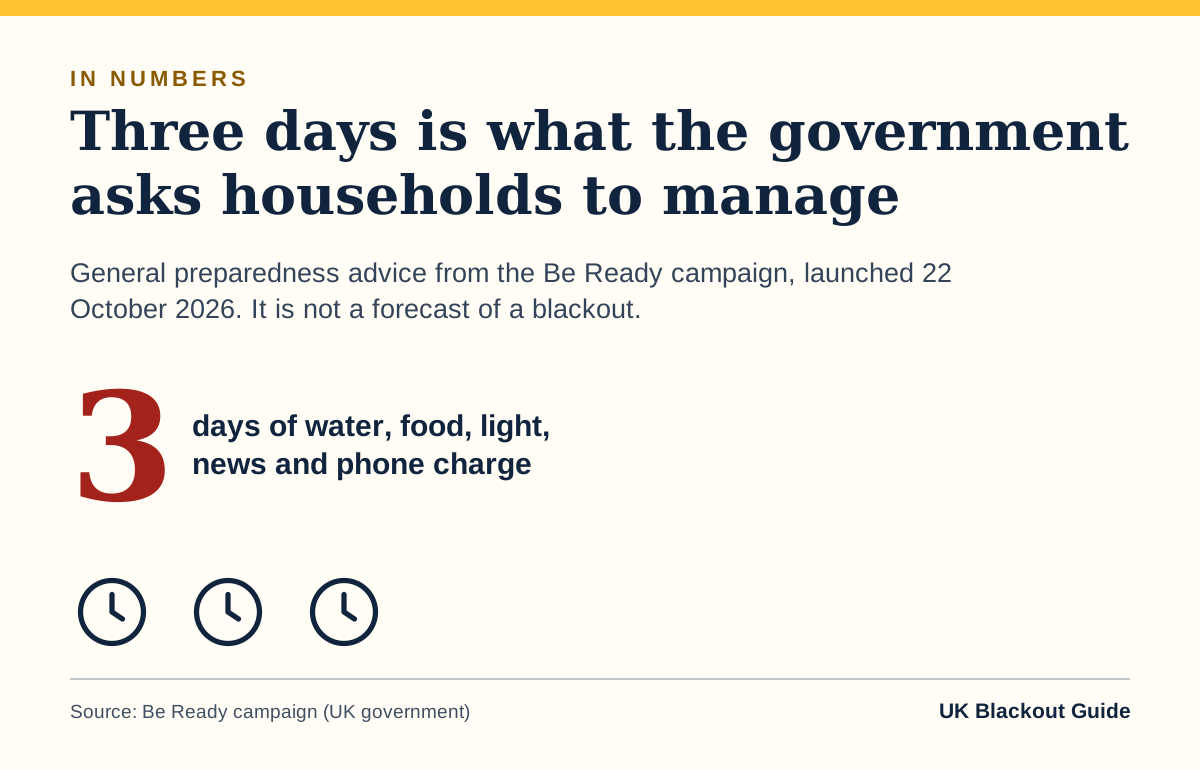
Three days is the figure the UK government chose when it launched the Be Ready campaign on 22 October 2026. The campaign asks households to be able to look after themselves for that long, and it presents this as general preparedness for any emergency, from floods to storms to a power cut. It is not a forecast of how long any power cut would last.
Three days is also the longest period official household guidance asks you to cover. Nothing in Be Ready asks for a week or a month. Some headlines after the launch talked about a "three-day blackout", which mixed up the preparedness target with a prediction; the Be Ready campaign explained page sets out exactly what the campaign does and does not say.
The campaign also asks you to build the kit gradually and check it every six months. That matters for longer plans too: a store that is built slowly from normal shopping costs little, and takes nothing away from other shoppers.
The restoration figures: 24 hours, five days and about seven days
Under the Electricity System Restoration Standard, set by government in 2021, NESO must have the capability by 31 December 2026 to restore 60% of electricity demand in each region within 24 hours, and 100% of Great Britain's demand within five days. Restarting a grid from nothing is done power station by power station, region by region, which is why the targets are staged.
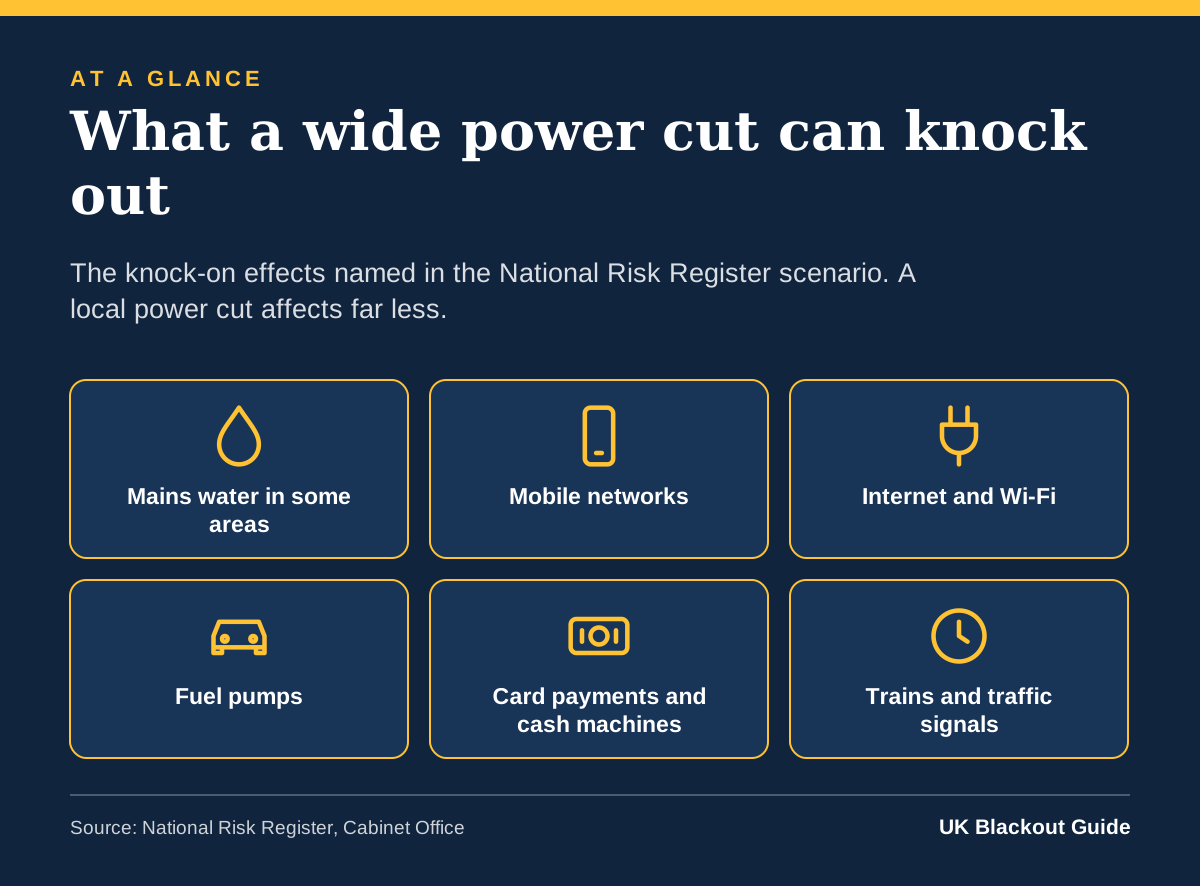
The National Risk Register gives a separate figure: restoration of the transmission system could take up to about seven days. It also describes knock-on effects on water, mobile networks, internet, fuel, payments and transport. Those services depend on electricity, so they come back after it, and the order in which they fail and recover is covered in what stops working in a blackout.
Why your street may differ from the national figure
The figures are targets for the system as a whole. A 60% target within 24 hours allows for some homes in each region waiting longer than a day. Local faults are different again: a damaged line on a rural road can take longer to reach than a city substation.
What has actually happened
Past events show what happened on those occasions. They are not a forecast of what would happen here.
- On 9 August 2019 a lightning strike followed by the loss of two generators disconnected about 1 million customers. Most were back within an hour, though rail disruption was severe.
- In December 2015 Storm Desmond flooded a substation in Lancaster, cutting power to about 61,000 properties. Mobile, internet, cash machines and card payments failed locally, while local radio kept broadcasting on a generator.
- After Storm Arwen in November 2021, about 1 million customers lost power, and some rural homes in northern England and Scotland were off for more than a week.
- On 28 April 2025 the whole of Spain and Portugal lost power. Most supply was restored by the early hours of the next day; the lessons from Spain and Portugal are mostly about cash, radios and phones.
The longest cuts in recent UK history were regional and storm-related. Great Britain has never lost its whole national grid.
One more kind of cut is worth knowing. The official plan for a national energy shortage is rota power cuts, which could switch areas off for about three hours at a time by load block letter. None has been announced. A plan that copes with no supply at all copes easily with a few hours off each day, because you can recharge whenever the power is on, and rota power cuts explained shows how to find your load block.
Three days without power: the plan the government asks for
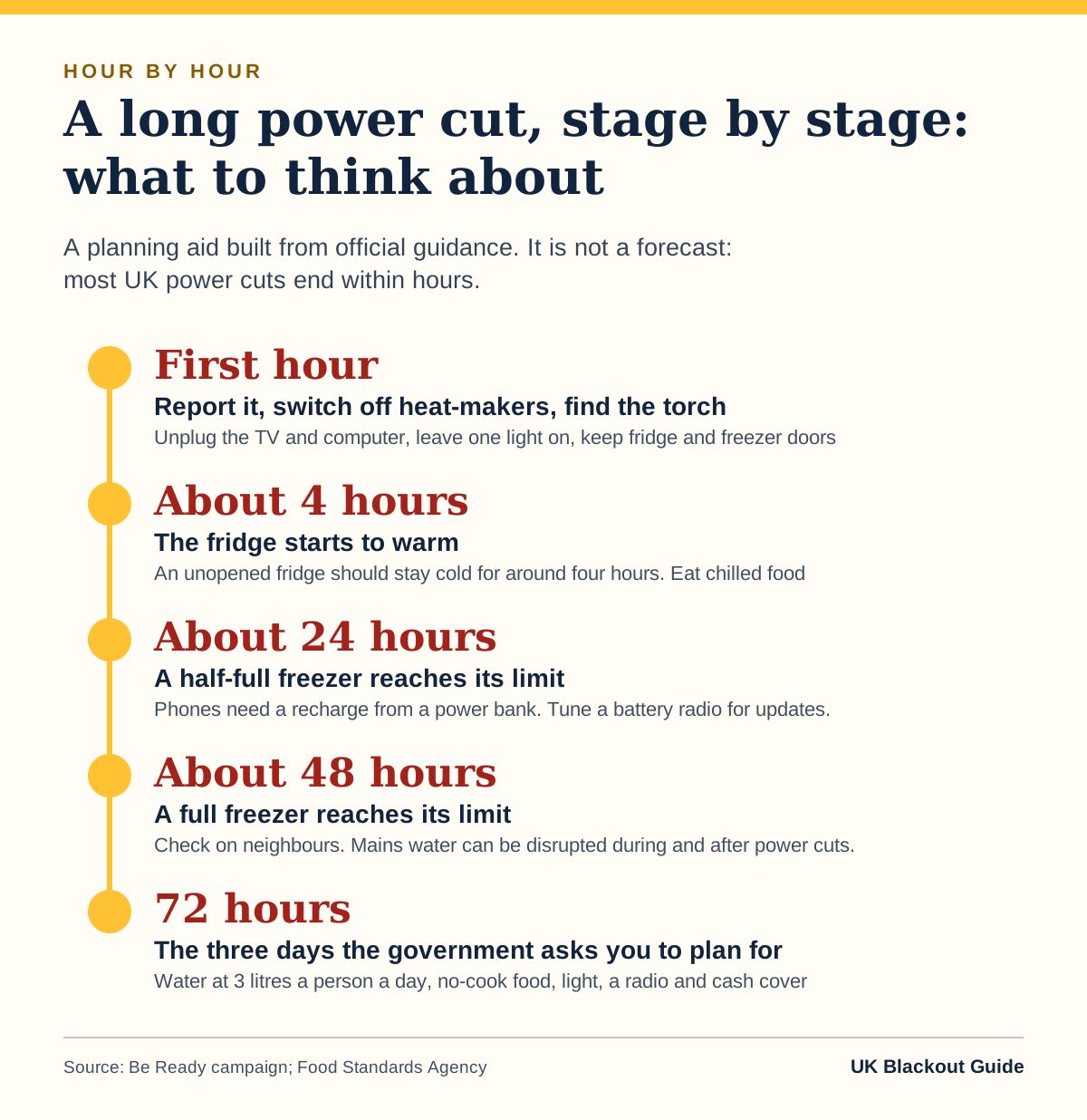
The Be Ready list for three days is short: water at 3 litres per person per day for drinking (9 litres each), food that needs no cooking or fridge, a tin opener, a torch with spare batteries, a battery or wind-up FM radio, a charged power bank, a first aid kit, essential medication, hand sanitiser and wipes, blankets and warm clothes, cash in notes and coins, printed documents, a written list of contacts and medication, baby supplies and pet food. Every item is gone through in the full emergency kit list.
Day one: safety, then information
Report the cut on 105 (03457 643643 in Northern Ireland). Switch off ovens, irons, electric fires and fryers, and unplug the TV and computer so a surge on return cannot damage them. Then get your information source working. A battery or wind-up radio is the official recommendation because it does not depend on broadband or the mobile network; try both FM and digital.
Leave the fridge and freezer shut. The Food Standards Agency says an unopened fridge should stay cold for around four hours, so eat fridge food first.
Day two: ration what you cannot replace
By the second morning the fridge is no longer cold and the phone battery is what everyone is watching. Put phones on low power mode, agree set times to check messages, and charge from the power bank rather than letting phones run flat. A 20,000 mAh power bank gives about 3 to 4 charges of a typical phone, enough for one phone for three days with care.
Treat stored water as the supply and the tap as a bonus, because mains water can be disrupted during and after power cuts. A full freezer typically stays frozen for about 48 hours and a half-full one about 24, so day two is when you decide what to cook first, if you have a safe way to cook.
Day three: routine does more than kit
By day three, tiredness and cold are the main risks. Keep everyone in one room in the day, wear layers, close doors and curtains, and eat at regular times even if meals are cold. The NHS advises heating rooms you use to at least 18°C; if you cannot, clothing and bedding do the work. Check on neighbours, particularly anyone older or living alone.
Never bring a barbecue, camping stove, patio heater or generator indoors for warmth or cooking. They produce carbon monoxide, which has no smell and can kill. Use torches for light; the Be Ready campaign says they are safer than candles.
If someone in your home relies on powered medical equipment, they should already be on the free Priority Services Register, which tells your network operator to offer extra support in a cut.
A week without power: what changes after day three
The government has not asked anyone to prepare for a week and has not suggested a power cut of that length is expected. A week is optional planning beyond official guidance. Some households choose it as a personal margin because the Risk Register's figure for restoring the transmission system is about seven days, and because some rural homes were off for more than a week after Storm Arwen.
| Need | Days 1 to 3 | Days 4 to 7 |
|---|---|---|
| Water | Stored bottles | Refilling, collecting and treating |
| Food | Fridge, then freezer, then cupboard | Tins and dry goods only |
| Phone charge | Power bank | Car, solar or a power station |
| Money | Cash in your wallet | A planned cash reserve |
| Washing | Wipes and sanitiser | A proper wash routine with heated water |
| Mood | Novelty | Tiredness and boredom |
The pattern is that everything you ran down in the first three days has to be replenished or replaced with a slower method.
Water becomes the first job of each day
At 3 litres per person per day, a week is 21 litres each and 84 litres for a family of four, before cooking or washing. Few homes store that much, so a week means storage plus a way to top up. Fill containers whenever the mains is running, and keep a means of making doubtful water safe, such as boiling or purification tablets, in case your water company's advice changes. Container sizes and storage are covered in how much water to store.
Cooking takes over from cold meals
Three days of cold tins is tolerable; seven is hard, especially in winter. A gas hob may light with a match while the gas supply continues. If not, a single-burner camping stove used outdoors is the usual answer, and cooking without electricity covers the safe options. Work out how many gas canisters a week of two hot meals a day needs, and store them somewhere cool, away from the living space. Freezer contents will have gone by day two or three; if in doubt, throw it out.
Recharging replaces stored charge
One power bank is not enough for a week and a household. A car can charge phones while the engine runs, outdoors. A portable power station holds far more and can be topped up from a solar panel, though UK winter yields are low. A fridge-freezer averages 40 to 80 watts, which is roughly 1 to 2 kWh a day, so keeping one going for a week needs a large unit and a way to refill it.
Cash, fuel and people
In a wide-area cut, card payments, cash machines and fuel pumps may not work, as happened locally in Lancaster in 2015 and across Spain and Portugal in 2025. Keep notes and coins at home and keep the car at least half full as a habit. By the second half of a week the difficulties are human: sleep suffers in a cold house, children get bored, and older relatives may quietly stop eating and drinking enough. Keep mealtimes, keep one warm room, and get outside in daylight. After long unplanned cuts, payments may be available under Ofgem's Guaranteed Standards, so note when the power went off and came back; power cut compensation explains how to claim.
30 days: optional planning beyond official guidance
The government has not asked households to prepare for a month without electricity, and it has not suggested an outage of that length is expected. Thirty days is about four times the longest official figure. What follows is for people who like a wide margin, and it is not something you need to have in place. The UK has had no national or regional cut on this scale.
Water: you cannot store your way through a month
At 3 litres per person per day, 30 days is 90 litres each, or 360 litres for a family of four. That is 360 kilos of water before any is used for cooking or washing. Most homes can store a week or two at best. The realistic plan is three layers: a modest store, whatever alternative supply your water company provides during long interruptions (use that first), and the ability to filter and disinfect water from other sources.
Food: a month from the cupboard
A month of food is a bigger version of the cupboard you already have. The fridge is finished within hours and the freezer within about two days, so everything has to be tinned, dried or jarred, with a safe way to heat it. An adult needs roughly 2,000 to 2,500 kcal a day. Buy food you eat anyway and rotate it through normal meals so nothing is wasted; the basics of that are in building a three-day food supply, which scales up a week at a time.
Electricity: a small budget you can refill
Over 30 days, stored charge stops mattering. What matters is how much energy you can gather each day. A 100 W portable solar panel in the UK typically yields roughly 300 to 400 Wh on a clear summer day and often only 30 to 80 Wh on a dull winter day. That covers phones, LED lights and a radio in any season, and a laptop and router in summer. It will not run a kettle, a heater or, without several panels, a fridge-freezer. Gas boiler controls and a pump draw about 100 to 150 watts, too much for a small solar setup in winter, so plan to heat people with clothing and bedding instead. Most rooftop solar shuts off in a power cut unless the system has battery backup able to run independently, as solar panels in a power cut explains.
A generator can fill gaps, but HSE guidance limits home petrol storage to 30 litres without notifying anyone, in suitable containers, in a garage or shed rather than the living space. That is days of running, not a month. Run generators outdoors only, away from doors and windows, and never plug one into a house socket: back-feed can kill engineers and damage your home. Connecting to house wiring needs a changeover switch fitted by a qualified electrician, and generators for home backup covers the rest.
Health and a decision point for leaving
Supplies are the easier half. The harder half is anything that depends on services: repeat prescriptions, refrigerated medicines, powered medical equipment and care visits. Talk to your pharmacist or clinician about a sensible reserve, and do not stockpile medicines on your own initiative. Decide in advance when you would stop and go somewhere with power. If anyone in the house is ill, very young, very old or dependent on equipment, or the house cannot be kept warm, staying for a month is the wrong goal. The NHS describes hypothermia as a body temperature below 35°C, with shivering, pale cold skin, slurred speech, confusion and tiredness; call 999.
90 days: stock, rotation and routine for those who want it
A 90-day plan is a personal choice. The government has not asked households to prepare for that long, and no official body has suggested an outage of that length is expected. There are still reasonable motives for a deep larder: it protects against job loss, illness, snow and supply hiccups as much as power cuts, and it lets you help relatives and neighbours. Those everyday benefits are the best justification for it.
The stock: what three months adds up to
| Item | Per person, 90 days | Practical approach |
|---|---|---|
| Drinking water at 3 litres a day | 270 litres | Store one to two weeks, collect and treat the rest |
| Food at about 2,000 kcal a day | About 180,000 kcal | Deep cupboard of staples, rotated |
| Toilet roll, soap, bin bags | Three months of normal use | Buy in bulk when on offer |
| Batteries | Depends on your lights and radio | Rechargeables plus a solar charger |
Food fits in a tall cupboard or under beds. Water does not, which is why treatment matters more than storage for any plan this long. For a filter in daily use, check the filter life in litres and whether replacement parts are sold separately.
Rotation: the part that makes it affordable
A three-month store that sits untouched will expire and cost you the whole amount again. A store you eat from costs almost nothing extra, because you were buying the food anyway. Buy staples you already cook with, put new stock at the back, eat from the front and replace what you use. Specialist long-life rations have a narrow role as a compact reserve that needs no attention for years.
Routine: the daily jobs
Over 90 days, problems come from small things left undone. A workable day has fixed jobs: fetch and treat water in the morning, put the solar panel out, cook the main meal in daylight, wash hands and dishes properly, deal with waste, and listen to a radio bulletin at a set time. Stomach bugs spread fast where washing is hard, so settle your methods early using washing and toilets without running water. Keep bedtimes, give children tasks, and build in things to look forward to.
Power across more than one season
Three months spans a change of season. A setup that feels generous in June may only cover phones, a radio and two LED lamps in December, so plan around the winter figure and treat anything more as a bonus. Two panels help most in winter, when every watt-hour counts.
What no stockpile can cover
No cupboard replaces hospitals, pharmacies, income, schools or the water and sewage networks for three months. Prescription medicines are supplied in limited amounts, and your clinician's advice on reserves comes first. That is why official planning is built around restoring power within days, and why your own plan should include other people. Households that know their neighbours cope better.
What each length of plan costs, roughly
Costs depend on what you already own, and prices change, so treat these as rough bands for a household of two to four people rather than a shopping bill.
| Plan | What it adds | Rough cost if starting from nothing |
|---|---|---|
| 3 days | Water containers, torch and batteries, radio, power bank, first aid kit, three days of food, cash | About £100 to £200, much less if you already have some items |
| 1 week | More water storage, a camping stove and gas, extra food, a larger cash reserve | Add about £100 to £200 |
| 1 week with power | A portable power station around 1,000 Wh | Add about £500 to £1,000 |
| 30 days | A water filter, a solar panel, a deeper rotated larder | Add a few hundred pounds, mostly food you would eat anyway |
| 90 days | Bulk staples, filter replacements, long-life rations as a reserve | Varies widely; rotation keeps the real cost low |
The three-day plan is the only one the government asks for, and it is achievable on almost any budget if you build it a few items at a time. Beyond that, the expensive step is electricity, not food: a power station or solar kit costs more than a month of extra groceries. Spend on it only if someone in the home depends on powered equipment, you work from home, or you live somewhere rural with a history of long storm cuts.
What to buy for three days: budget, mid-range and high-end
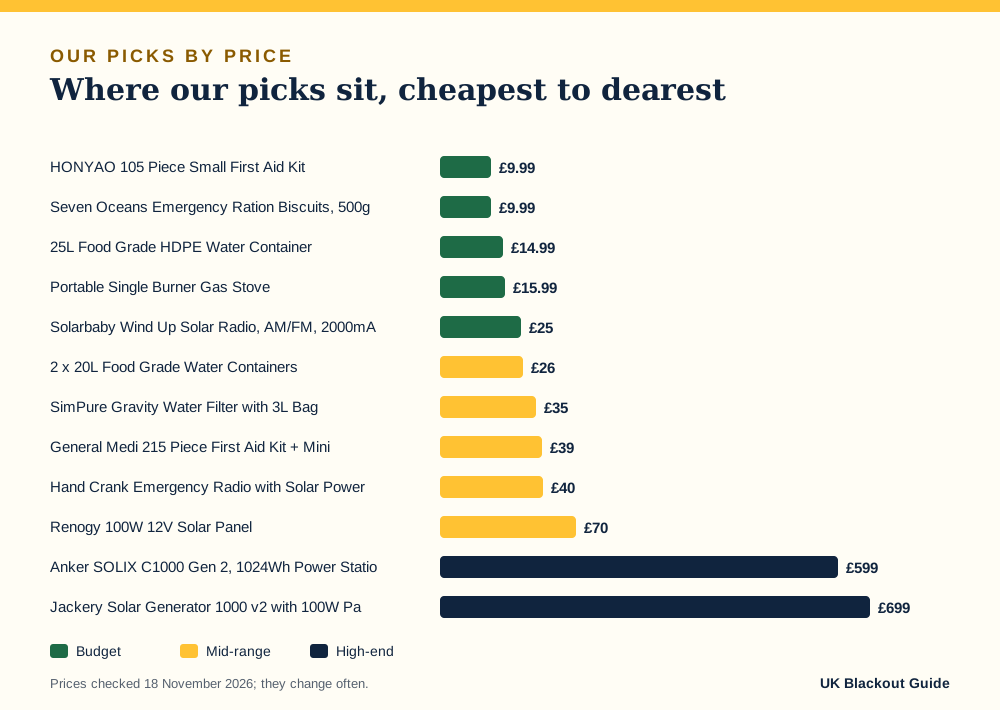
For three days you need light, a radio, water storage and first aid more than anything with a plug. The picks below are chosen from Amazon UK listings on their stated features, price and buyer ratings, and ordered from the three-day essentials to the larger items for a week or longer. We have not tested them, and prices and stock change.
High-end picks What the extra money buys in a power cut

Anker SOLIX C1000 Gen 2, 1024Wh Power Station
★ 4.7 from 1,700 buyers · About £599 when checked 18 November 2026The listing gives 1024Wh and 2000W output, enough for a router, lights and phone charging for several days, or a fridge-freezer for part of a day. Rated 4.7 from about 1,700 buyers.
- About 1kWh of storage
- Strong buyer rating
- Overkill for a three-day kit
- Needs solar or mains to refill
Jackery Solar Generator 1000 v2 with 100W Panel
★ 4.6 from 142 buyers · About £699 when checked 18 November 2026A 1kWh power station sold with a 100W solar panel, according to the listing, so it can refill daily. Expect roughly 300 to 400 Wh on a clear summer day and far less in winter. Rated 4.6.
- Panel included
- Refillable without mains
- Winter solar yield is low
- Large outlay for an optional plan
Mid-range picks The sensible middle for most homes


Hand Crank Emergency Radio with Solar Power Bank, 2000mAh
★ 4.5 from 1,100 buyers · About £40 when checked 18 November 2026The listing gives AM/FM, a hand crank, a solar charger and a 2000mAh battery that works as a power bank. Rated 4.5 from about 1,100 buyers.
- Three ways to charge
- Can top up a phone
- 2000mAh is a small top-up, not a full phone charge
2 x 20L Food Grade Water Containers
★ 4.6 from 1,000 buyers · About £26 when checked 18 November 2026Two 20 litre UN food grade jerry cans give 40 litres, more than the 36 litres a family of four needs for three days of drinking. Rated 4.6 from about 1,000 buyers.
- 40 litres in total
- Two smaller cans are easier to move
- Check how you will pour from them; no tap mentioned
General Medi 215 Piece First Aid Kit + Mini Kit
★ 4.8 from 14,800 buyers · About £39 when checked 18 November 2026The listing gives 215 pieces plus a 43 piece mini kit, including an emergency blanket. One stays home, one goes in a grab bag. Rated 4.8 from about 14,800 buyers.
- Two kits in one
- Very highly rated
- Add your own medicines
SimPure Gravity Water Filter with 3L Bag
★ 4.5 from 1,800 buyers · About £35 when checked 18 November 2026A gravity filter with a 3 litre bag, so water filters while you do other jobs, with no pumping. Rated 4.5 from about 1,800 buyers.
- No pumping needed
- Treats a batch at a time
- Pair with boiling or tablets for viruses and chemicals
Renogy 100W 12V Solar Panel
★ 4.6 from 1,400 buyers · About £70 when checked 18 November 2026A 100W monocrystalline panel rated 4.6 from about 1,400 buyers. Check its connector and voltage match your power station's solar input before buying.
- Low price for 100W
- Well rated
- Rigid panel; needs mounting
- Connector may need an adaptor
Budget picks Cheapest ways to be covered



Solarbaby Wind Up Solar Radio, AM/FM, 2000mAh
★ 4.2 from 5,000 buyers · About £25 when checked 18 November 2026The listing describes a hand crank and solar radio with AM/FM and a 2000mAh rechargeable battery, so it keeps working when the batteries and the mains are gone. Rated 4.2 from about 5,000 buyers.
- Crank and solar charging
- FM for UK stations
- Listing shows AM/FM, not DAB
25L Food Grade HDPE Water Container
★ 4.8 from 446 buyers · About £14.99 when checked 18 November 2026A 25 litre food grade container, enough for nearly three days of drinking water for three people at the Be Ready figure. Rated 4.8 from about 450 buyers.
- Food grade HDPE
- Large single capacity
- 25 kilos when full; hard to lift
HONYAO 105 Piece Small First Aid Kit
★ 4.8 from 4,300 buyers · About £9.99 when checked 18 November 2026A 105 piece kit with plasters, a foil blanket and burn gel, according to the listing. Covers the Be Ready first aid item for a small household. Rated 4.8 from about 4,300 buyers.
- Low price
- Burn gel and foil blanket
- Small for a large family
Portable Single Burner Gas Stove
★ 4.6 from 204 buyers · About £15.99 when checked 18 November 2026A folding single-burner gas stove, rated 4.6. Enough to boil water and heat a pan once cold meals wear thin. Outdoor use only.
- Small and cheap
- Never use indoors
- Gas cartridge sold separately
Seven Oceans Emergency Ration Biscuits, 500g
★ 4.4 from 188 buyers · About £9.99 when checked 18 November 2026A 500g pack of nine ration bars, according to the listing, needing no water or heat. A small reserve that sits alongside normal tins. Rated 4.4.
- Needs no cooking
- Compact
- Not a substitute for ordinary food you rotate
Most households need only the budget and mid-range picks: two water containers, a wind-up radio and a first aid kit come to well under £100. The high end here means a large power station or solar kit, and for a three-day plan that is overkill unless someone relies on powered medical equipment or you need to keep a fridge running. If you are spending that much, compare options first in power stations for power cuts.
What to add for a week or longer
Each step beyond three days adds a different kind of item. Add them in order, and stop wherever you are comfortable.
- For a week: more water containers, a camping stove for outdoor use with enough gas, a larger cash reserve in notes and coins, and a way to recharge phones such as a car charger.
- For a week with electricity: a portable power station sized in watt-hours for what you need to run, and a carbon monoxide alarm made to EN 50291 if you will use any fuel-burning appliance.
- For 30 days: a water filter and tablets, a 100 W or larger solar panel matched to your power station's input, and a deeper rotated food cupboard.
- For 90 days: bulk staples bought on offer and rotated, filter replacements, rechargeable batteries with a solar charger, and a few long-life rations.
Warmth matters more with every extra day in winter. Sleeping bags, thermal layers and hot water bottles cost far less than any heater and carry no carbon monoxide risk; how to keep warm in a power cut sets out what works. If you are thinking about a gas heater or generator, read up on carbon monoxide before you buy. A battery radio becomes more useful, not less, as a cut goes on; the BBC has described plans to keep broadcasting on FM from an emergency studio with generator-backed transmitters, and emergency radios lists sets that work without mains.
Common questions about long outages, answered in full
Is three days a prediction of how long a blackout would last?
No. It is a general preparedness target from the Be Ready campaign. Most power cuts are far shorter, and no national blackout has been forecast or announced.
Could a national blackout last for weeks?
Nothing in official planning suggests that. The stated capability is full restoration of Great Britain's demand within five days, and the National Risk Register refers to about seven days for the transmission system. Longer plans are optional.
What does Black Sky mean?
Black Sky is a term for a prolonged, wide-area outage that disrupts other essential services. Coverage of it rose after the Be Ready launch. It is a planning term rather than a prediction, and what Black Sky means explains where it comes from.
Do I need a generator?
Not for three days. A torch, a radio, a power bank, stored water and food that needs no cooking cover it. A generator adds cost, fuel storage limits and carbon monoxide risk, and only makes sense for specific needs.
Checklist
How long could a UK blackout last? Planning for 3, 7, 30 or 90 days
- Three days of water: 3 litres per person per day
- Three days of food that needs no cooking or fridge
- Torch, spare batteries and a battery or wind-up radio
- Charged power bank and first aid kit
- Cash in notes and coins
- Optional week: more water, an outdoor stove and gas
- Optional week: a way to recharge phones
- Optional 30 days: water filter, solar panel, rotated larder
- Optional 90 days: bulk staples and filter replacements
- CO alarm made to EN 50291 if using any fuel appliance
- A decision point for leaving home
- Check everything every six months
What the research found
These are published reports and statistics, summarised by us. They record what was measured or what happened; none is a forecast.
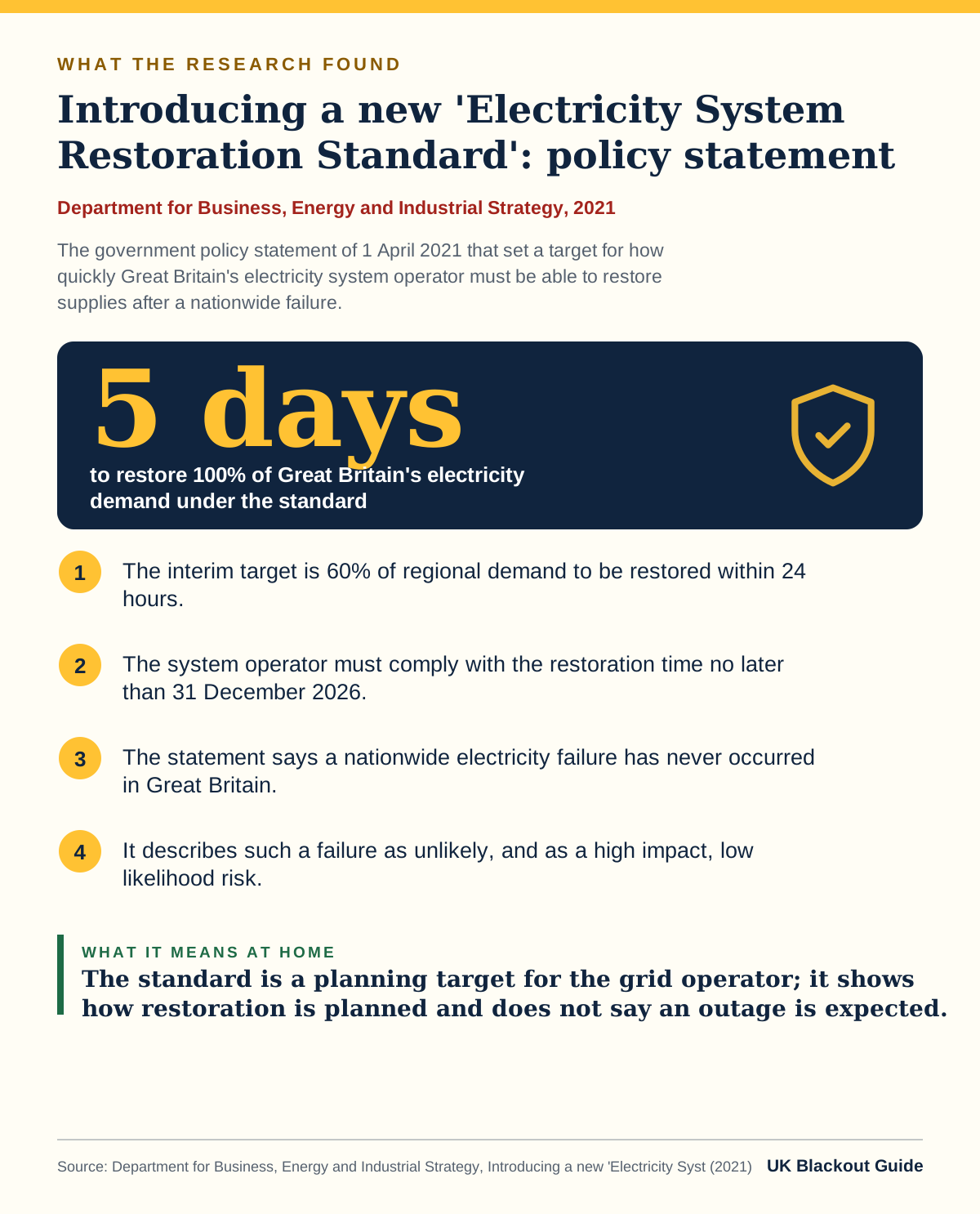
Department for Business, Energy and Industrial Strategy (2021). The government policy statement of 1 April 2021 that set a target for how quickly Great Britain's electricity system operator must be able to restore supplies after a nationwide failure. The standard is a planning target for the grid operator; it shows how restoration is planned and does not say an outage is expected.
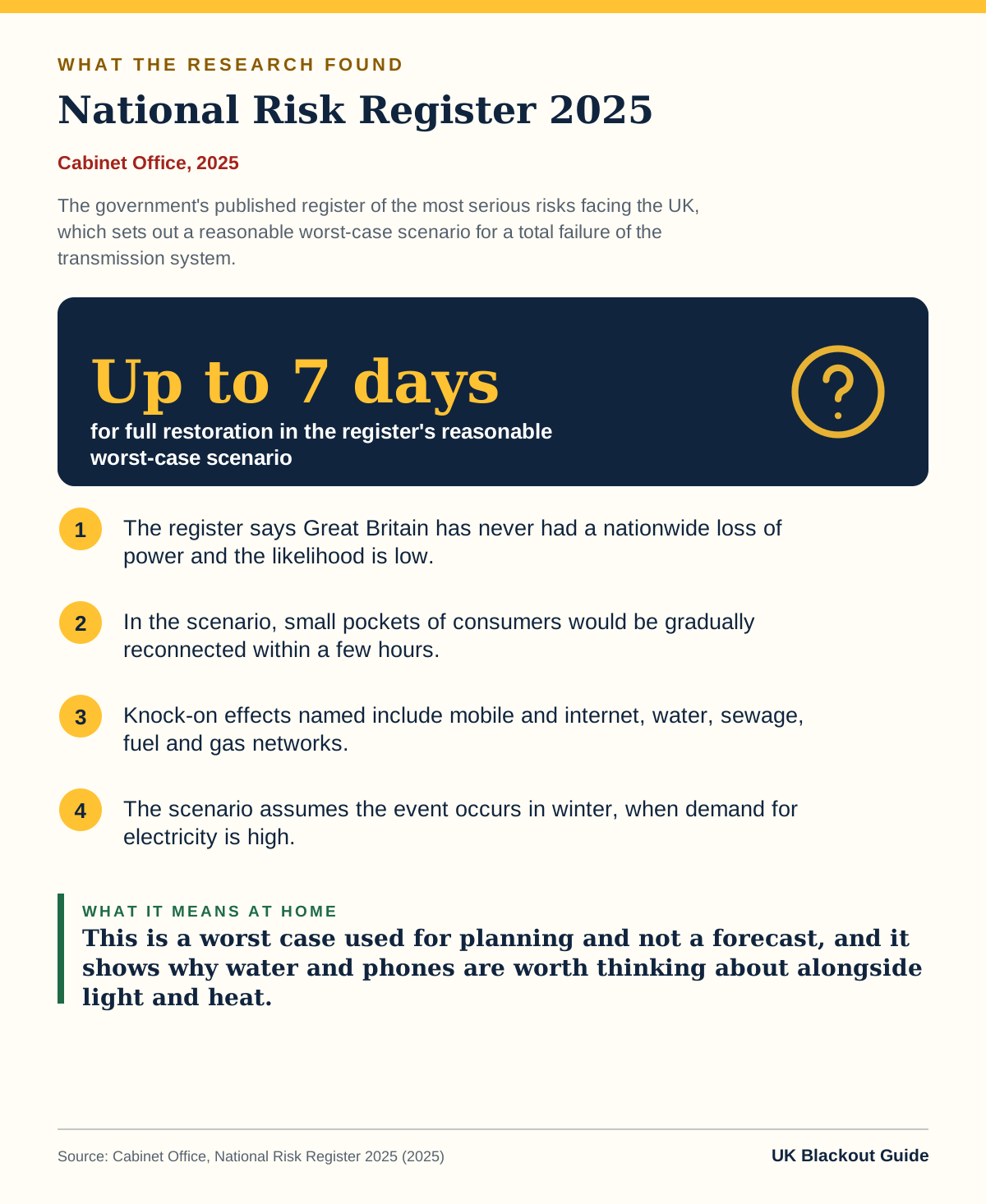
Cabinet Office (2025). The government's published register of the most serious risks facing the UK, which sets out a reasonable worst-case scenario for a total failure of the transmission system. This is a worst case used for planning and not a forecast, and it shows why water and phones are worth thinking about alongside light and heat.
Our data: what this costs
We recorded the price and buyer rating of every relevant listing we found on Amazon UK for this guide, 462 in all, and worked out the spread. These are our own figures, not a retailer's or a manufacturer's.
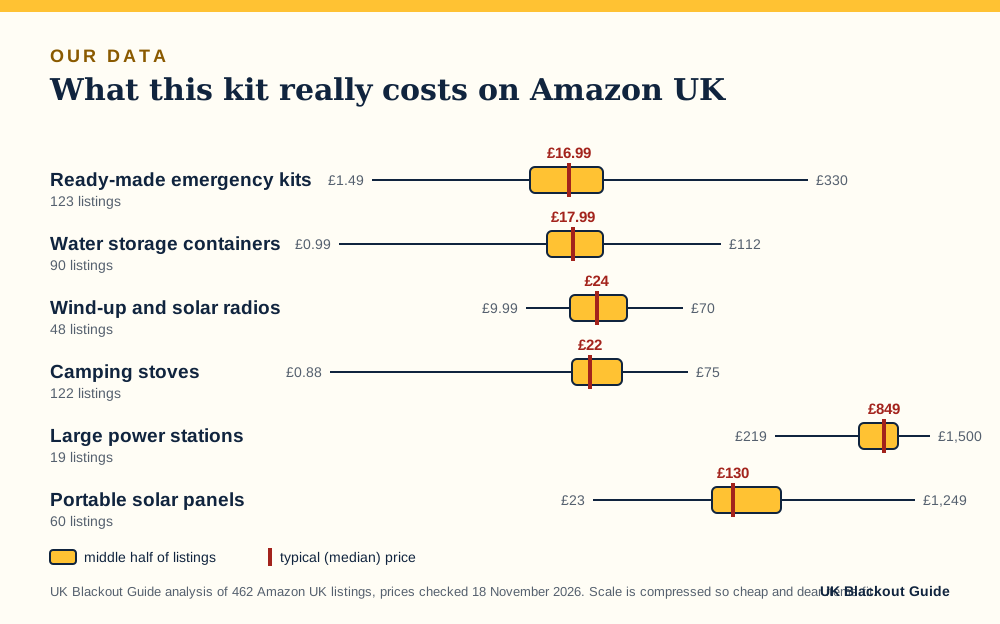
- The typical (median) price for ready-made emergency kits is £16.99, and half of all listings fall between £10.49 and £26.
- The widest spread is in ready-made emergency kits: the dearest listing costs about 19 times the typical one, so the top of the range is rarely needed for a power cut.
- 77% of ready-made emergency kits listings are rated 4.5 stars or higher by buyers, the highest share in this group.
| Product type | Listings | Cheapest | Typical | Middle half | Dearest | Rated 4.5+ |
|---|---|---|---|---|---|---|
| Ready-made emergency kits | 123 | £1.49 | £16.99 | £10.49 to £26 | £330 | 77% |
| Water storage containers | 90 | £0.99 | £17.99 | £13.00 to £26 | £112 | 59% |
| Wind-up and solar radios | 48 | £9.99 | £24 | £17.18 to £35 | £70 | 66% |
| Camping stoves | 122 | £0.88 | £22 | £17.61 to £33 | £75 | 64% |
| Large power stations | 19 | £219 | £849 | £619 to £999 | £1500 | 67% |
| Portable solar panels | 60 | £23 | £130 | £101 to £238 | £1249 | 49% |
Method: one search page per product type on Amazon UK, off-topic listings removed, prices and ratings as shown on 18 November 2026. It is a snapshot, not a full market survey, and prices move.
Common questions
Has Great Britain ever had a full national blackout?
No. There have been large regional incidents, such as 9 August 2019 and Storm Arwen in 2021, but never a complete loss of the national grid.
Does the restoration standard cover Northern Ireland?
The standard applies to Great Britain. Northern Ireland's system is run separately as part of the all-island system.
Is a week of supplies officially recommended?
No. Be Ready asks for three days, and the government has not suggested a week-long cut is expected. A week is a personal choice.
Does the government recommend a month of supplies?
No. Anything beyond three days is optional planning beyond official guidance.
Can I keep a freezer going for a week on a power station?
Only with a large unit and a way to recharge it. A fridge-freezer averages 40 to 80 watts, roughly 1 to 2 kWh a day.
Is it worth buying a generator for a 90-day plan?
Rarely. HSE guidance allows up to 30 litres of petrol at home without notifying anyone, which is days of running, not months.
Is building a long-term store the same as panic buying?
No, if you build it slowly from normal shopping. A little extra each week takes nothing from other shoppers.
How often should I check the kit?
Every six months, as Be Ready advises. Replace food and water near its date, recharge the power bank and test the torch and radio.
Will I get compensation for a long cut?
Possibly. Ofgem's Guaranteed Standards set payments for long unplanned cuts, with rules that depend on the weather. Check with Ofgem or your network operator.
- Be Ready campaign, UK government
- NESO, National Energy System Operator
- National Risk Register, Cabinet Office
- Food Standards Agency
- Health and Safety Executive
- NHS
- Ofgem
- Power Cut 105
Reviewed against these sources on 18 November 2026. If official advice has changed since, follow the official advice.
General information only. This page is not professional, safety, medical, legal or financial advice, and it is not official guidance. No national blackout has been forecast or announced, and nothing here suggests one is expected. We are independent and have no connection to the government or any energy company. Always check the official sources linked on this page. Full disclaimer
Keep reading
 Guide
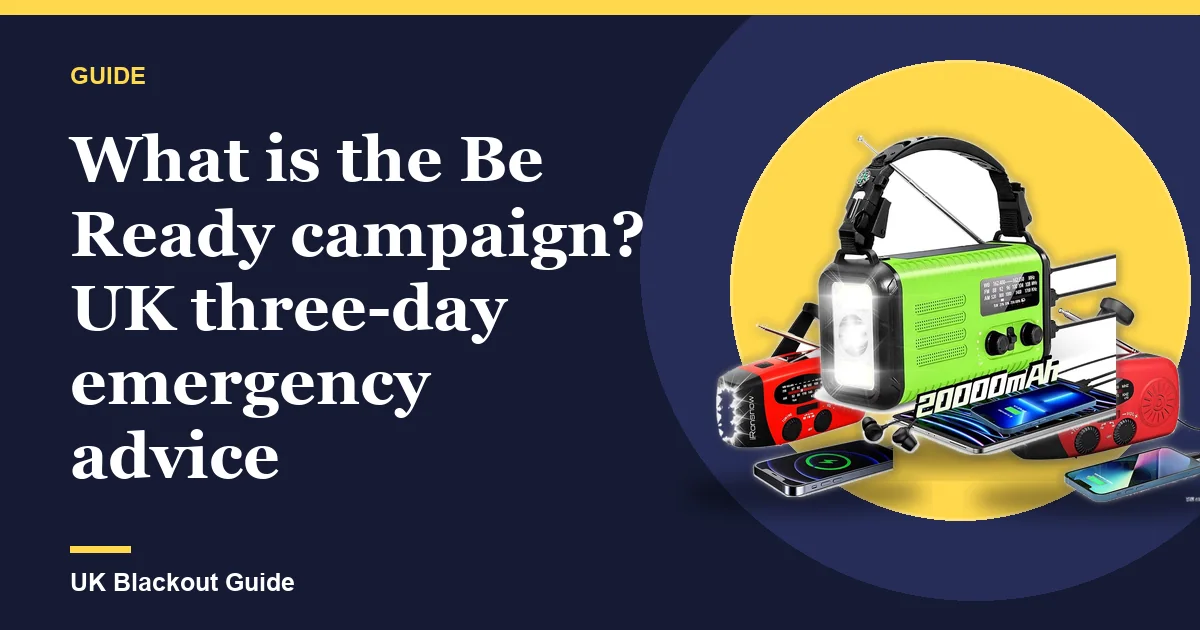
What is the Be Ready campaign? UK three-day emergency advice
Be Ready campaign explained: what the UK government's three-day advice asks households to do, the official kit list, and what the three-day claim really means.
Read: What is the Be Ready campaign? UK three-day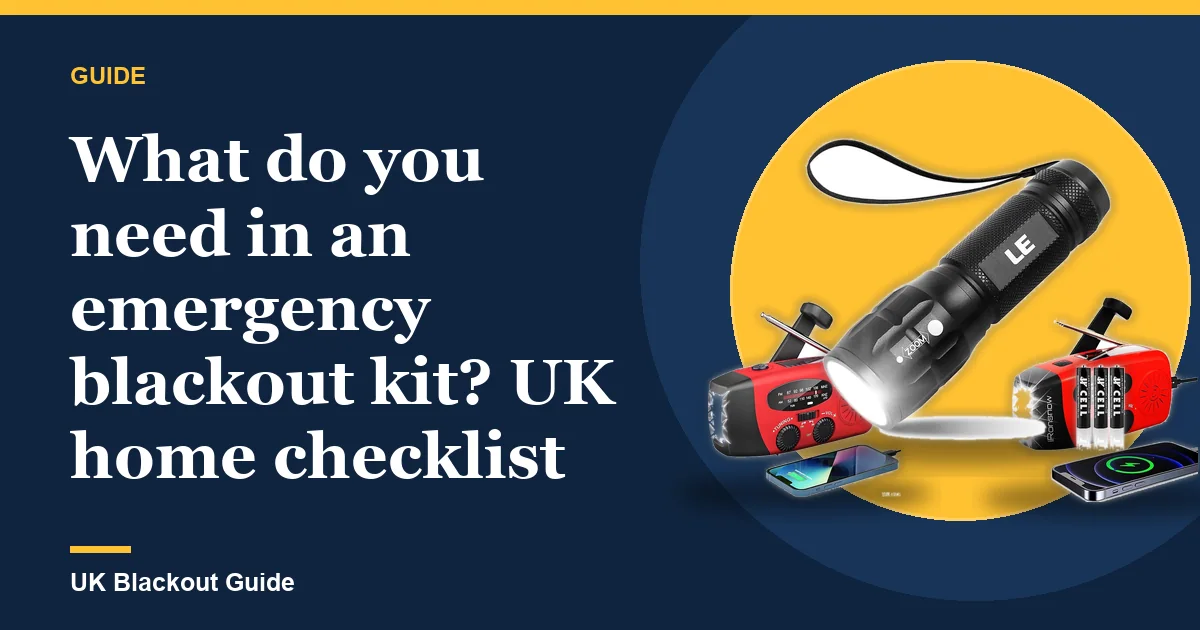 Guide
What do you need in an emergency blackout kit? UK home checklist
Emergency blackout kit for home in the UK: the official Be Ready list, a 72-hour kit item by item, what to buy first, costs, storage and six-monthly checks.
Read: What do you need in an emergency blackout Guide
What stops working in a power cut? A UK guide to what still runs
What stops working in a power cut in the UK: heating, phones, internet, water, card payments, trains and smart meters, what still runs, and what runs out first.
Read: What stops working in a power cut? A UK guide Buying guide
What can a power station run in a power cut? Best UK picks
Best portable power stations for power cuts: which size runs your router, fridge or CPAP, runtime sums, kettles, heaters, safety indoors and picks at every budget.
Read: What can a power station run in a power cut?