On this page
- In pictures
- What a Black Sky event means, in plain English
- What the Black Sky reports actually say, and what the government has not said
- What a black start is and how a grid is restarted from nothing
- The 31 December 2026 restoration deadline: 60% in 24 hours, 100% in five days
- How long restoration could take, according to the National Risk Register
- Exercise Mighty Oak: the 2023 national outage rehearsal
- What would be restored first, and why some areas wait longer
- What a household would notice during a restart
- What to keep at home for a long restart: budget, mid-range and high-end
- Running your own small exercise
- Checklist
- What the research found
- Our data: what this costs
- Common questions
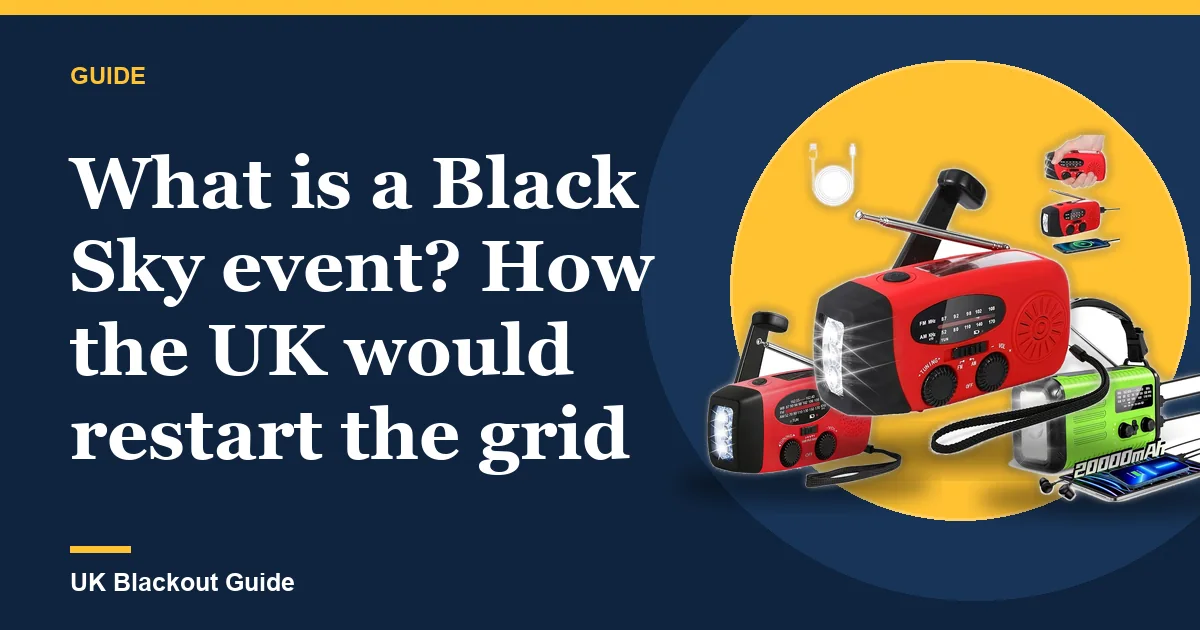
A Black Sky event is planners' shorthand for a prolonged, wide-area power outage that also disrupts water, phones, fuel, payments and transport. It is a scenario, not a forecast, and has never happened in the UK. The grid would be restarted by a black start, building up power islands from sites that start unaided. NESO must be able to restore 60% of each region within 24 hours and all demand within five days.
 Emergency Wind Up Radio with Torch and USB★ 4.5 from 250 buyers · About £24Check price on Amazon
 2000mAh Wind Up Solar Emergency Radio★ 4.5 from 61 buyers · About £16.99Check price on Amazon
 Wind Up Solar Radio, Large Battery★ 4.5 from 167 buyers · About £54Check price on Amazon
Chosen from Amazon UK listings on specification, price and buyer ratings. Not hands-on tested. We earn a commission if you buy.
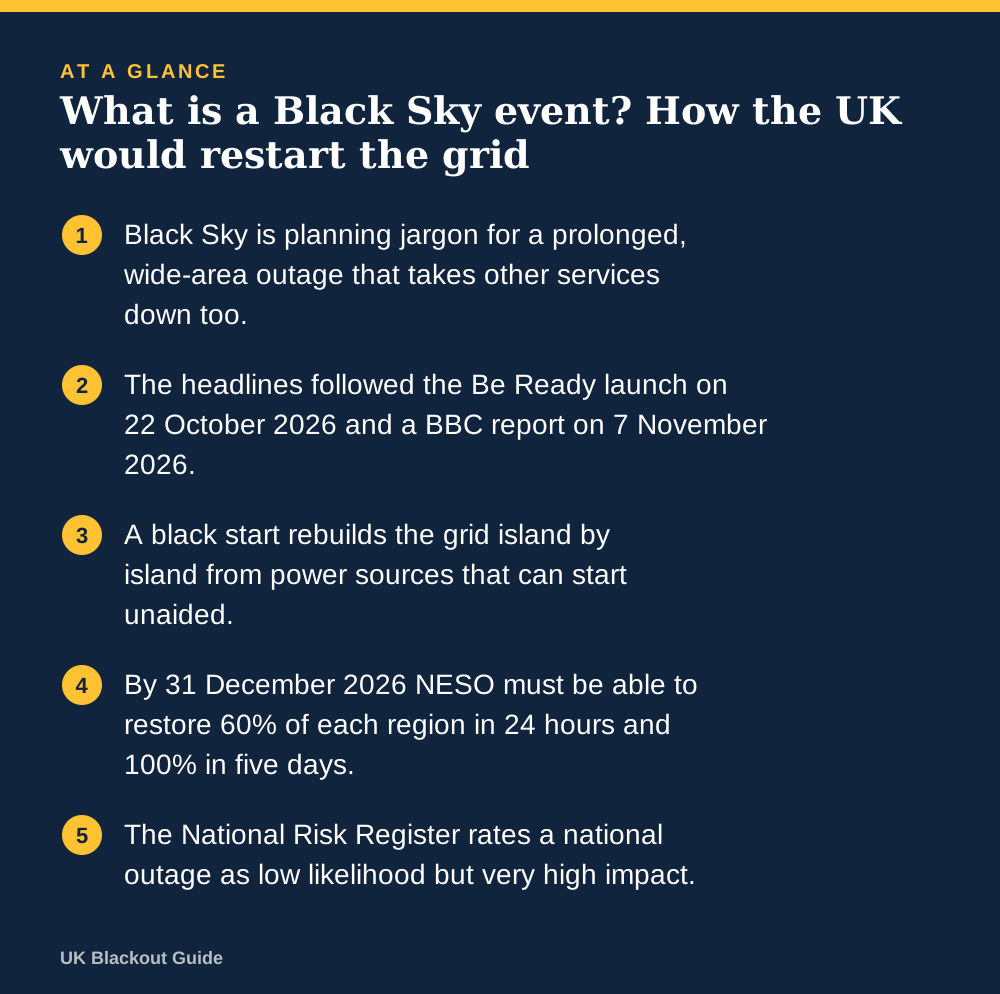
- Black Sky is planning jargon for a prolonged, wide-area outage that takes other services down too.
- The headlines followed the Be Ready launch on 22 October 2026 and a BBC report on 7 November 2026.
- A black start rebuilds the grid island by island from power sources that can start unaided.
- By 31 December 2026 NESO must be able to restore 60% of each region in 24 hours and 100% in five days.
- The National Risk Register rates a national outage as low likelihood but very high impact.
- A battery or wind-up FM radio is the item that matters most in this scenario.
In pictures: the numbers that matter
What a Black Sky event means, in plain English
Black Sky is a term used by emergency planners for a prolonged power outage over a very wide area that also disrupts other essential services, such as water, phones, fuel, payments and transport. It describes a scenario to plan for, not a prediction, and it has never happened in the UK.
What sets it apart is scale and duration. In an ordinary power cut, even a large one, the area around you still works, and help, supplies and engineers come in from outside. In a Black Sky scenario the outage is so wide and lasts so long that the services which depend on electricity begin to fail too, and there is no unaffected area next door to lean on.
Planners sometimes contrast it with blue sky days, when everything works normally, and grey sky days, meaning familiar emergencies such as storms and floods that services handle routinely. Black Sky is the hardest end of that scale: not one problem but half a dozen arriving together, each making the others harder to solve. Phones are needed to coordinate repairs, and phones depend on power. Fuel is needed for generators, and fuel pumps depend on power.
It is planning jargon used in the resilience and energy sectors, not the name of a government programme or a secret plan. The government's public documents generally refer to a national power outage, and in strict terms a Black Sky event is the most severe kind of blackout, as distinct from the everyday power cut described in what a blackout is.
It is also different from rota power cuts. Those are planned cuts that could be used in a national energy shortage, lasting about three hours at a time and scheduled by load block letter. They are announced in advance and the rest of the system keeps working around them.
What the Black Sky reports actually say, and what the government has not said
Two dated events explain most of the recent coverage. On 22 October 2026 the government launched its Be Ready campaign, asking every household to be able to manage for three days; the campaign is presented as general preparedness and makes no forecast, as the Be Ready campaign explained sets out. Then, on 7 November 2026, a BBC report described how the corporation would keep broadcasting in a prolonged outage: on FM radio, from an emergency studio, with generator-backed transmitters and supplies for at least three days.
Put a public preparedness campaign and a broadcaster's contingency plan within three weeks of each other and a wave of headlines follows. The BBC report was about contingency planning, which broadcasters and utilities do as a matter of course.
What the government has not said
- It has not said a Black Sky event, or any national blackout, is expected. No national blackout has been forecast or announced.
- It has not linked the Be Ready campaign to any date, season or threat.
- It has not asked households to prepare for longer than three days.
The National Risk Register, from the Cabinet Office, describes a national power outage as low likelihood but very high impact. Both can be true at once: a serious house fire is unlikely in any given year, and people still fit smoke alarms. Everything official on the subject is gathered in what the government has said about a UK blackout.
How to read a Black Sky headline
Look for three things in any article: a date, a named source, and a statement of likelihood. Reports that rest on the Be Ready launch, the BBC's account or the Risk Register are describing preparation. Reports that imply a blackout is scheduled have no basis in any of those sources.
What a black start is and how a grid is restarted from nothing
A black start is the process of restarting the electricity grid after a total or near-total shutdown. Engineers now tend to call it electricity system restoration; black start is the older name, and the one the public knows. Great Britain has never had to do it for the whole grid.
Why a dead grid is hard to restart
A large power station is a factory that happens to make electricity. It needs pumps, fans, control systems and cooling running before it can generate anything, and those normally take their power from the grid. With the grid dead, most stations cannot start themselves.
The second difficulty is balance. A grid works only while supply and demand match, and in a restart they have to match from the first moment. You cannot switch on a region of a million homes and then go looking for the generation to feed it. Each block of customers is added only when there is a generator ready to carry it. Adding too much of either at once would trip the system again, which is why all the stations cannot simply be switched back on together.
The restart, step by step
- Isolate. The network is broken into sections with every switch open, so nothing is connected by accident.
- Start the starters. A few contracted sites that can start unaided, using their own batteries or small on-site generators, bring themselves up.
- Energise a section. Each feeds power into a short stretch of network and on to a nearby larger power station, which uses it to start.
- Add demand in blocks. Local customers are reconnected in measured steps to give the generators a stable load. This forms a power island, a small working grid on its own.
- Grow the islands. More stations and customers are added to each.
- Join them up. Neighbouring islands are synchronised so their frequencies match exactly, then linked, until the country is one system again.
Every step involves people in control rooms and at substations talking to each other, which is why the energy industry keeps its own communications able to run without mains power.
Which power sources can start the grid
Traditionally the job fell to large stations that could self-start, such as hydro plants and some fossil-fuelled stations with their own auxiliary generators. The pool of providers has since widened to other kinds of technology and to sources in more parts of the country.
Home solar panels play no part. Most home solar shuts off in a power cut unless the system has battery backup able to run independently of the grid, and even then it powers your own home, not the street; the detail is in solar panels in a power cut.
The 31 December 2026 restoration deadline: 60% in 24 hours, 100% in five days
By 31 December 2026, NESO, the National Energy System Operator that runs Great Britain's electricity system, must have the capability to restore electricity after a total shutdown to these targets:
| What must be restored | Within |
|---|---|
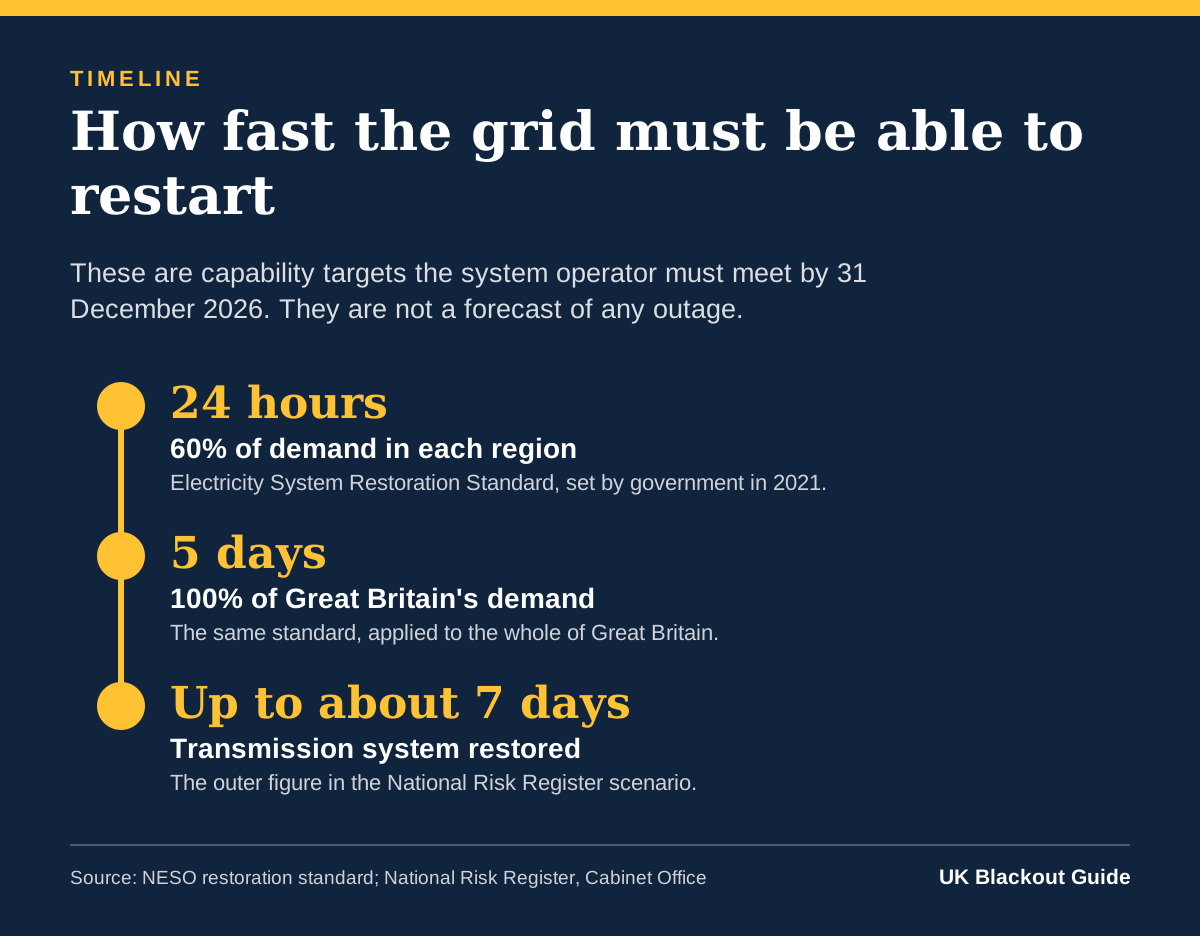
| 60% of demand in each region | 24 hours |
| 100% of Great Britain's demand | 5 days |
The targets come from the Electricity System Restoration Standard, set by government in 2021. The deadline has been fixed since then. It is the completion date for a piece of resilience work and says nothing about when, or if, a shutdown might happen.
What the wording means
It is a standard for capability, not a promise about any particular event. It requires that the plans, contracts and equipment exist to make that pace achievable; it does not promise every home would be back within five days in every possible event.
Demand here means the electricity homes and businesses would normally be using, so 60% of demand restored is roughly 60% of normal consumption reconnected, not 60% of power stations running.
The 60% figure applies in each region on purpose. A recovery that brought one part of the country back quickly while another waited most of a week could meet a national average and still leave millions in the dark. Writing it region by region means restoration capability has to be spread around Great Britain.
The standard covers Great Britain only. Northern Ireland's electricity system is run separately.
How long restoration could take, according to the National Risk Register
You may see two durations quoted. The restoration standard speaks of 100% of demand within five days. The National Risk Register says restoring the transmission system could take up to about seven days, and describes knock-on effects on water, mobile, internet, fuel, payments and transport.
They come from different documents with different purposes. One is a capability NESO must build; the other is the Risk Register's description of how long restoring the transmission system could take in a national outage. Neither is a prediction of how long a blackout would last on your street, and in any real event some areas would return much sooner than others. The figures are compared in full in how long a national blackout could last.
Within the scenario the standard is written for, the targets allow for up to 40% of demand in a region still being off after the first day, and for full restoration taking until day five. Household guidance is separate: Be Ready asks for three days, and the government has not suggested an outage of any particular length is expected.
The one real example on record
When Spain and Portugal lost all power on 28 April 2025, most supply was restored by the early hours of the next day. An expert panel later pointed to voltage-control problems and generators disconnecting in succession. That is what happened there, not a guide to what would happen here; the full account is in lessons from the Spain and Portugal blackout.
Great Britain itself has never needed a full national restart. Its largest cuts, such as 9 August 2019 and Storm Arwen in 2021, were regional, as the history of UK power cuts shows.
Exercise Mighty Oak: the 2023 national outage rehearsal
Exercise Mighty Oak was a UK government exercise held in 2023 to rehearse the response to a national power outage. It was a planning rehearsal, not a real event, and no electricity was switched off.
The confirmed facts are brief. We have not been able to verify against an official source how long it ran, who took part or what it concluded, so none of that is given here. If you see a confident account full of detail, check where it came from. It is normal for the detail of resilience exercises to stay out of public view, and the absence of a published report says nothing about the level of risk.
What an exercise is, and is not
An emergency exercise is a rehearsal. People who would have a role in a real emergency work through a scenario and practise the decisions they would face: who needs to be told, what gets priority, how information reaches the public when normal channels are down. No homes are disconnected; an exercise about a power outage happens with the lights on.
Nor is it a sign that something is about to happen. Organisations rehearse fires, floods and many other emergencies on a regular cycle, to find the weak points in a plan while nothing is at stake. The government has not published its reasons for choosing this scenario, so we do not guess at them.
Where Mighty Oak sits on the timeline
- 2021: the government set the Electricity System Restoration Standard.
- 2023: Exercise Mighty Oak rehearsed a national power outage.
- 22 October 2026: the Be Ready campaign launched.
- 7 November 2026: the BBC reported its emergency broadcasting arrangements.
- 31 December 2026: NESO's restoration capability deadline.
Seen in order, these show planning carried out over several years, well before the recent headlines. None of these steps says an outage is expected.
What would be restored first, and why some areas wait longer
Power would return unevenly. Restoration grows outward from the sites that can start unaided, through power islands that are joined up over time, so your town might come back hours or days before one fifty miles away, depending on where it sits relative to those starting points. Do not read anything into a neighbouring area getting power first.
Within an island, customers are reconnected in measured blocks so the generators have a stable load. That means streets come back in groups rather than all at once, and the 60% target in each region still leaves some homes waiting longer, up to the five-day target for full restoration.
Power may also come and go. While islands are small they are fragile, and engineers may need to disconnect an area again to keep the system stable. Treat the first return of power as provisional.
Local repairs follow a similar logic in ordinary cuts. After storms, engineers generally restore the largest groups of customers first, because one repair to a main line can bring back thousands of homes, while a farmhouse at the end of a long line may need its own repair and comes later. If someone in your home relies on powered medical equipment, the Priority Services Register tells your network operator you may need extra help in a long cut; it is free, and many households qualify.
What a household would notice during a restart
While the power is off
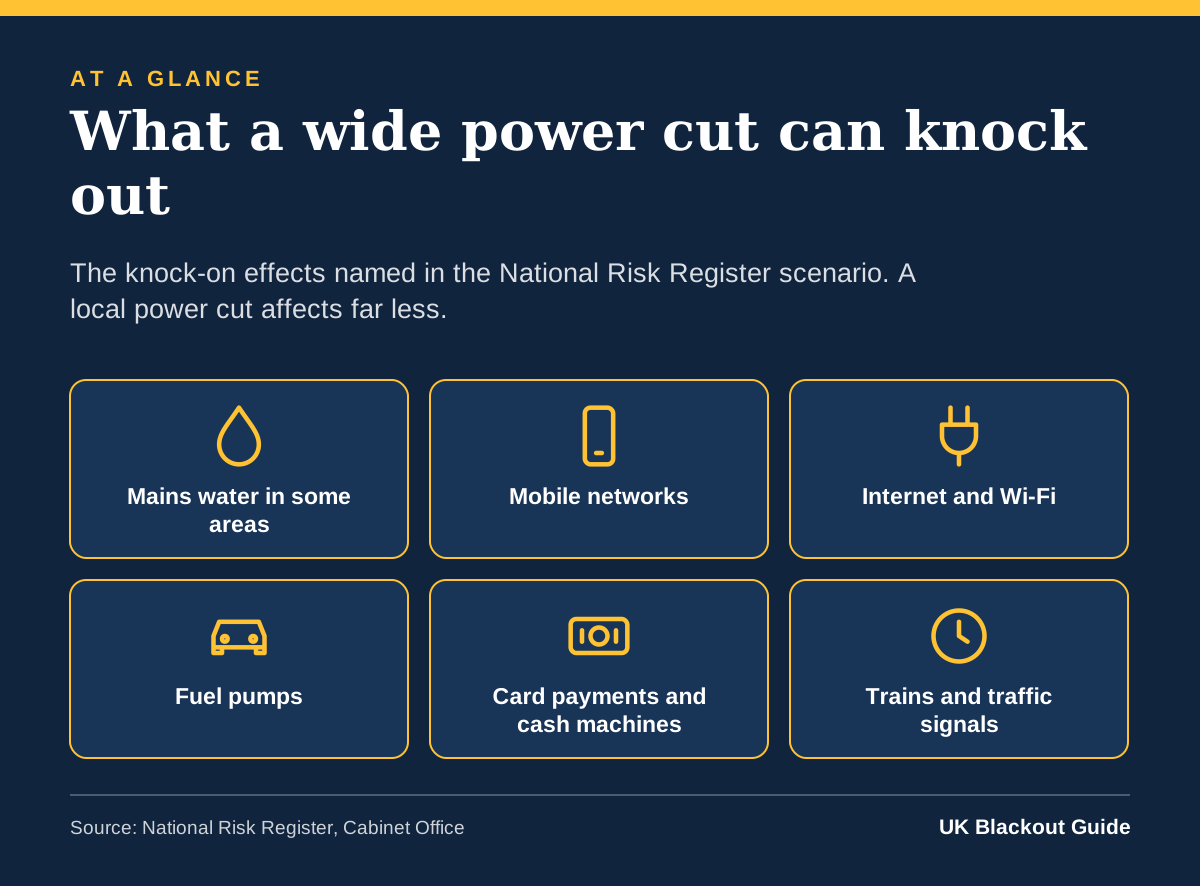
Following the official Be Ready advice: turn off irons, ovens, electric fires and fryers; unplug the TV and computer; keep fridge and freezer doors closed; keep warm with layers and blankets, closing doors and curtains; check on neighbours; and keep away from fallen power lines. Mains water can be disrupted during and after power cuts, and card payments, cash machines and mobile service may fail with the power. The fuller list is in what stops working in a blackout.
How you would hear what is happening
Broadband would be down, and mobile networks might work only temporarily in some areas on backup power. A 999 call from a mobile can roam onto any available network, and a corded landline may work; how each kind of phone behaves is set out in whether mobile phones work in a power cut.
Broadcast radio is the planned fallback. The BBC has described plans to keep broadcasting on FM from an emergency studio with generator-backed transmitters and supplies for at least three days. That makes a battery or wind-up radio the one item that connects you to the restoration effort: you would hear which regions are back, what to expect and any safety advice. Try FM and digital, and write down your local frequencies in advance.
When the power comes back
- Leave one light switched on so you know when power returns, but keep ovens, heaters and irons off.
- Recharge phones, power banks and torches straight away, in case the supply drops again.
- Hold off running everything at once; add appliances gradually.
- Check the fridge and freezer. The Food Standards Agency says a fridge stays cold for around 4 hours unopened and a full freezer about 48 hours; if in doubt, throw it out.
A surge can occur when supply is restored, which is why official advice is to unplug the TV and computer; a surge-protected lead adds a margin for other electronics, as covered in protecting appliances from power surges.
What to keep at home for a long restart: budget, mid-range and high-end
The preparation for the first days of a Black Sky scenario is the same three-day kit Be Ready recommends for any emergency: water at 3 litres per person per day, food that needs no cooking, a tin opener, a torch, a battery or wind-up FM radio, a charged power bank, a first aid kit, medication, warm layers, cash and printed contact details. The full official list is in the emergency kit list. The item most specific to this scenario is a radio, so the picks below focus on radios, plus a first aid kit and foil ponchos.
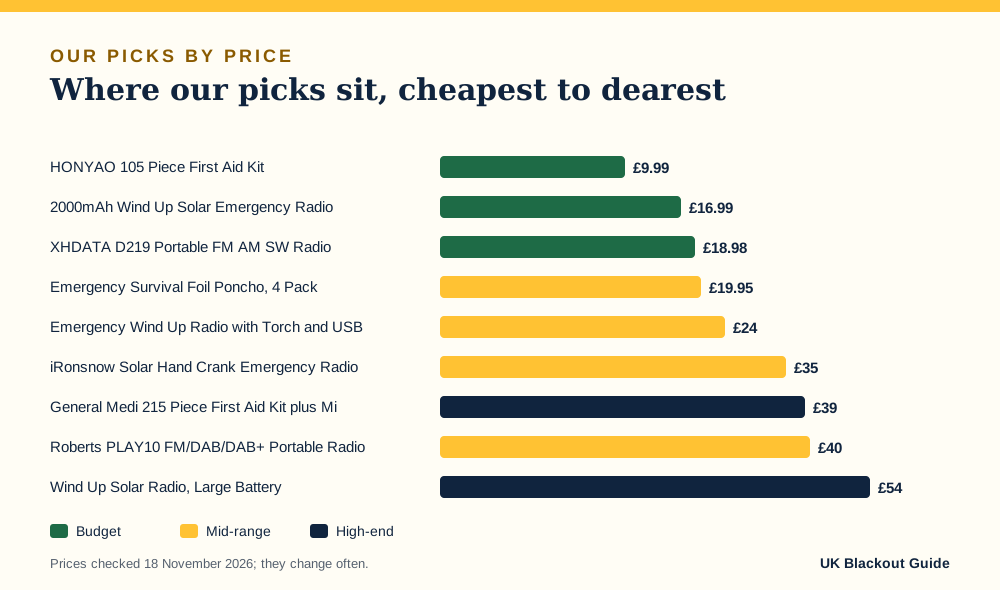
They were chosen from Amazon UK listings on 18 November 2026 on what each listing states, the price band and verified buyer ratings. We have not tested them, and prices change. Some radio listings claim very large battery capacities; judge those on ratings and the rest of the listing, not the headline number.
High-end picks What the extra money buys in a power cut

Wind Up Solar Radio, Large Battery
★ 4.5 from 167 buyers · About £54 when checked 18 November 2026A hand crank and solar AM/FM radio rated 4.5 from about 170 buyers. The listing claims 20,000 mAh, which we cannot verify, so judge it on the crank, solar and ratings. A larger battery means more phone top-ups between cranking sessions.
- Crank and solar
- Large stated battery
- Battery claim is the maker's own
- Fewer ratings than cheaper sets
General Medi 215 Piece First Aid Kit plus Mini Kit
★ 4.8 from 14,800 buyers · About £39 when checked 18 November 2026A 215 piece kit with a 43 piece mini kit, including an emergency blanket, rated 4.8 from about 14,800 buyers. The mini kit can go in a grab bag while the main kit stays at home.
- Two kits in one
- Very large number of ratings
- More than most homes need for three days
Mid-range picks The sensible middle for most homes


Emergency Wind Up Radio with Torch and USB
★ 4.5 from 250 buyers · About £24 when checked 18 November 2026The listing describes a wind-up radio with solar and hand crank charging, AM/FM, a three-LED torch and a USB port to top up a phone. It is rated 4.5 from about 250 buyers.
- Three ways to charge
- Torch built in
- Modest number of ratings
iRonsnow Solar Hand Crank Emergency Radio
★ 4.6 from 6,300 buyers · About £35 when checked 18 November 2026A solar and hand crank AM/FM radio with a 2,000 mAh battery, rated 4.6 from about 6,300 buyers, the most among the wind-up radios here. A set that charges itself keeps working through a long restart.
- Most buyer ratings among wind-up sets
- Crank and solar
- The title mentions US NOAA weather bands, which are not used in the UK
Roberts PLAY10 FM/DAB/DAB+ Portable Radio
★ 4.5 from 5,500 buyers · About £40 when checked 18 November 2026A portable FM, DAB and DAB+ radio from Roberts, rated 4.5 from about 5,500 buyers. Official advice is to try both FM and digital in a power cut, and this set does both.
- FM and DAB
- Established brand
- No crank or solar, so keep batteries in stock
Emergency Survival Foil Poncho, 4 Pack
★ 4.7 from 1,500 buyers · About £19.95 when checked 18 November 2026Four reversible thermal foil ponchos, rated 4.7 from about 1,500 buyers. One each adds a heat-retaining layer for a cold house when the heating is off.
- One per person for four
- Light to store
- A foil layer helps but does not replace blankets and warm clothing
Budget picks Cheapest ways to be covered


2000mAh Wind Up Solar Emergency Radio
★ 4.5 from 61 buyers · About £16.99 when checked 18 November 2026The listing describes an AM/FM radio with hand crank and solar charging, a 2,000 mAh battery, an LED torch, an SOS alert and a USB port for phones. At under £20 and rated 4.5, it covers the core job of hearing broadcasts with no mains, though only about 60 buyers have rated it.
- Crank and solar charging
- Torch and phone top-up
- Few buyer ratings
- Small battery for phone charging
XHDATA D219 Portable FM AM SW Radio
★ 4.4 from 5,800 buyers · About £18.98 when checked 18 November 2026A small battery-operated FM, AM and shortwave radio rated 4.4 from about 5,800 buyers. Running on ordinary batteries means you can stock spares for a long restart.
- Runs on standard batteries
- Large number of buyer ratings
- No crank or solar
- No DAB
HONYAO 105 Piece First Aid Kit
★ 4.8 from 4,300 buyers · About £9.99 when checked 18 November 2026A 105 piece first aid kit including plasters, an emergency foil blanket and burn gel, rated 4.8 from about 4,300 buyers. A first aid kit is on the official Be Ready list.
- Highly rated
- Includes a foil blanket
- Small kit; add any personal medication separately
A radio under £20 that runs on AA batteries or a crank does the essential job: picking up FM news. Paying £25 to £40 buys solar charging, a torch and a USB port to top up a phone, or a better-known DAB set. The £50-plus radios add larger built-in batteries; useful if you want one device to run for days, but overkill for a three-day plan if you already keep a power bank and spare batteries.
Running your own small exercise
The idea behind Mighty Oak works at any scale. A plan that has never been tried usually has a gap in it, and trying it is how you find the gap.
Pick an evening and switch off at the fuse box for two hours, or simply agree not to use mains power. Do not do this if anyone in the home relies on powered medical equipment, and keep the fridge and freezer closed throughout. Then check:
- Can everyone find a torch in the dark, and does it work?
- Does the radio pick up a station, and do you know which one to choose?
- Is the number to report a cut written down? It is 105 in England, Scotland and Wales, and 03457 643643 in Northern Ireland.
- If you were apart with no phones, would each person know where to meet?
- Is there cash in the house, and a printed list of contacts and medication?
Most households find one or two surprises: flat batteries, a missing tin opener, a phone list that exists only on a phone. Write down what you would change and fix it at your next six-monthly kit check, the routine set out in how to prepare for a blackout. Streets that know who might need help are better placed to look after each other, so it is worth talking to neighbours too.
Checklist
What is a Black Sky event? How the UK would restart the grid
- Keep a battery or wind-up FM radio and note local frequencies
- Store 3 litres of water per person per day for three days
- Keep three days of food that needs no cooking, and a tin opener
- Keep torches and spare batteries, not candles
- Keep a charged power bank
- Keep cash in notes and coins, and printed contacts and medication lists
- Join the Priority Services Register if you qualify
- Know to unplug the TV and computer and switch off hot appliances
- Leave one light on to show when power returns
- Try a two-hour practice evening without mains power
What the research found
These are published reports and statistics, summarised by us. They record what was measured or what happened; none is a forecast.
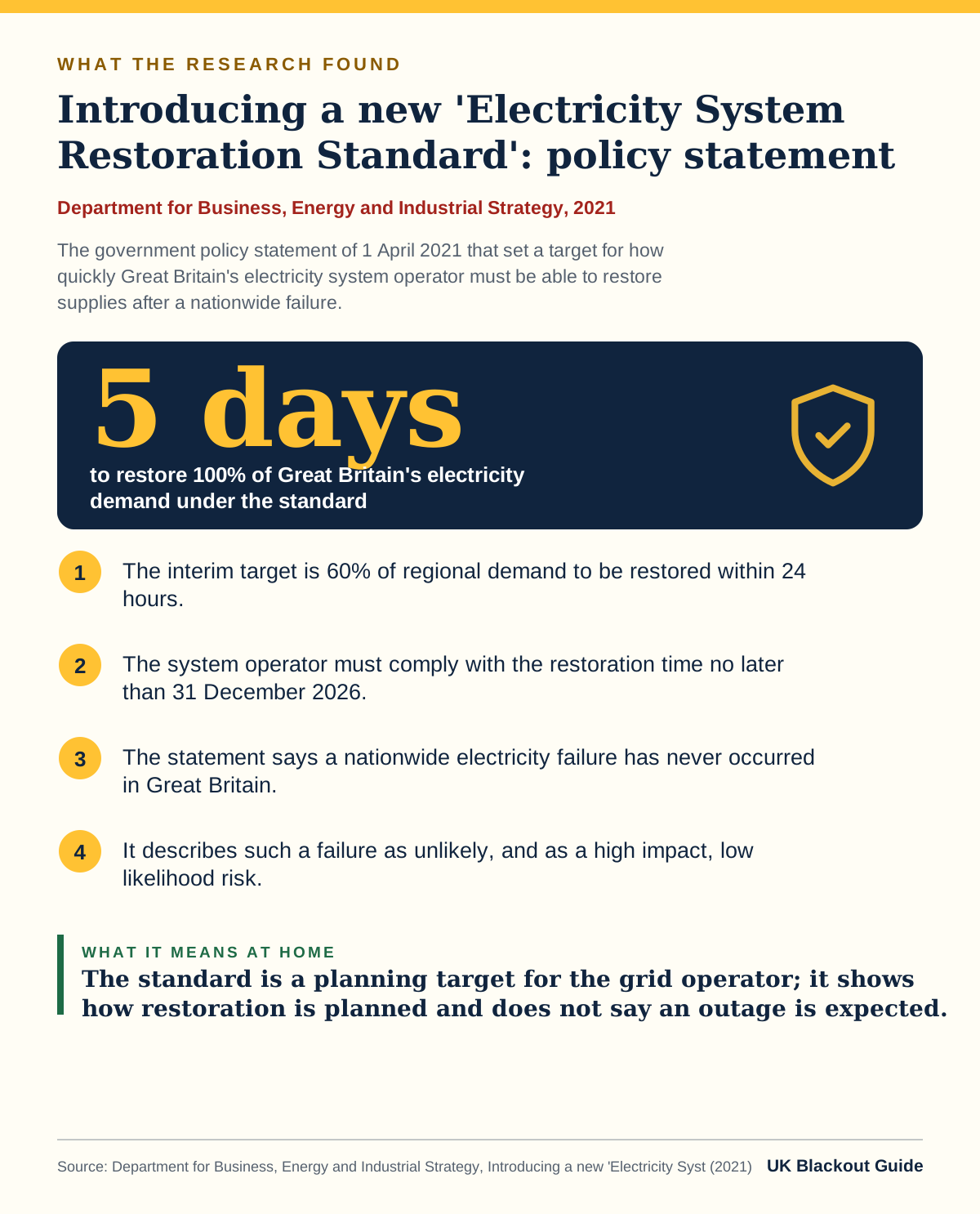
Department for Business, Energy and Industrial Strategy (2021). The government policy statement of 1 April 2021 that set a target for how quickly Great Britain's electricity system operator must be able to restore supplies after a nationwide failure. The standard is a planning target for the grid operator; it shows how restoration is planned and does not say an outage is expected.
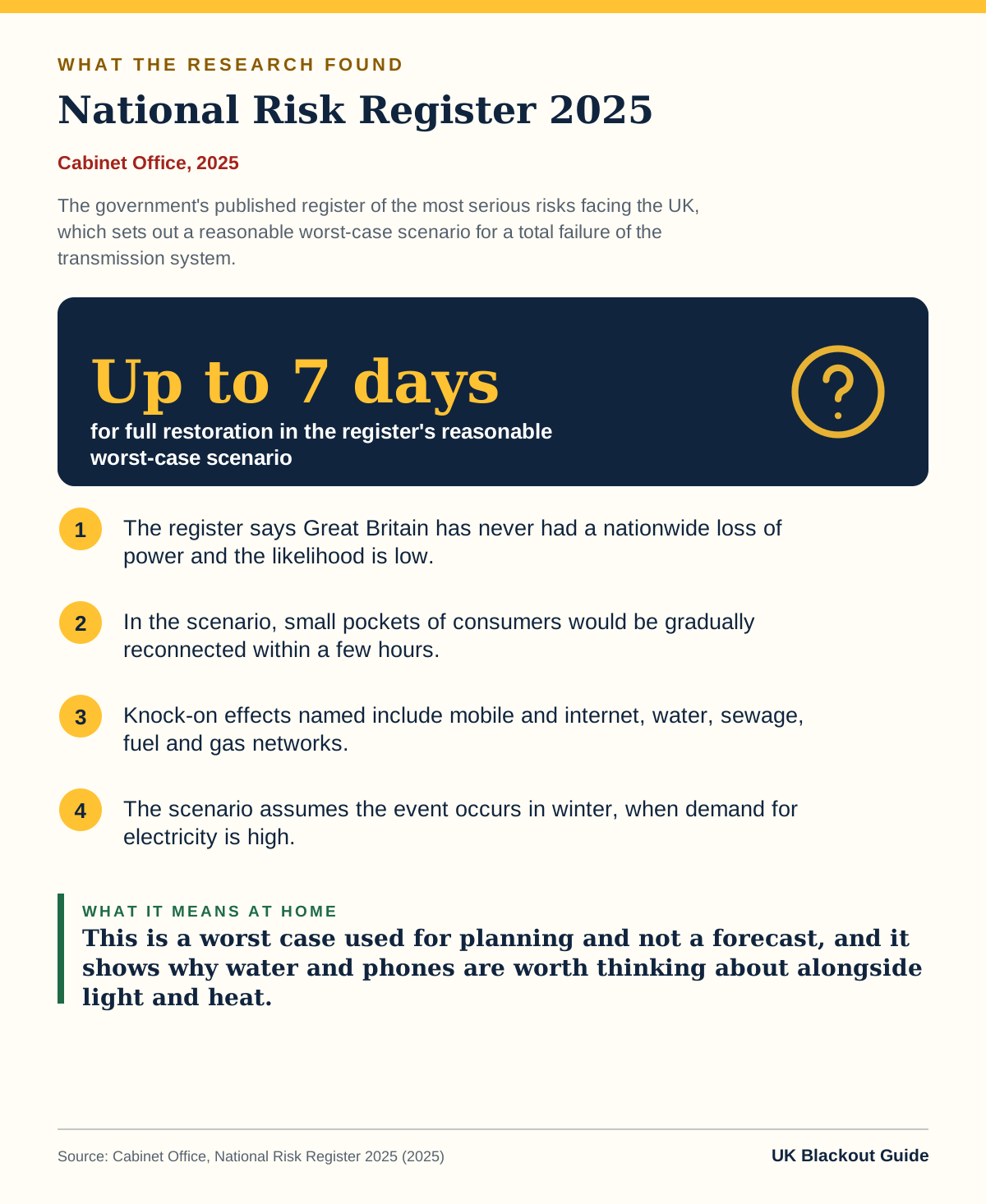
Cabinet Office (2025). The government's published register of the most serious risks facing the UK, which sets out a reasonable worst-case scenario for a total failure of the transmission system. This is a worst case used for planning and not a forecast, and it shows why water and phones are worth thinking about alongside light and heat.
Our data: what this costs
We recorded the price and buyer rating of every relevant listing we found on Amazon UK for this guide, 204 in all, and worked out the spread. These are our own figures, not a retailer's or a manufacturer's.
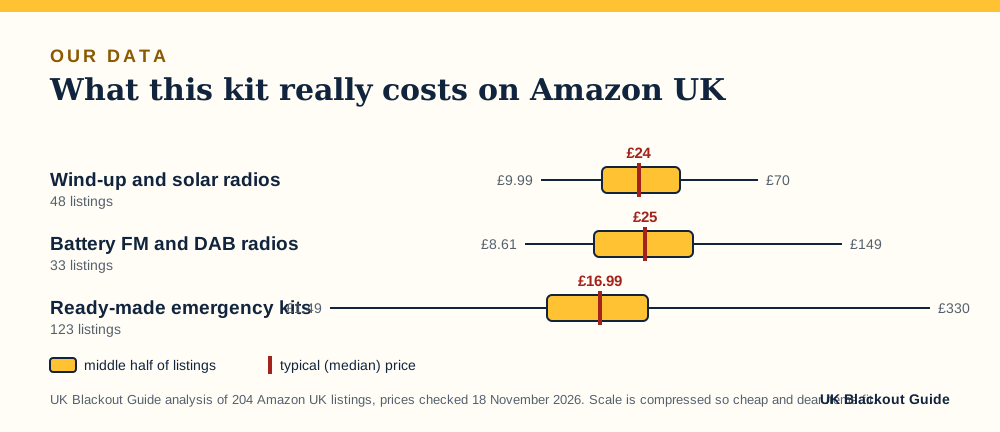
- The typical (median) price for wind-up and solar radios is £24, and half of all listings fall between £17.18 and £35.
- The widest spread is in ready-made emergency kits: the dearest listing costs about 19 times the typical one, so the top of the range is rarely needed for a power cut.
- 77% of ready-made emergency kits listings are rated 4.5 stars or higher by buyers, the highest share in this group.
| Product type | Listings | Cheapest | Typical | Middle half | Dearest | Rated 4.5+ |
|---|---|---|---|---|---|---|
| Wind-up and solar radios | 48 | £9.99 | £24 | £17.18 to £35 | £70 | 66% |
| Battery FM and DAB radios | 33 | £8.61 | £25 | £15.99 to £39 | £149 | 38% |
| Ready-made emergency kits | 123 | £1.49 | £16.99 | £10.49 to £26 | £330 | 77% |
Method: one search page per product type on Amazon UK, off-topic listings removed, prices and ratings as shown on 18 November 2026. It is a snapshot, not a full market survey, and prices move.
Common questions
Is a Black Sky event expected in the UK?
No. It is a planning scenario. The National Risk Register rates a national power outage as low likelihood but very high impact, and no national blackout has been forecast.
Is Black Sky an official government term?
It is planning jargon used in the resilience and energy sectors and in media coverage. The government's public documents generally refer to a national power outage.
Has a Black Sky event ever happened in the UK?
No. The UK has had large regional power cuts, but never a prolonged outage across the whole country.
Has Great Britain ever carried out a full black start?
No. The whole grid has never shut down, so a national restart has never been needed. Parts of the process are tested regularly.
Does the 31 December 2026 deadline mean a blackout is expected then?
No. It is the date by which NESO must have restoration capability in place, set in 2021, and it is not linked to any predicted event.
Would my home be back on within 24 hours?
Not necessarily. The 24-hour target is 60% of demand in each region, so some homes would wait longer, up to the five-day target.
Who is NESO?
The National Energy System Operator runs Great Britain's electricity system, balancing supply and demand and planning how the grid would be restarted after a shutdown.
Would my home solar and battery help restart the grid?
No. Home systems are designed to disconnect from the grid in a power cut. A battery able to run independently can power your own home but not the street.
Did Exercise Mighty Oak cut anyone's power?
No. It was a planning rehearsal held in 2023, and no electricity supplies were switched off.
- National Risk Register, Cabinet Office
- Be Ready campaign, UK government
- National Energy System Operator (NESO)
- Food Standards Agency
Reviewed against these sources on 18 November 2026. If official advice has changed since, follow the official advice.
General information only. This page is not professional, safety, medical, legal or financial advice, and it is not official guidance. No national blackout has been forecast or announced, and nothing here suggests one is expected. We are independent and have no connection to the government or any energy company. Always check the official sources linked on this page. Full disclaimer
Keep reading
 Guide
What is the Be Ready campaign? UK three-day emergency advice
Be Ready campaign explained: what the UK government's three-day advice asks households to do, the official kit list, and what the three-day claim really means.
Read: What is the Be Ready campaign? UK three-day Guide
Is the UK going to have a blackout? What the government has said
Is the UK going to have a blackout? No national blackout has been forecast or announced. What Be Ready, the Risk Register and NESO actually say, with dates.
Read: Is the UK going to have a blackout? What the Guide
What stops working in a power cut? A UK guide to what still runs
What stops working in a power cut in the UK: heating, phones, internet, water, card payments, trains and smart meters, what still runs, and what runs out first.
Read: What stops working in a power cut? A UK guide Explainer
Spain and Portugal blackout 2025: what happened and UK lessons
On 28 April 2025 Spain and Portugal lost all power for most of a day. Phones, cards and trains failed. What happened and the practical lessons for UK homes.
Read: Spain and Portugal blackout 2025: what