On this page
- The best light to have for a power cut
- Torches or candles: what the official advice says
- Lumens explained: how bright you really need
- How many torches a household should have
- Torches: what to look for
- Lanterns for lighting a room, and how long they last
- Head torches for hands-free jobs
- Automatic power cut lights and emergency bulbs
- LED candles and glow sticks: where they are useful
- A room-by-room lighting plan
- Your phone as a torch, and solar garden lights indoors
- Batteries, charging and storage
- What to buy: budget, mid-range and high-end
- Checklist
- Our data: what this costs
- Common questions
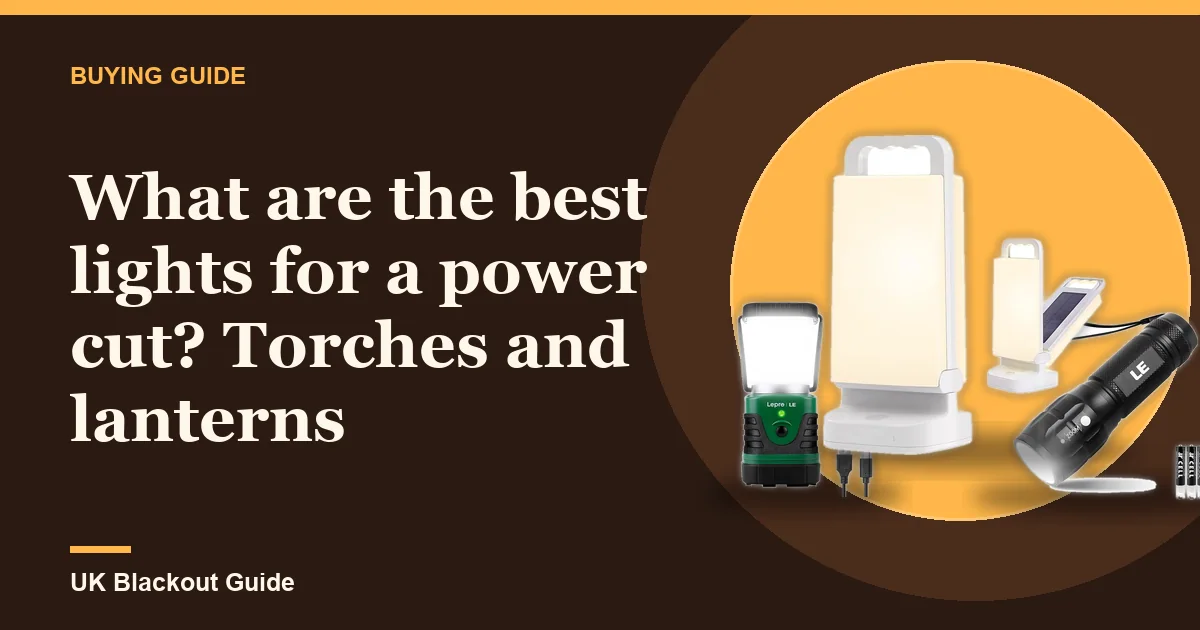
The best single light for a power cut is a rechargeable LED lantern with a proper low setting, because it lights a whole room hands-free. Add a head torch for each adult, a torch by every bed and at the fuse box, and an automatic light on the stairs. The government's Be Ready advice is that torches are safer than candles, so keep candles as a last resort.
 LE Rechargeable Camping Lantern 1000lm★ 4.6 from 33,400 buyers · About £28Check price on Amazon
 Lepro LED Torch, Battery Powered, Adjustable Focus★ 4.6 from 50,800 buyers · About £11.99Check price on Amazon
 Lepwings Solar Rechargeable Lantern, 6000mAh★ 4.4 from 2,100 buyers · About £37Check price on Amazon
Chosen from Amazon UK listings on specification, price and buyer ratings. Not hands-on tested. We earn a commission if you buy.
- A lantern lights the room; a head torch lights the job
- Be Ready says torches are safer than candles
- You need 200 to 400 lumens for a room, far less to move around
- Plan one personal light per person, a lantern and a fuse box torch
- Automatic plug-in lights cover the first dark minutes on the stairs
- Keep spare AA or AAA cells and a charged power bank
The best light to have for a power cut
If you buy one light, make it a rechargeable LED lantern with a proper low setting, because it lights a whole room for everyone at once. If you buy two, add a head torch for jobs that need both hands. After that, an automatic light on the stairs and a small torch by each bed cover the rest of the house.
Most homes own one torch, and one torch does a poor job of lighting a home. It throws a narrow beam at whatever you point it at, leaves the rest of the room black and ties up a hand. It helps to think about the three jobs light does in a cut:
- Filling a room so people can eat, talk and play cards: a lantern.
- Lighting a task in front of you, such as cooking or finding the fuse box: a head torch.
- Marking a route so nobody falls on the stairs: small low-power lights, automatic lights, LED candles or glow sticks.
How the options rank
| Light | Best at | Weak point |
|---|---|---|
| Rechargeable LED lantern | Lighting the room everyone sits in | Flat if you forgot to charge it |
| Head torch | Hands-free jobs, stairs, cooking, first aid | Dazzles people if left on high |
| Hand torch | Outdoors, lofts, meter cupboards, the bedside | Ties up a hand |
| Automatic plug-in light | The first minute of a cut, on the stairs | Small battery, cannot recharge until power returns |
| Wind-up torch | Never runs out | Dim and tiring to keep going |
| LED candles and glow sticks | Comfort and route markers | Too dim to work by |
| Phone torch | Finding a real torch | Spends the battery you need for calls |
| Candles | Nothing a torch cannot do better | Naked flame |
Whichever you choose, three features separate a useful emergency light from a drawer ornament: a true low setting, a stated runtime in hours, and a power source you can replenish in a cut, meaning spare cells or USB charging from a power bank. Very high brightness is not on the list.
Torches or candles: what the official advice says
Torches. The Be Ready kit list asks for a battery or wind-up torch with spare batteries and says plainly that torches are safer than candles. It does not list candles at all.
A power cut puts a household in unfamiliar conditions: dark rooms, people moving about with their hands full, children excited or unsettled, pets underfoot. Adding naked flames raises the risk of fire at the same moment smoke is harder to see. Battery smoke alarms keep working in a cut, so test yours now, and read our guide to fire safety during a power cut for the rest.
| LED torch or lantern | Candle | |
|---|---|---|
| Light output | Tens to hundreds of lumens, adjustable | About 12 lumens, fixed |
| Fire risk | Very low | Naked flame |
| Carry it around | Yes | Not safely |
| Leave it unattended | Yes | No |
| Around children and pets | Fine | Needs constant supervision |
| Heat | None to speak of | Far too little to warm a room |
The case people make for candles is that they are cheap, need no batteries and are already in the cupboard. A box of tea lights is better than sitting in the dark. But a candle gives off far too little heat to warm a room, and a single set of cells in an LED light on low usually outlasts several candles. The honest case for candles is atmosphere, and battery LED candles give the same glow without the flame. A few candles in a normal room will not use a dangerous amount of oxygen; the real hazard is fire.
If candles are all you have: stand them in a proper holder on a flat, heat-resistant surface, away from curtains and anything hanging above. Never leave one burning in an empty room or while you sleep, keep them out of reach of children and pets, and do not walk around carrying one. Tea lights are harder to knock over, but their metal cups get hot enough to damage surfaces. Oil and hurricane lamps enclose the flame but still need fuel and supervision.
Lumens explained: how bright you really need
Lumens measure the total light a torch or lantern gives out, in every direction, on its brightest setting. For a power cut you need far fewer than the packaging suggests. In a dark house your pupils open up and you see well on very little light.
| Job | Lumens needed |
|---|---|
| Finding your way to the bathroom or stairs | 10 to 30 |
| Reading, cooking, first aid, a board game | 50 to 150, aimed at the task |
| Lighting a living room for a family | 200 to 400, from a lantern placed high |
| Looking down the garden or along the street | 300 and up, in a focused beam |
For reference, a candle gives about 12 lumens, a keyring light 10 to 20, an old 40 W bulb 400 to 450 and an old 60 W bulb about 800. A modern LED gives around 100 lumens for each watt it draws, which is why watts no longer tell you how bright anything is. Lux is a different measure: how much light lands on a surface, which depends on distance and beam width.
Why the headline figure misleads
Two lights with the same lumen figure can look very different. A torch gathers its light into a beam, so one patch is bright and the room stays dark. A lantern spreads the same light everywhere, which is why a 200 lumen lantern lights a room better than a 1,000 lumen torch lying on the table. Beam distance depends on focus, not lumens alone. Warm white light is also easier to live with for an evening than harsh blue-white.
The big number is the maximum, often a short burst before the torch steps down to stop overheating. Reputable makers quote figures under the ANSI FL1 standard, which counts runtime until the light has faded to 10% of its starting output, so a torch quoted at 10 hours may be dim for much of it. Many cheap listings claim hundreds of thousands of lumens. That is not credible for a handheld torch, and a listing whose main claim is impossible deserves extra doubt on everything else.
Brightness against battery life
In a cut the scarce thing is stored energy, and brightness spends it. Run a light at a quarter of its output and it lasts around four times as long, often more. A 1,000 lumen torch is fine as long as it also has a real low mode. For indoor use, a low of 20 to 50 lumens and a high of about 300 covers the house and garden.
How many torches a household should have
There is no official number; Be Ready asks for a battery or wind-up torch with spare batteries. A practical rule is one personal light per person, one shared lantern, and one torch that lives at the fuse box. For a family of four that is six lights.
One torch meets the letter of the kit list, and it is far better than none. The trouble shows within minutes: someone takes it to the fuse box and everyone else is in the dark, or a child needs the toilet while an adult is using it to cook. A single light is also a single point of failure: batteries leak, torches get dropped, rechargeables are found flat.
| Household | Personal lights | Lantern | Fuse box torch | Total |
|---|---|---|---|---|
| One person in a flat | 1 | 1 | 1 | 3 |
| Couple | 2 | 1 | 1 | 4 |
| Family of four | 4 | 1 | 1 | 6 |
| Family of five, three floors | 5 | 2 | 1 | 8 |
For adults a head torch is the most useful personal light. For children, a small hand torch they can work themselves is better, and a child with their own torch is usually a calmer child; helping children through a power cut has more on keeping them settled. Add a torch to the car, and an automatic light on the landing on top of these numbers. You do not have to buy it all at once: Be Ready's advice is to build a kit gradually, so start with the lantern and one torch and add a light each month. A phone does not count, for reasons covered further down.
Torches: what to look for
A torch is the first thing you reach for when the lights go out, and the job is simple: get you to the fuse box, the stairs and the kit cupboard without a fall, and light the garden or the street if you need to go out.
- Replaceable batteries or rechargeable, ideally both. Torches taking AA or AAA cells are always ready if you keep spares, and cells store for years. Rechargeables are cheap to run and refill from a power bank or the car, but can be flat when needed. One of each is the safest plan.
- A low mode for indoors. A torch that is too bright bounces off white walls and ruins your night vision.
- Simple controls. One press on, one press off suits older relatives; cycling through strobe modes in the dark does not.
- Adjustable focus lets you widen the beam for a room or narrow it for the garden.
A wind-up torch never runs out, which is why Be Ready names it, but the output is modest and needs regular winding, so treat it as a backup. Two modest torches are more use than one powerful one. Stick a small piece of glow-in-the-dark tape on each torch so it can be found in a dark drawer.
Lanterns for lighting a room, and how long they last
A lantern shines in every direction, so one on a table lights faces, food and the floor around it. In a longer cut most households gather in one room in the evening, and that is where the lantern belongs. A few hundred lumens on its top setting, with a lower setting for most of the evening, suits an ordinary living room. Hang it high, from a hook or on a shelf, and the light spreads further with less glare. A warm setting is easier on the eyes and helps children settle.
How long an LED lantern lasts
A typical rechargeable LED lantern runs for roughly 4 to 8 hours on its brightest setting and anything from 20 to well over 50 hours on its lowest. On high a lantern might draw 3 to 5 watts; on low, half a watt or less. You can check a maker's claim yourself: runtime in hours ≈ battery watt-hours × 0.85 ÷ the light's watts. If the box gives mAh, multiply by 3.7 and divide by 1,000 to get watt-hours for a lithium cell.
| Lantern battery | On high (3 W) | On low (0.5 W) |
|---|---|---|
| 5,000 mAh (about 18.5 Wh) | About 5 hours | About 31 hours |
Real life falls short of the box. Runtimes are measured until the light has faded a long way, cold rooms cut battery performance, and rechargeable cells lose capacity with age and drain slowly on the shelf. Treat the maker's figure as a best case. The LEDs themselves are rated for tens of thousands of hours, so the battery ages long before they do. Larger cells such as D size hold far more energy than AAs, which is why D-cell lanterns are known for long runtimes.
Making one lantern last three days
In midwinter you might want light for 6 hours each evening plus an hour in the morning, about 20 hours over three days. A lantern with a 30-hour low mode covers that with room to spare if you keep it on low, switch it off when the room is empty, and use a head torch for short tasks instead of turning the lantern up. Your eyes adjust within a few minutes. In a rota cut of about three hours at a time, one charged lantern covers the whole gap. A USB lantern can be topped up from a power bank, which takes only a small share of a 20,000 mAh bank, and our list of the best power banks for power cuts covers the sizes worth owning. Phones come first if supplies are tight.
Rechargeable lanterns suit most homes if you also own a power bank. Battery lanterns suit long cuts, because spare cells store for years. A sensible mix is one good rechargeable and one battery or wind-up model. Solar panels on lanterns are a useful extra, but in a UK winter the panel alone will not keep up with nightly use. LED lanterns run cool and can be left on low all night.
Head torches for hands-free jobs
Most of what you do in a power cut needs two hands: resetting a trip switch, changing a nappy, carrying a pan, helping an older relative down the stairs. A head torch points light wherever you look and leaves your hands alone, which makes it the most useful personal light in the house. It is also the right light for cooking on a camping stove outdoors, for first aid and for reading in bed.
- A low white mode or a red mode. Indoors, a head torch on full power dazzles everyone you look at. Red light lets you see nearby without spoiling night vision and will not wake a sleeping child.
- A stated runtime tells you more about the third evening than any lumen figure.
- A lamp that tilts down, so you light your hands without bending your neck.
- One large button, easier with cold fingers and for anyone with limited grip.
- An easy strap, so one torch fits an adult and a ten-year-old with one pull of the buckle.
Keep one where you would start dealing with a cut, by the fuse box or with the kit, and one in the car, since changing a wheel by phone light is miserable. Older children generally enjoy head torches; supervise young ones and teach them not to shine it in faces. A head torch is still no replacement for a room light, so use it alongside a lantern.
Never bring a camping stove, barbecue or generator indoors because it is dark outside. They produce carbon monoxide, which has no smell. Use a head torch and cook outdoors.
Automatic power cut lights and emergency bulbs
Every other light needs you to find it first. An automatic power cut light does not. It sits in a socket, keeps its battery charged from the mains and lights up the moment the supply fails, so in a cut at night there is light before you have worked out what has happened. That makes it a strong first purchase for anyone at risk of a fall, and one of the simplest steps in looking after older relatives through a power cut.
- Put them on the route, not in the room: the top of the stairs, the landing, the hall and the path from bed to bathroom. Low sockets light the floor, which is what you need on stairs. Add one at any turn in the stairs.
- Check the listing says it comes on when mains power fails. Some rechargeable night lights do not. Look for the words power failure or power outage, a UK three-pin plug and UK voltage.
- Choose a lift-out torch if you can. It solves the oldest problem in a power cut, finding a torch in the dark.
Their batteries are small and cannot recharge until the mains returns, so treat them as a bridge to your main lights. They draw very little to stay topped up, and they respond to any loss of power at the socket, so they work in a rota cut too. An automatic light only tells you the power is off if you see it. If you need to know at once, for medical equipment or a freezer in the garage, a power failure alarm is the right tool.
Emergency light bulbs
Rechargeable bulbs look like ordinary LED bulbs with a small battery inside, so a table lamp or a hook over the cooker keeps working. Two different products share the name. Some charge in a live fitting and switch to battery when the mains fails. Most popular ones are USB-charged, remote-controlled lights in a bulb shape for lamps with no wiring; you charge them like a phone and switch them on yourself, and they will not come on automatically. Wall switches complicate the automatic kind, because a bulb cannot always tell a switch from a cut, so test one before you rely on it.
Check the fitting first. Many UK lamps take B22 bayonet (two pins, push and twist); E27 is the large screw type. A battery bulb is heavier and longer than a normal one, so check it clears the shade, and avoid bulbs listed as E26 or 120V, which are for North American supplies. Expect a few hours at full brightness and much longer dimmed; the longest figure on a listing refers to the lowest setting.
LED candles and glow sticks: where they are useful
Both are marker and comfort lights, not working lights. Neither lets you chop vegetables or read small print, but both can be left glowing unattended with no fire risk.
LED candles
LED candles keep the comfort of candlelight and drop the flame, so they can sit on a windowsill, in a child's room or next to a sleeping pet. A few warm, flickering lights change the mood of a dark house quickly, and that matters on a long evening. The useful features are plain ones: a timer that switches them on at dusk and off again to save batteries over several evenings, a big enough pack to mark a route, and a waterproof casing for a damp bathroom. Remotes are easy to lose in the dark, so make sure each candle has a switch on its base.
LED tea lights usually take coin or button cells, which can cause severe internal injury if a child swallows one. Keep tea lights and spare cells out of reach of young children and choose lights with a secure battery cover.
Glow sticks
A glow stick is a sealed tube holding two chemicals kept apart by a thin inner capsule. Bend it until the capsule snaps, shake it, and it glows for hours with no electricity, flame or heat. It is waterproof and has no switch to fumble. Emergency 6 inch sticks are usually sold with a stated duration of about 12 hours, long enough for a winter night, though the glow is strongest in the first hour and fades after that. Green and yellow look brightest; white is closest to normal light; red and blue are dim and best kept for play.
- Tie one to the bannister at the top and bottom of the stairs.
- Hang one on the bathroom door handle; it is safe on a wet surface.
- Give one to a child for the night, or hang it out of reach for very young children.
- Clip one to a coat, a dog's collar or a pushchair if you have to go out on unlit streets.
The limits are real. A glow stick is single use and cannot be turned off, so one snapped at 5pm is partly spent by bedtime. Cold makes it fainter but longer-lasting. The chemicals degrade in storage, faster if the foil wrapper is opened, so keep them wrapped somewhere cool and dark and replace them by the date on the pack. Do not cut them open or let children or pets chew them: the liquid irritates skin, eyes and mouth, and some contain a small glass capsule. If one leaks, rinse with plenty of water and follow NHS advice if you are concerned.
A room-by-room lighting plan
Before buying anything, walk through your home one evening with the lights off and the curtains closed. Notice where you slow down: usually the top of the stairs, a step into a kitchen or extension, the corner where the dog bed lives, and the cupboard with the fuse box. Those places come first; comfortable light for the evening comes second. A typical three-bedroom house can be covered with about eight inexpensive lights, each kept in the room where it will be used.
| Area | What to put there | Why |
|---|---|---|
| Hall, stairs, landing | Automatic plug-in power cut light | Comes on unaided and marks the trip hazards |
| Living room | Lantern placed high, plus LED candles if you like | Lights the whole group for the evening |
| Kitchen | Head torch on a hook, second small lantern | Both hands free for hot food and knives |
| Bathroom | Small battery light, LED candle or glow stick | No sockets, wet floor, visited half asleep |
| Bedrooms | Torch in each bedside drawer | The first thing you reach for at 3am |
| Fuse box and meter cupboard | Torch kept inside or beside it | To check whether it is a trip or a wider cut |
| Front and back doors | Torch or head torch | Bins, the car, checking on neighbours |
Hall, stairs and landing. Falls on stairs are the main injury risk in a dark house. If there is a socket on the landing and another in the hall, use both. In a flat, put one in the corridor between bedroom and bathroom; communal stairwells have their own emergency lighting for a limited time, so keep a torch by your front door too, as covered in dealing with a power cut in a flat.
Living room. In a winter cut this is likely to be the one room you keep warm as well as lit. A room lit by one lantern looks dim for a few minutes and comfortable after that.
Kitchen. Hands are full of sharp and hot things, so the light should be on your head; a lantern on the worktop puts your shadow over whatever you are chopping. Decide what you need from the fridge before you open the door, and use a torch so you are quick.
Bathroom and bedrooms. You only need to see the edges of things in a bathroom. Every bed should have a torch reachable without getting up. For younger children, a rechargeable night light that keeps glowing when the mains goes is worth having in the room all year. Never leave a candle in a bedroom.
Fuse box and doors. A torch at the fuse box tells you whether only your house is off or the whole street. If it is a wider cut, you can report the power cut on 105. Take a light when you check on a neighbour, and stay well away from fallen power lines. Mains-powered outside security lights will not work; solar ones with their own battery will.
Your phone as a torch, and solar garden lights indoors
Should you use your phone as a torch
Use it for the first few minutes, to find a proper torch, then switch it off. In a power cut your phone is how you report the fault, follow your network operator's updates, reach family and call 999, and official advice is that mobile networks may work only temporarily in some areas on backup power. Every bit of battery spent lighting the kitchen is unavailable for that, as our guide to whether mobile phones work in a power cut explains.
It is also a poor torch: a wide, short flood with little brightness control, and a phone that has to be held or balanced. Drop it in the dark and you risk your only way to call for help. Using the torch does not damage the phone, though some phones dim it if they get hot.
If the phone is your only light tonight, stand it face up on a table with the torch on and put a clear plastic bottle of water on top: the water scatters the beam into a soft room light. Turn on low power mode, lower the screen brightness, and use the light in short bursts. A white screen on low gives a gentle glow for finding things close by. If candles are the alternative, the phone is still the safer choice.
An old phone makes a poor emergency torch, because it holds its charge badly in a drawer. It is more useful kept charged as a spare for 999 calls.
Do solar garden lights work indoors
Yes. A solar garden light that has charged outside during the day will work indoors that evening, because its sensor simply switches the LED on in the dark. Pull it out of the lawn at dusk and stand it in a jar on the stairs or the bathroom shelf. It is a free, flame-free marker, but expect only a few lumens, less than a single candle. Larger solar security lights and lanterns with bigger panels are brighter and more useful.
Winter is the weak point. A 100 W panel that yields 300 to 400 Wh on a clear summer day often manages only 30 to 80 Wh on a dull winter one, and the tiny panel on a garden light suffers the same drop. After a grey December day a stake light may glow for an hour or two. Each morning, put the lights back outside in the most open spot with the panel wiped clean; charging through a window or under an indoor lamp works poorly. Never fit non-rechargeable batteries in a solar light, because the panel will try to charge them. The same daylight rule applies to rooftop panels, as set out in what solar panels do in a power cut. Treat garden lights as a bonus, not a substitute for the torch on the Be Ready list.
Batteries, charging and storage
Be Ready asks households to be able to manage for three days. For lighting, that means enough stored energy for three evenings and the dark mornings either side. LED lights use very little: a lamp draws 5 to 10 W at full brightness and far less dimmed, so lighting is the cheapest thing in the house to keep running.
- Standardise. If every light takes the same size of battery, or charges from the same USB-C cable, you are never left with the wrong spares. AA and AAA are the sizes worth keeping, and the batteries worth stocking for emergencies covers which types store best.
- Keep one full change of cells per light that takes replaceable batteries. On low settings that is usually more than enough for three days.
- Store spares in one known place, in their packaging, away from heat, with the rest of your kit.
- Top up rechargeables every three to six months, because they slowly lose charge on the shelf, and after every use.
A light you cannot find is no use. Give each one a fixed home and tell everyone where it is: a head torch on a hook by the back door, a torch in each bedside drawer, the lantern on the shelf with your household emergency kit. Check them when the clocks change: switch each on for a minute, recharge, look for leaking batteries and put it back.
A small light on its lowest setting in the hall or bathroom overnight is worthwhile if anyone is likely to get up, particularly children and older people. You can also run ordinary LED lamps from a portable power station for many hours, but it is still worth owning lights with their own batteries so you are not relying on a single device.
What to buy: budget, mid-range and high-end
Lights are among the cheapest things in a power cut kit. These picks come from Amazon UK listings, chosen for what suits a blackout: long stated runtimes, standard cells you can stockpile, solar or wind-up charging, and lights that come on by themselves. We have not tested them. Ignore implausible lumen claims in any title, and check the current listing, since prices and stock change.
High-end picks What the extra money buys in a power cut

Lepwings Solar Rechargeable Lantern, 6000mAh
★ 4.4 from 2,100 buyers · About £37 when checked 18 November 2026The listing gives a 6,000 mAh battery, 80 hours of battery life, a dimmable LED and solar charging, and names emergency outages among its uses. The extra money buys a stated battery size, a long runtime and a way to add charge from daylight when the sockets are dead. It averages 4.4 from about 2,100 buyers.
- Solar and USB charging
- Long stated runtime
- Winter solar charging is slow
- Dearest lantern here
BLUETECH Power Failure Flashlight, 3-Pack
★ 4.6 from 2,100 buyers · About £61 when checked 18 November 2026Three plug-in units with motion detection, which the listing describes as power failure and blackout lights. Three is enough to light the route from bed to front door in one order. They have the most feedback of the automatic lights, 4.6 from about 2,100 buyers, at around £60 for the set.
- Lights by itself when power fails
- Covers three spots
- Small batteries, a bridge to your main lights
- Check the plug is UK three-pin
Mid-range picks The sensible middle for most homes


LE Rechargeable Camping Lantern 1000lm
★ 4.6 from 33,400 buyers · About £28 when checked 18 November 2026The listing states 1,000 lumens with warm and cool light, a believable figure for a lantern and plenty for a living room. It has the largest body of feedback in the category, 4.6 from about 33,400 buyers.
- Warm and cool light
- Huge number of ratings
- Must be kept charged
USB-C Rechargeable Lantern with Remote
★ 4.7 from 2,000 buyers · About £23 when checked 18 November 2026The title names power cuts among its uses and claims 300 hours of running, which can only apply to the dimmest of its five modes. A long low mode is still what gets you through several evenings on one charge. Rated 4.7 by about 2,000 buyers.
- Long low-mode runtime
- Magnetic base and remote
- The 300-hour figure is the dimmest setting only
Lepro Rechargeable Head Torch, 2-Pack
★ 4.6 from 22,600 buyers · About £14.99 when checked 18 November 2026Two rechargeable head torches with a stated 30 hour runtime, presumably on the lowest setting, so several evenings on one charge. The listing averages 4.6 from about 22,600 buyers.
- Two torches for the price
- Long stated runtime
- Needs charging; keep a battery torch too
BORUIT AAA Head Torch, Red and White, 2-Pack
★ 4.6 from 1,400 buyers · About £18.04 when checked 18 November 2026These take AAA batteries, so they do not depend on having been charged and keep going as long as you have spares. The listing gives red and white light and four modes. Rated 4.6 by about 1,400 buyers.
- Runs on standard cells
- Red light mode
- Batteries are an ongoing cost
Xtralite NiteSafe Sensor II Night Light
★ 4.5 from 963 buyers · About £24 when checked 18 November 2026The listing describes four functions in one rechargeable unit, including a motion sensor night light, a power failure light and a torch. It comes on by itself when the mains fails and lifts out for the walk to the fuse box. Rated 4.5 by about 960 buyers.
- Comes on automatically
- Lifts out as a torch
- One unit covers one spot
Neporal MagicGlow Rechargeable Bulbs, B22, 2-Pack
★ 4.1 from 416 buyers · About £19.99 when checked 18 November 2026The only bulb pick whose title states a B22 bayonet fitting, sold as an emergency bulb, with a 2,000 mAh battery, USB charging and dimming. The stated 24 hours will be on the dimmest setting. Rated 4.1 by about 420 buyers.
- B22 fitting
- Dimmable
- USB charged: you switch it on yourself
- Lower rating than other picks
Budget picks Cheapest ways to be covered


Lepro LED Torch, Battery Powered, Adjustable Focus
★ 4.6 from 50,800 buyers · About £11.99 when checked 18 November 2026A battery-powered LED torch with adjustable focus. Replaceable batteries mean it is ready after a year in a drawer and back in action in seconds on the third night. The most rated torch in the category, 4.6 from about 50,800 buyers.
- Ready whenever you have spare cells
- Adjustable beam
- Batteries may not be included
Simpeak Hand Crank Solar LED Torch, 2-Pack
★ 4.4 from 7,400 buyers · About £4.78 when checked 18 November 2026Two hand crank torches with solar charging and a clip, according to the listing. They need no batteries and no mains, so they cannot be flat when you find them. Rated 4.4 by about 7,400 buyers.
- Can never run flat
- Very cheap
- Modest light for the effort
Battery Operated Foldable LED Lantern, 2-Pack
★ 4.5 from 1,600 buyers · About £14.99 when checked 18 November 2026These run on ordinary batteries and the title names power failure among their uses, so they sit ready for years beside a sealed pack of cells with no charging routine. Rated 4.5 by about 1,600 buyers.
- No charging needed
- Two lanterns
- Basic light output
Kingavon 20-LED Emergency Sensor Light
★ 4.5 from 397 buyers · About £13.88 when checked 18 November 2026A 20 LED rechargeable emergency sensor light, rated 4.5 by about 400 buyers. It is the cheapest way here to put automatic light in one more spot, such as the kitchen or by the fuse box.
- Low price
- Rechargeable
- Few details in the listing
Flickering LED Votive Tea Lights with Timer
★ 4.4 from 1,000 buyers · About £10.99 when checked 18 November 2026The listing states a timer that runs six hours on and 18 off in each cycle. Switch them on at dusk on the first evening and they repeat every night of the cut, while the off period rests the batteries. Rated 4.4 by about 1,000 buyers.
- Built-in timer
- No flame
- Coin cells: keep from young children
- Comfort light only
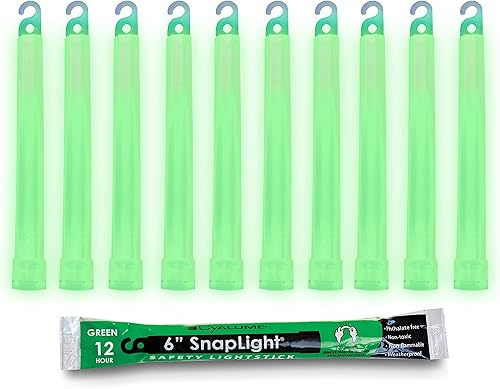
Cyalume SnapLight Green 6 Inch Glow Sticks, 10
★ 4.7 from 4,100 buyers · About £18.00 when checked 18 November 2026Ten 6 inch green sticks sold as emergency lights, each with a stated 12 hour duration, long enough to mark the stairs through a winter night. The most reviewed emergency pack, 4.7 from about 4,100 buyers.
- No batteries, flame or heat
- Stated 12 hours
- Single use
- Check the expiry date
How much to spend: the budget tier, under £15 per item, buys a pair of battery lanterns, a battery torch, a single automatic light, a pack of tea lights and a pack of glow sticks, which between them meet the official advice and cover a house. The middle tier, £15 to £30, is where most people should buy the main-room lantern and a head torch two-pack, and where automatic lights add a lift-out torch. The high end, around £35 to £60, buys a solar lantern with a stated large battery, worth it if your cuts tend to run for days, or a three-pack of automatic lights to cover the whole route from bed to front door. For a short local cut in a small flat, the high end is overkill: a mid-range lantern, a head torch each and a pack of spare cells do the job. Money beyond that is better spent on a second torch for another room than a brighter one.
Checklist
What are the best lights for a power cut? Torches and lanterns
- Buy one LED lantern with a low setting for the main room
- Give every adult a head torch and every child a small torch
- Keep a torch at the fuse box and one by the front door
- Fit an automatic power cut light at the top of the stairs
- Put a torch in each bedside drawer
- Keep a pack of glow sticks or LED tea lights for the bathroom and stairs
- Standardise on AA or AAA cells and keep one full change per light
- Top up rechargeable lights every three to six months
- Give every light a fixed home and tell everyone where
- Test your battery smoke alarms
- Keep candles as a last resort only, never unattended
- Check every light when the clocks change
Our data: what this costs
We recorded the price and buyer rating of every relevant listing we found on Amazon UK for this guide, 480 in all, and worked out the spread. These are our own figures, not a retailer's or a manufacturer's.
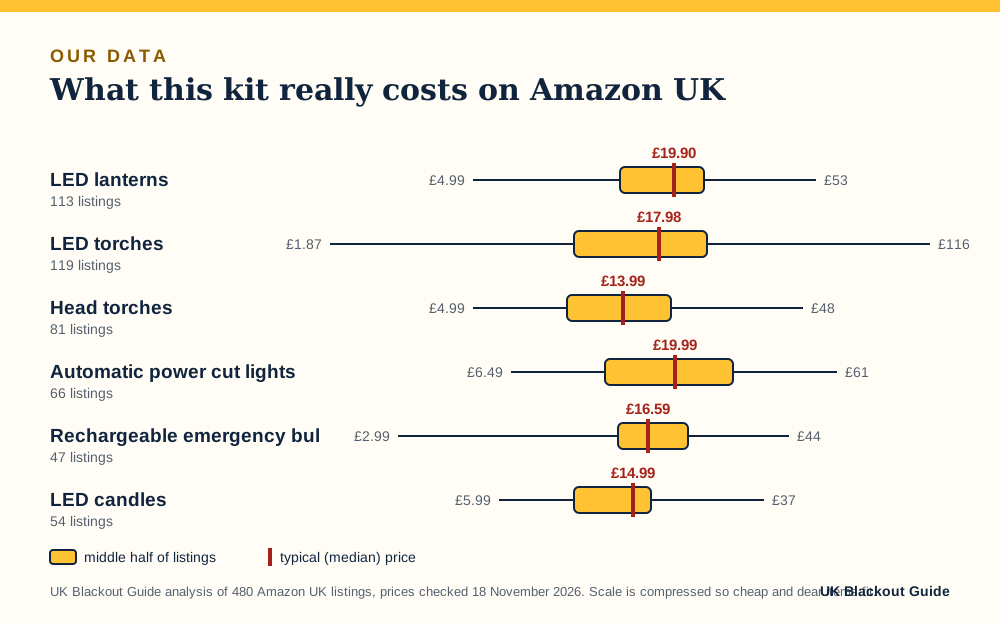
- The typical (median) price for LED lanterns is £19.90, and half of all listings fall between £13.72 and £24.
- The widest spread is in LED torches: the dearest listing costs about 6 times the typical one, so the top of the range is rarely needed for a power cut.
- 70% of LED lanterns listings are rated 4.5 stars or higher by buyers, the highest share in this group.
| Product type | Listings | Cheapest | Typical | Middle half | Dearest | Rated 4.5+ |
|---|---|---|---|---|---|---|
| LED lanterns | 113 | £4.99 | £19.90 | £13.72 to £24 | £53 | 70% |
| LED torches | 119 | £1.87 | £17.98 | £9.99 to £25 | £116 | 70% |
| Head torches | 81 | £4.99 | £13.99 | £9.54 to £19.48 | £48 | 55% |
| Automatic power cut lights | 66 | £6.49 | £19.99 | £12.42 to £30 | £61 | 47% |
| Rechargeable emergency bulbs | 47 | £2.99 | £16.59 | £13.59 to £22 | £44 | 24% |
| LED candles | 54 | £5.99 | £14.99 | £9.99 to £16.99 | £37 | 56% |

Method: one search page per product type on Amazon UK, off-topic listings removed, prices and ratings as shown on 18 November 2026. It is a snapshot, not a full market survey, and prices move.
Common questions
Is a lantern or a torch better for a power cut?
A lantern is better for lighting a room and a torch for moving around or going outside. Most homes want one of each, starting with the lantern.
What is the best light for someone living alone?
A head torch, since it lights whatever you are doing in any room. Add a plug-in automatic light near the stairs.
Is 1,000 lumens too bright for indoors?
For most indoor jobs, yes. It causes glare off walls and drains the battery. It is fine if the torch also has a proper low mode.
Why do torches claim a million lumens?
It is marketing. Those figures are far beyond what a small handheld torch can produce, so judge the torch on everything else.
Can I leave an LED lantern on all night?
Yes, on its lowest setting. LED lanterns stay cool and have no flame, though it uses hours you may want the next evening.
Do rechargeable bulbs come on automatically in a power cut?
Some do, but many popular models are USB-charged lights you switch on yourself. Check the listing says it lights when mains power fails.
How long do glow sticks last once snapped?
Most 6 inch emergency sticks state about 12 hours. They are brightest at the start and faint by morning.
Are LED candles bright enough for a power cut?
Not as your only light. They give a gentle glow for comfort and marking routes, and work best alongside a lantern.
Do I need special emergency lights, or will camping lights do?
Camping lanterns and head torches are well suited to power cuts. What matters is a low setting, a known runtime and batteries you can replace or recharge.
How many spare batteries should I keep?
At least one full change for each light that takes replaceable cells, stored in one known place.
Reviewed against these sources on 18 November 2026. If official advice has changed since, follow the official advice.
General information only. This page is not professional, safety, medical, legal or financial advice, and it is not official guidance. No national blackout has been forecast or announced, and nothing here suggests one is expected. We are independent and have no connection to the government or any energy company. Products are chosen from retailer listings and buyer ratings and have not been tested by us; some links earn us a commission. Always check the official sources linked on this page. Full disclaimer
Keep reading
 Guide
What do you need in an emergency blackout kit? UK home checklist
Emergency blackout kit for home in the UK: the official Be Ready list, a 72-hour kit item by item, what to buy first, costs, storage and six-monthly checks.
Read: What do you need in an emergency blackout Guide
What should you do in a power cut? UK step-by-step guide
What to do in a power cut in the UK: check your fuse box, call 105, what to switch off, the first hour and first 24 hours, cuts at night, and when power returns.
Read: What should you do in a power cut? UK Guide
Do alarms and smart locks work in a power cut? Home security UK
Home security in a power cut: whether burglar alarms, smart locks, cameras and electric garage doors work, how to open them by hand, and simple steps.
Read: Do alarms and smart locks work in a power Buying guide
Which batteries should you stock for a power cut? UK guide
Best batteries for emergencies in the UK: which sizes to stock, alkaline vs rechargeable, how many to keep for a power cut, and budget to high-end picks.
Read: Which batteries should you stock for a power