On this page
The Cloudflare outage on Friday 20 February 2026 began at 5.48pm UK time and lasted about six hours. A bug in an automated clean-up task withdrew the internet routes for around 1,100 blocks of customer addresses, about a quarter of those using its Bring Your Own IP service. Cloudflare said it was not caused by a cyber attack.
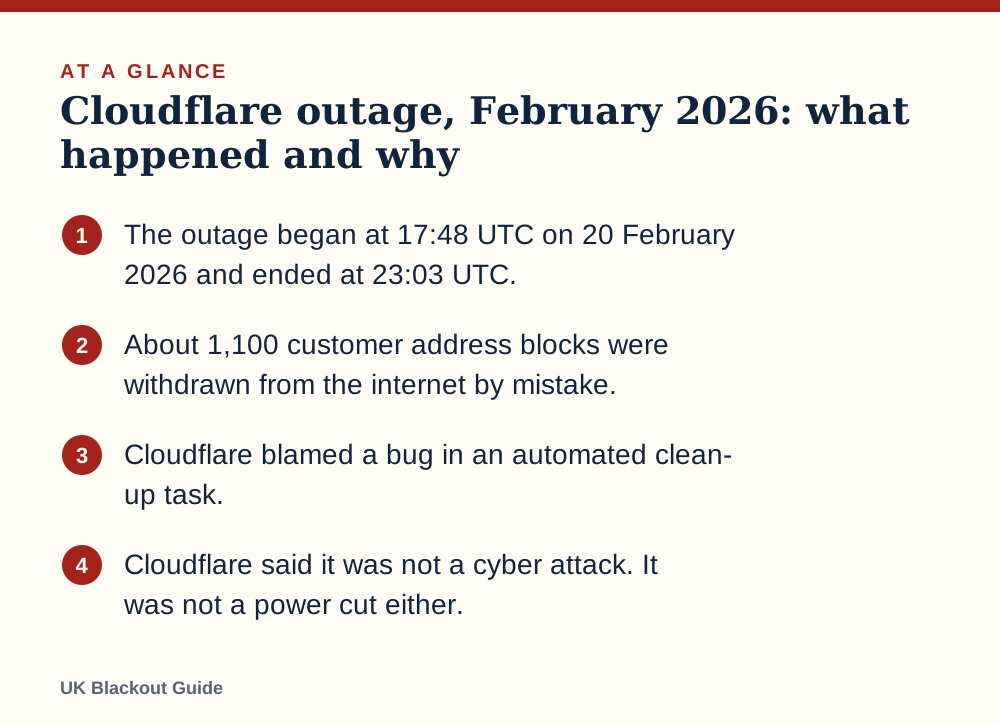
- The outage began at 17:48 UTC on 20 February 2026 and ended at 23:03 UTC.
- About 1,100 customer address blocks were withdrawn from the internet by mistake.
- Cloudflare blamed a bug in an automated clean-up task.
- Cloudflare said it was not a cyber attack. It was not a power cut either.
What happened at Cloudflare
Cloudflare sits in front of a large share of the world's websites, speeding them up and filtering out junk traffic. On Friday 20 February 2026, some of its customers found their sites and services could not be reached at all.
The customers affected were those using a service called Bring Your Own IP, where a company brings its own internet addresses and asks Cloudflare to announce them to the rest of the internet. For about a quarter of those address blocks, Cloudflare stopped making that announcement, so traffic had nowhere to go and connections timed out.
When it started and how long it lasted
Cloudflare's own account gives a start time of 17:48 UTC, which is the same as UK time in February. Address blocks were being withdrawn until 18:46 UTC, when an engineer stopped the faulty task.
About 800 blocks were restored at around 20:20 UTC by reversing the changes. Roughly 300 more needed engineers to rebuild their settings by hand, which was finished at 23:03 UTC. Cloudflare gives the total length as six hours and seven minutes. ITPro described it as an outage of about seven hours.
Who and what was affected
Cloudflare said about 1,100 address blocks were withdrawn, roughly 25% of the 4,306 blocks in the service. Services that ran on them, including website delivery and security, became unreachable.
Cloudflare's own 1.1.1.1 website showed an error, though its 1.1.1.1 address lookup service kept working. Cloudflare's report does not name the customers affected, and the reports we read do not describe disruption to UK banks or public services. That contrasts with the Google Cloud outage of October 2026, which disrupted Revolut, Lloyds, Halifax and HSBC customers in the UK.
The cause, as stated by Cloudflare
Cloudflare had been automating a job that used to be done by hand: removing address blocks when a customer asks. A regular clean-up task asked an internal system for the list of blocks waiting to be deleted. Because of a bug in that request, the system returned every block in the service, and the task began deleting them. Automation that went wrong was also behind the AWS outage of October 2025, where two automated processes clashed and left a key database service without a working internet address.
Cloudflare said no cyber attack or malicious activity of any kind was involved. It said its testing had not covered this case, and set out changes including stricter checks on such requests, snapshots that allow a quick rollback, and monitoring that halts unusually fast or broad deletions. A similar fault appeared in the Microsoft Azure outage of July 2026, when a bug in automated maintenance removed network routes from more devices than intended.
What customers were told
At 19:19 UTC Cloudflare published guidance so that customers could re-announce their own addresses through its dashboard, and some restored their own service that way. Others had lost the settings needed to do so and had to wait for Cloudflare's engineers.
It was Cloudflare's second widely reported outage in four months, after the Cloudflare outage of November 2025, when an oversized configuration file crashed its traffic software and took X and ChatGPT offline.
What this does and does not tell us about power cuts
This was a software fault at an internet company. It was not a power cut and did not cause one. Cloudflare said plainly that it was not an attack, and no official body has said a cyber attack on the UK electricity grid is expected.
What it tells a household is narrow: websites and apps can disappear for an evening with the electricity on, because of a mistake in a system most people have never heard of. In a real power cut the internet fails for different reasons, set out in whether the internet works in a power cut.
The things that help are the same either way. Keep some money in a form that needs no network, as covered in cash for emergencies, and know the limits of card payments, banking apps and mobile phones when the systems behind them stop.
Common questions
Was the February 2026 Cloudflare outage a cyber attack?
No. Cloudflare said it was not caused by a cyber attack or malicious activity of any kind.
How long did the Cloudflare outage last?
Cloudflare gives the length as six hours and seven minutes, from 17:48 UTC to 23:03 UTC on 20 February 2026.
Did the outage affect all Cloudflare customers?
No. It affected customers using the Bring Your Own IP service, and about a quarter of the address blocks in that service.
- Cloudflare: Cloudflare outage on February 20, 2026
- ITPro: Cloudflare outage explained: What happened, who was impacted, and how was it resolved?
Reviewed against these sources on 18 November 2026. If official advice has changed since, follow the official advice.
General information only. This page is not professional, safety, medical, legal or financial advice, and it is not official guidance. No national blackout has been forecast or announced, and nothing here suggests one is expected. We are independent and have no connection to the government or any energy company. Always check the official sources linked on this page. Full disclaimer
Keep reading
 News
Google Cloud outage hits UK banks, October 2026: what happened and why
The Google Cloud outage of 20 October 2026 hit UK banks including Revolut, Lloyds and HSBC for about eight hours. Google blamed a power event in a London zone.
Read: Google Cloud outage hits UK banks, October News
Amazon Web Services outage, October 2025: what happened and why
The Amazon Web Services outage of 20 October 2025 disrupted Lloyds, HMRC, Snapchat and many more. AWS blamed a DNS fault in its DynamoDB database service.
Read: Amazon Web Services outage, October 2025: News
Microsoft Azure outage, July 2026: what happened and why
The Microsoft Azure outage of 23 July 2026 disrupted Microsoft 365, Teams and Azure for about five hours. Microsoft blamed a bug in automated network maintenance.
Read: Microsoft Azure outage, July 2026: what News
Cloudflare outage, November 2025: what happened and why
The Cloudflare outage of 18 November 2025 knocked X, ChatGPT and many other sites offline for hours. Cloudflare blamed an oversized internal file, not an attack.
Read: Cloudflare outage, November 2025: what